Last month, the number of employed people increased by 194,000, marking the fourth consecutive month of growth. However, the number of employed people in the manufacturing sector, which is considered a source of high-quality jobs, saw its largest decline in six years and two months, indicating sluggish performance.
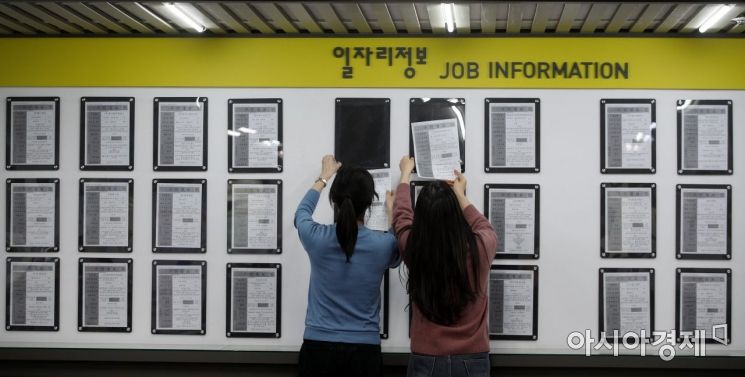 In January, the number of employed people increased by more than 1.13 million compared to the previous year. This increase is the largest in 22 years. However, it is evaluated that this is largely due to the fact that the number of employed people decreased by nearly 1 million due to the COVID-19 crisis a year ago. In particular, looking at the numbers by age group, the number of employed people in their 30s, which had decreased by more than 270,000 a year ago, increased by only about 20,000 last January. The photo shows employees at the Seoul Western Employment Support Center replacing job information on the job information bulletin board that day. Photo by Kim Hyunmin kimhyun81@
According to the “April 2025 Employment Trends” released by Statistics Korea on May 14, the number of employed people in April was 28,887,000, an increase of 194,000 compared to the same month last year. This was a slight increase from the previous month’s figure of 193,000, continuing the upward trend for the fourth consecutive month since January.
By industry, employment increased in health and social welfare services (218,000, 7.3%), professional, scientific and technical services (113,000, 8.1%), and information and communications (72,000, 6.6%). However, the number of employed people decreased in construction (-150,000), agriculture, forestry and fisheries (-134,000, -8.6%), and manufacturing (-124,000).
The number of employed people in manufacturing recorded the largest decline since February 2019 (-151,000), and employment in agriculture, forestry and fisheries saw the biggest drop since November 2015 (-172,000). Gong Misook, Director of Economic Trend Statistics at Statistics Korea, explained, “The manufacturing sector continues to decline because the industry as a whole is not performing well. As for the impact of the tariff war, employment indicators are lagging indicators, so it is difficult to say that the effects have already appeared, but they may be seen in the future.”
By age group, the number of employed people increased by 340,000 among those aged 60 and over, and by 93,000 among those in their 30s. In contrast, the number of employed people decreased by 179,000 among those in their 20s, by 51,000 among those in their 40s, and by 14,000 among those in their 50s.
Employment indicators for young people (aged 15?29) were sluggish. The number of employed people in this age group decreased by 174,000 compared to the same month last year, and the employment rate fell by 0.9 percentage points. The youth employment rate (45.3%) has been on a downward trend for 12 consecutive months since May 2024. The youth unemployment rate rose by 0.5 percentage points year-on-year to 7.3%. Director Gong added, “However, the youth employment rate for April was the ninth highest for that month since related statistics began in July 1982.”
Last month, the employment rate for those aged 15?64 (according to OECD standards) was 69.9%, up 0.3 percentage points from the same month last year. The unemployment rate was 2.9%, down 0.1 percentage points year-on-year. The economically inactive population increased by 18,000, as the number of people who responded “resting” increased by 45,000 compared to the same month last year.
© The Asia Business Daily(www.asiae.co.kr). All rights reserved.
![Clutching a Stolen Dior Bag, Saying "I Hate Being Poor but Real"... The Grotesque Con of a "Human Knockoff" [Slate]](https://cwcontent.asiae.co.kr/asiaresize/183/2026021902243444107_1771435474.jpg)
















