Jeon Heekyung Emphasizes the Need to Develop Strategies to Improve Residents' Quality of Life
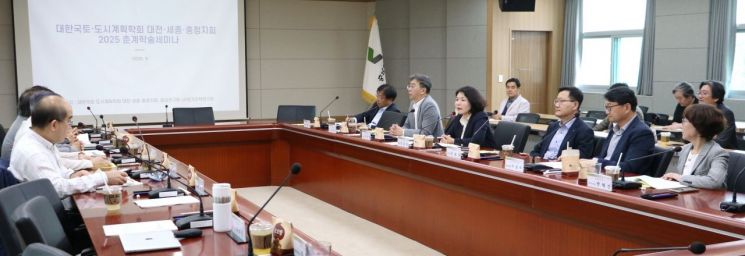 The Chungnam Research Institute held an academic seminar on the 13th with the theme of challenges and future responses in urban planning in the era of population decline. Photo by Chungnam Research Institute
The Chungnam Research Institute held a spring academic seminar on the afternoon of the 13th at the institute's conference room, jointly organized with the Daejeon-Sejong-Chungcheong Branch of the Korea Planning Association and the LH Land and Housing Research Institute, under the theme "Challenges and Future Responses in Urban Planning in the Era of Population Decline."
During the seminar, Choi Bongmoon, president of the Korea Planning Association (and professor at Mokwon University), delivered the keynote presentation, stating, "Cities can be maintained and developed not only based on population, but also on functions, networks, and environmental sustainability." He added, "It is necessary to revise the 'National Land Planning and Utilization Act,' which was enacted in 2003, to actively respond to the era of population decline and to newly establish the legal foundation for national land planning in Korea."
Jeon Heekyung, president of the Chungnam Research Institute, emphasized, "The differentiated urban growth of the Chungnam region, which has various spatial structures such as cities and rural, mountainous, and fishing villages, is the result of establishing and implementing urban planning through exchanges and cooperation among the government, Chungnam Province, cities and counties, as well as research institutes and companies." She stressed, "We must examine whether the strategies for improving the quality of life for residents and the implementation processes have proceeded smoothly, as this is essential to ensure sustainability that can encompass future generations."
Lim Junhong, senior research fellow at the Chungnam Research Institute, explained, "While the era of population decline highlights negative aspects such as economic crisis, labor shortages, and social instability, it is also an opportunity to newly reorganize the social structure in terms of the environment, cities, and socio-economic aspects."
He then proposed the following to change the paradigm of urban policy in Chungcheongnam-do: expanding urban networks to strengthen living services; creating local vitality towns by connecting underutilized spaces within the region (including universities); restructuring rural areas with a people-centered approach; transforming transportation and healthcare policies in response to the mobility revolution; and establishing a local vitality fund to respond to population decline.
© The Asia Business Daily(www.asiae.co.kr). All rights reserved.
![Clutching a Stolen Dior Bag, Saying "I Hate Being Poor but Real"... The Grotesque Con of a "Human Knockoff" [Slate]](https://cwcontent.asiae.co.kr/asiaresize/183/2026021902243444107_1771435474.jpg)
















