Strengthening Government Responsibility
from Screening Prospective Adoptive Parents
to Matching and Post-Adoption Management
The state's responsibility in the adoption process will be significantly strengthened. From now on, the government itself?not private adoption agencies?will directly review the qualifications of prospective adoptive parents and take charge of matching and protecting children.
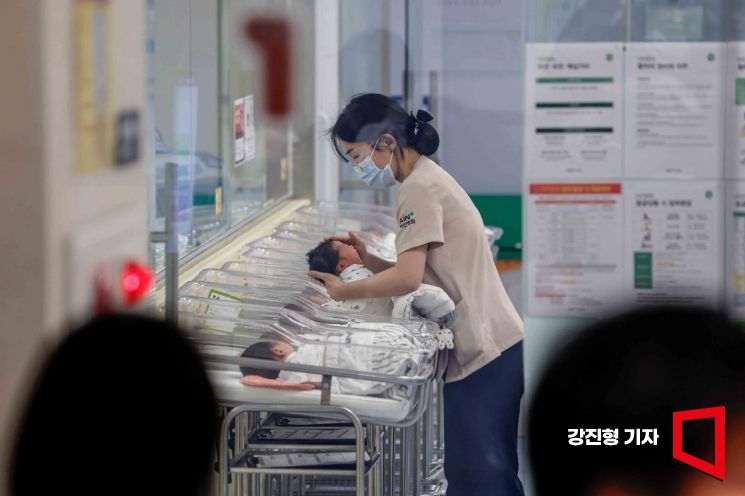 As Statistics Korea announced that the number of births last year increased by 8,300 from the previous year to 238,300, medical staff are caring for a newborn in the neonatal unit at Ain Hospital in Michuhol District, Incheon on February 27, 2025. Photo by Kang Jinhyung
On May 13, the Ministry of Health and Welfare announced that it would re-revise and enforce, starting July 19, the full amendment to the Enforcement Decree of the Special Adoption Act, the partial amendment to the Enforcement Decree of the Child Welfare Act, and the enforcement regulations related to the Enforcement Decree of the Act on Intercountry Adoption. This measure is a follow-up to the July 2023 revision of related laws aimed at strengthening the state's responsibility for domestic and international adoptions, in order to implement the Hague Convention on Protection of Children and Co-operation in Respect of Intercountry Adoption.
The Hague Convention on Protection of Children and Co-operation in Respect of Intercountry Adoption is an adoption treaty adopted at the Hague Conference on Private International Law in 1993. It aims to guarantee the fundamental rights of children in adoption and to establish a cooperative system to prevent child abduction and trafficking.
The core of the reform is to greatly strengthen the state's responsibility throughout the entire adoption process. Previously, adoption agencies received applications from prospective adoptive parents and handled matching through counseling and investigations. Going forward, the Ministry of Health and Welfare will accept applications from adoptive parents, conduct counseling and investigations, and then lead the matching of children and parents through deliberation by the Adoption Policy Committee. This committee will be composed of 50 members, including academics, medical professionals, legal experts, and adoption specialists.
The government's involvement in individual reviews, such as the qualifications of adoptive parents, will also be strengthened. A Ministry of Health and Welfare official explained, "In the future, deliberations (on matching) will be conducted by individual subcommittees, not by adoption agencies," adding, "This reflects the intent of the Hague Convention, which holds that matching should not be left to individual responsibility but should be managed by a team."
The responsibility to protect children before adoption will also be reinforced. From now on, mayors, governors, and heads of city, county, and district offices?not adoption agencies?will be designated as guardians of children and will be responsible for their protection until adoption is finalized. While protecting the child, they must check the child's adaptation, development, and caregiving environment every quarter. Even during the court's temporary custody decision, if a prospective adoptive parent attempts to sell the child or commits sexual, physical, or emotional abuse, the mayor, county head, or district head must take immediate protective measures.
'Pre-adoptive foster care,' which allows someone to care for a child prior to adoption, will only be possible if there is a court decision for temporary custody. Post-adoption follow-up for one year will also be conducted under the supervision of the Ministry of Health and Welfare, not adoption agencies, to check the adjustment of the adoptee and adoptive parents and provide necessary services.
This reform also aims to revitalize domestic adoption. The Ministry of Health and Welfare plans to establish and implement a basic plan every five years and an implementation plan every year to encourage domestic adoption. For international adoption, the Ministry will act as the central authority, directly negotiating with foreign governments to ensure responsibility and trust between countries. Kim Sanghee, Director of Population and Child Policy at the Ministry of Health and Welfare, stated, "The significance of this revision is that it will complete the legal foundation for a public adoption system centered on the state and local governments starting in July," adding, "We will do our utmost to ensure that the newly implemented adoption system is successfully established in the field."
© The Asia Business Daily(www.asiae.co.kr). All rights reserved.












