The Electronics and Telecommunications Research Institute (ETRI) will oversee the development of 6G low Earth orbit (LEO) satellite communication technology.
On May 12, ETRI announced that it had been selected as the lead organization for the government-led “6G Standard-Based Low Earth Orbit Satellite Communication System Development Project” (hereafter referred to as the development project) under the international standardization body 3GPP.
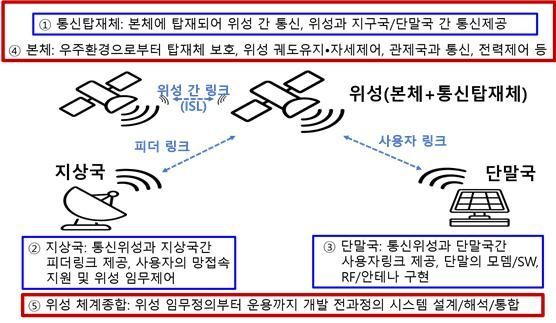 Diagram of the Promotion Direction for Low Earth Orbit Satellite Communication Technology Development. Provided by Electronics and Telecommunications Research Institute (ETRI)
According to ETRI, the development project aims to establish a LEO satellite communication system consisting of two LEO communication satellites, a ground station, and a user terminal station by 2030.
The core objective of the project is to build communication satellites and ground systems capable of facilitating both satellite-to-ground and inter-satellite communications, thereby developing a LEO satellite communication pilot network.
To this end, the Ministry of Science and ICT and the Korea Aerospace Administration recently announced the research and development institutions that will lead three detailed sub-projects under the development project. According to the announcement, ETRI will be responsible for overall coordination, including Sub-project 1.
As the lead research institution for the development project, ETRI plans to establish a collaborative framework among research organizations to carry out this large-scale system development initiative. The overall responsibility will be assumed by Lee Moonsik, Director of the Satellite Communication Research Division at ETRI.
Sub-project 1, led by ETRI, will involve Hanwha Systems, LIG Nex1, and Satrec Initiative, and will be responsible for developing key technologies for “3GPP 6G Standard-Based LEO Satellite Communication Payload and Ground Station.”
Sub-project 2, led by Solid, will focus on developing the user terminal station, while Sub-project 3, led by Korea Aerospace Industries (KAI), will develop the satellite bus and system integration.
Major telecommunications companies such as KT, KT SAT, SK Telecom, and LG Uplus will participate in the overall project, reflecting their requirements from the early stages of system development. They will also help lay the foundation for future commercialization.
Through the development project, ETRI aims to elevate core technologies such as regenerative repeater technology, payload digital signal processing technology, inter-satellite link technology, and high-efficiency phased array antenna technology to a world-class level.
In particular, by applying 3GPP’s 6G NTN standard technology, ETRI is focusing on laying the groundwork for the hyper-space communication era that encompasses both terrestrial and aerial communications.
Currently, the global market is led by SpaceX, with Eutelsat OneWeb and Amazon also entering the market in earnest. All of these companies operate based on proprietary technologies, resulting in low service interoperability and limitations due to device dependency.
In contrast, the 6G LEO satellite communication system being developed by ETRI, based on international standard technology, will emphasize openness and universality, allowing users to freely choose their preferred device models?just like with smartphones?and access internet communication services anytime, anywhere.
ETRI believes that the development project will serve as a milestone for achieving technological independence in the domestic satellite communication sector and establishing a foundation for entry into the global market. Additionally, by supporting domestic companies in building space-heritage records, ETRI expects to strengthen the competitiveness of the domestic industry.
ETRI President Bang Seungchan stated, “Through this development project, we aim to enable the world’s first verification of a 6G international standard-based LEO satellite communication system, and we hope that this will serve as a stepping stone for domestic technology to enter the global communication service market in the future.”
© The Asia Business Daily(www.asiae.co.kr). All rights reserved.












