India and Pakistan Reach Ceasefire Agreement After Clashes
Ongoing Mutual Accusations Over Responsibility
Both Sides Celebrate, Claiming "We Won"
India and Pakistan, which had reached a surprise ceasefire agreement brokered by the United States, are now accusing each other of violating the ceasefire, causing tensions between the two countries to rise once again. Both nations are asserting full sovereignty over Kashmir, the flashpoint of the recent armed conflict, leading some observers to predict that the ceasefire can only be temporary unless the Kashmir dispute is resolved.
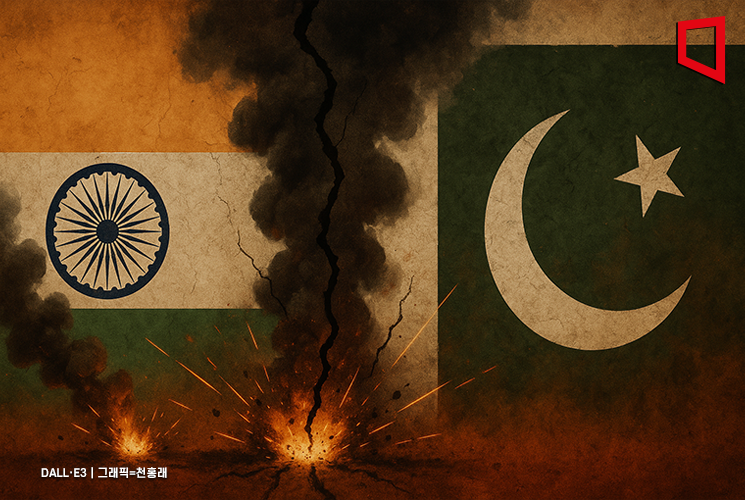
Vikram Misri, India's Deputy Foreign Minister, stated at a press conference on the 10th (local time), "There have been repeated violations of the agreement between India and Pakistan over the past several hours." Deputy Minister Misri emphasized, "We are responding appropriately to these violations and are taking them very seriously," and called on Pakistan to address these violations and take appropriate measures.
The ceasefire agreement between the two countries came after several days of cross-border military clashes, which have been described as the most serious armed conflict in decades. The negotiations were conducted under U.S. mediation, and on the same day, President Donald Trump praised the leaders of India and Pakistan, saying, "The leaders on both sides made a decisive move in a situation where millions of lives could have been at risk."
However, immediately after the ceasefire was announced, foreign media reported explosions and flashes of light in Indian-administered Kashmir, and both sides once again accused each other of violating the ceasefire agreement, shifting responsibility for the renewed clashes onto one another.
The Pakistani Ministry of Foreign Affairs refuted India's claims in a statement, saying, "There have been violations by India in some areas, but we are managing the situation with responsibility and restraint," and pledged to faithfully implement the ceasefire. Pakistani military spokesperson Ahmed Sharif Chaudhry stressed at a press conference, "Our Pakistani military is maintaining the ceasefire along the Line of Control with 200% certainty."
The UK’s Financial Times (FT) assessed that "while the surprise ceasefire agreement between India and Pakistan to halt the worst armed conflict in decades has largely held until Sunday, both countries continue to accuse each other of violating the ceasefire and differ in their interpretations of the agreement."
There are predictions that the ceasefire, achieved through external intervention by the United States and others, is unlikely to lead to a complete resolution of the conflict between the two countries. In particular, unless the sovereignty issue over Kashmir?the spark for the recent armed clashes?is resolved, there is a high likelihood that tensions will reignite. India, like Pakistan, claims sovereignty over the entire Kashmir region, but strongly opposes a resolution through international mediation.
The UK’s Guardian reported, "Residents unanimously say that unless the fundamental issue of the 'Kashmir dispute' is resolved, the ceasefire can only be temporary."
The United States has assessed that it played a major role in brokering the ceasefire, but both sides have celebrated the ceasefire by highlighting their own military achievements. Indian Defense Minister Rajnath Singh stated, "The roar of the Indian military echoed all the way to Rawalpindi, the headquarters of the Pakistani military," emphasizing that the recent military action, named 'Operation Sindoor,' "is not just a military operation but a symbol of India's political and strategic will." In Pakistan, there was also widespread praise for the military. In the border regions, parades were held in which flower petals were showered upon the military, and Prime Minister Shehbaz Sharif declared May 11 as 'Armed Forces Day in Response to Recent Indian Attacks.'
© The Asia Business Daily(www.asiae.co.kr). All rights reserved.
![Clutching a Stolen Dior Bag, Saying "I Hate Being Poor but Real"... The Grotesque Con of a "Human Knockoff" [Slate]](https://cwcontent.asiae.co.kr/asiaresize/183/2026021902243444107_1771435474.jpg)
















