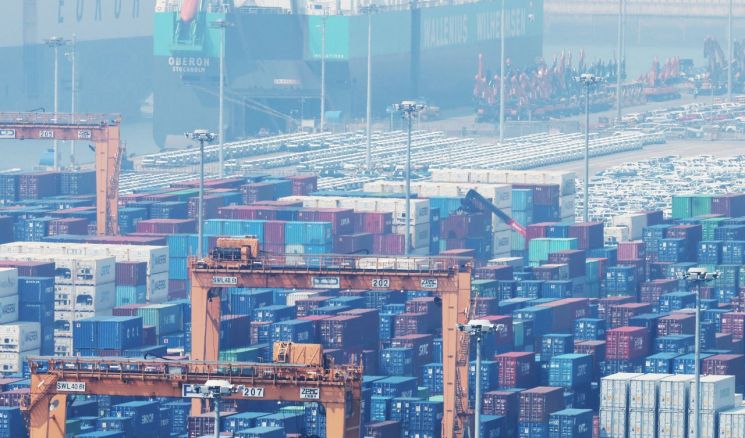
From May 1 to 10, South Korea's exports plunged by double digits, causing the trade balance to return to a deficit. While semiconductor exports showed an upward trend and acted as a buffer, the decline in exports appears to have been exacerbated by the United States' strengthened item-specific tariffs and weakened demand in major markets such as China and the United States.
According to the Korea Customs Service on May 12, exports from the 1st to the 10th amounted to $12.8 billion, down 23.8% from the same period last year. Imports also fell by 15.9% to $14.6 billion. The trade balance recorded a deficit of $1.7 billion.
Taking into account the number of business days, the average daily export value was $2.57 billion, a slight decrease of 1.0% compared to the same period last year.
By item, semiconductor exports increased by 14.0%, partially offsetting the overall export slump. However, exports of key items such as passenger vehicles (-23.2%), petroleum products (-36.2%), and ships (-8.7%) all declined. Notably, the share of semiconductor exports rose by 8.8 percentage points to 26.6% compared to the same period last year.
By country, exports to Taiwan increased by 14.2%. However, all major export markets recorded double-digit declines, including China (-20.1%), the largest market, as well as the United States (-30.4%), Vietnam (-14.5%), and the European Union (-38.1%). Exports to the three major countries (China, the United States, and Vietnam) accounted for 48.7% of the total.
On the import side, there were increases in semiconductor manufacturing equipment (10.6%) and passenger vehicles (22.1%). However, overall import volume shrank due to declines in key items such as crude oil (-6.1%) and semiconductors (-8.2%). Energy imports, including crude oil, gas, and coal, fell by 13.7% compared to the same period last year.
The sluggish export and import performance appears to be directly attributable to the global economic slowdown and weakened demand in major markets. In addition, the United States' strengthened item-specific tariff measures, implemented since April, are analyzed to have acted as an indirect burden. In particular, as major export items such as automobiles and steel faced increased tariff burdens in the U.S. market, their local price competitiveness weakened, leading to export volume adjustments as a result.
While the increase in semiconductor exports is a positive sign, there are concerns that the export recovery could be constrained amid global supply chain restructuring and the growing trend of protectionism led by the United States.
The Korea Customs Service stated, "It is necessary to consider the impact of short-term factors such as changes in the number of business days."
© The Asia Business Daily(www.asiae.co.kr). All rights reserved.
!["The Woman Who Threw Herself into the Water Clutching a Stolen Dior Bag"...A Grotesque Success Story That Shakes the Korean Psyche [Slate]](https://cwcontent.asiae.co.kr/asiaresize/183/2026021902243444107_1771435474.jpg)
















