Lee targets centrist voters with livelihood and unity
Kim aims to rally the broader conservative camp
Uncertainty over Lee Jun Seok's participation in the "anti-Lee Jae Myung big tent"
With 23 days remaining until the presidential election, each camp will begin their official 22-day campaign period starting on the 12th.
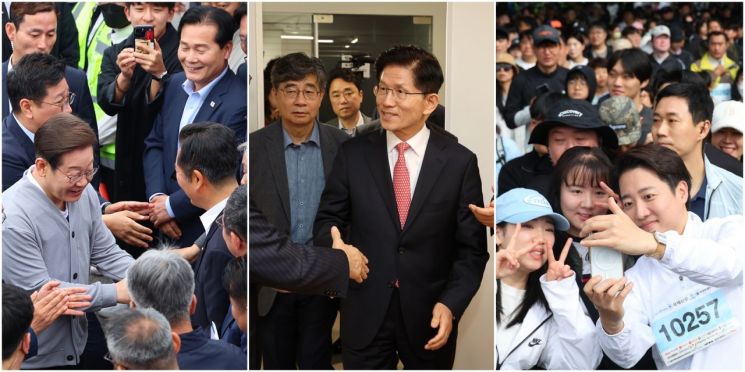 From the left, Democratic Party's Lee Jae Myung, People Power Party's Kim Moon Soo, and Reform New Party's Lee Jun Seok presidential candidates are meeting with citizens. Photo by Yonhap News
Democratic Party candidate Lee Jae Myung, People Power Party candidate Kim Moon Soo, and Reform New Party candidate Lee Jun Seok have completed their registration and are now fully prepared for the presidential race.
Democratic Party candidate Lee has been able to ease the burden of legal risks as the retrial of his Public Official Election Act case has been postponed, allowing him to launch a full-scale campaign. The People Power Party, after an unprecedented controversy over changing its candidate, has finalized Kim Moon Soo as its nominee and is expected to focus on an "anti-Lee Jae Myung" strategy in its bid to regain power.
Both sides are refining their general election strategies. Democratic Party candidate Lee plans to continue his focus on livelihood and economic issues, which he has consistently emphasized, aiming to solidify his "frontrunner" status by appealing to centrist voters. During his "Listening Tour" in Yeongam, South Jeolla Province, Lee told reporters, "The key issues are the economy and people's livelihoods," adding, "I will do my best for recovery and growth, unity, and the happiness of the people." Lee will kick off his first campaign rally on the 12th at Gwanghwamun Square in Seoul, and then continue rallies in Dongtan, Gyeonggi Province, and Daejeon, focusing on semiconductors and science and technology.
Kim plans to build an "anti-Lee Jae Myung big tent" within the broader conservative camp to confront Lee. He aims to form a united front with all forces opposed to Lee and position himself as Lee's main rival. Kim is also actively pursuing alliances to expand the tent, including with former Prime Minister Han Duck Soo, with whom he clashed over candidate unification, and with Reform New Party candidate Lee Jun Seok.
However, there are signs of stumbling from the very first steps. Lee Nak Yon, senior advisor to New Future and formerly of the Democratic Party, has announced he will not run for president and will not support any other candidate, which is seen as weakening the momentum behind the big tent strategy.
Meanwhile, the Democratic Party is seeking to attract centrist voters by framing the People Power Party and candidate Kim as sympathetic to insurrection and by targeting the controversy over their candidate replacement.
Another variable is the possibility of a three-way race if Reform New Party candidate Lee Jun Seok stays in the race until the end. Some analysts say Lee's presence has grown as the People Power Party has experienced internal conflict following its unprecedented candidate switch. Lee Jun Seok expects that the "Dongtan model," which led to victory in the last general election under a three-way race, will also work in this presidential election. He believes that disillusioned conservative voters, disappointed by the People Power Party's candidate replacement, may shift their support to him. In this situation, some observers believe the likelihood of Lee Jun Seok joining the big tent led by Kim has become even smaller.
© The Asia Business Daily(www.asiae.co.kr). All rights reserved.

















