Analysis of Sub-Minimum Wage Rate in 2024 by the Korea Employers Federation
Last year, one out of every eight workers in South Korea received wages below the minimum wage. The Korea Employers Federation pointed out that the rate of workers earning less than the minimum wage is particularly high in certain sectors, such as accommodation and food services and small business owners. The federation argued that the minimum wage should remain stable for a considerable period of time.

According to the Korea Employers Federation on May 11, 2025, the rate of workers earning less than the minimum wage in South Korea in 2024 was 12.5%, with 2.76 million workers earning below the minimum wage. The rate of workers earning less than the minimum wage refers to the proportion of employees who do not receive the legally mandated minimum wage (9,680 won per hour in 2024).
The number of workers earning less than the minimum wage has steadily increased from 570,000 in 2001 to 2.76 million in 2024. The rate has also risen, reaching 12.5% in 2024, which is about three times higher than the 4.3% recorded in 2001.
The Korea Employers Federation interpreted the high rate of workers earning less than the minimum wage as a result of the sharp increases in the minimum wage in recent years, which have raised the minimum wage level in South Korea to a point where labor market acceptance has declined.
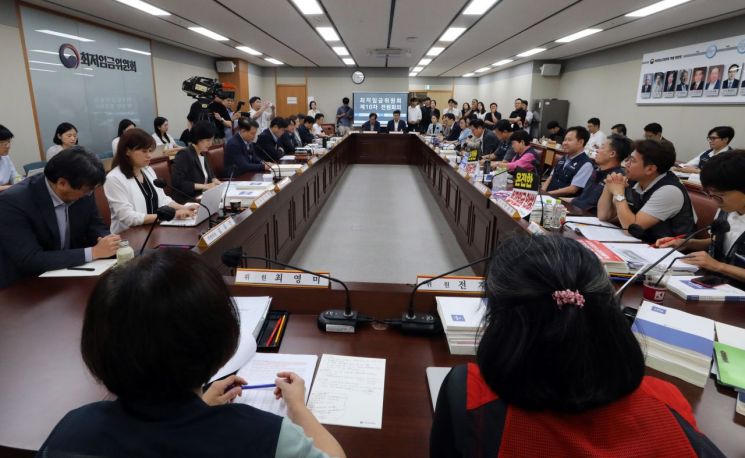 The full meeting of the Minimum Wage Commission held last year at the Government Sejong Complex. Photo by Yonhap News
Over the past ten years (2014?2024), the cumulative increase in the minimum wage was 89.3%. During the same period, this was 4.2 times higher than the inflation rate (21.2%) and 2.3 times higher than the increase in nominal wages (38.3%).
Last year, the rate of workers earning less than the minimum wage varied significantly by industry and business size. The rate was particularly high in accommodation and food services (33.9%) and agriculture, forestry, and fisheries (32.8%). As a result, the gap between major industries in terms of the rate of workers earning less than the minimum wage reached as much as 32.1 percentage points.
Additionally, among the 3.92 million workers employed at businesses with fewer than five employees, 29.7% were paid less than the minimum wage. In contrast, the rate was only 2.5% at businesses with 300 or more employees.
If statutory weekly holiday allowances are included in the calculation, the number of workers earning less than the minimum wage last year rises to 4,679,000, with the rate reaching 21.1%. The current method of calculating the rate of workers earning less than the minimum wage does not take weekly holiday allowances into account, resulting in an underestimation of the actual rate.
Ha Sangwoo, Executive Director of the Korea Employers Federation, stated, "The rate of workers earning less than the minimum wage remains high, and an even greater problem is that the rate is extremely high in certain sectors. In accommodation and food services and in businesses with fewer than five employees, the rate exceeds 30%, showing that some industries and business sizes are unable to cope with the current minimum wage level."
He emphasized, "To improve acceptance of the minimum wage, it is important to maintain stability in the minimum wage for a considerable period going forward. It is also necessary to apply differentiated minimum wages by industry, taking into account the significant differences in payment capacity between sectors."
© The Asia Business Daily(www.asiae.co.kr). All rights reserved.


















