Basic Pension Age to 70 by 2040
National Pension Eligibility to 68 by 2048
Senior Benefits Raised to 70, with Flexible Income and Asset Criteria
There has been a proposal to gradually raise the age standard for seniors in Korean society from the current 65 to 70, and to adjust the eligibility ages for the National Pension and Basic Pension accordingly. Experts have agreed that, for a sustainable welfare system in Korea, which has entered a super-aged society, the eligibility age for the National Pension should be raised to 68 by 2048, and the Basic Pension to 70 by 2040.
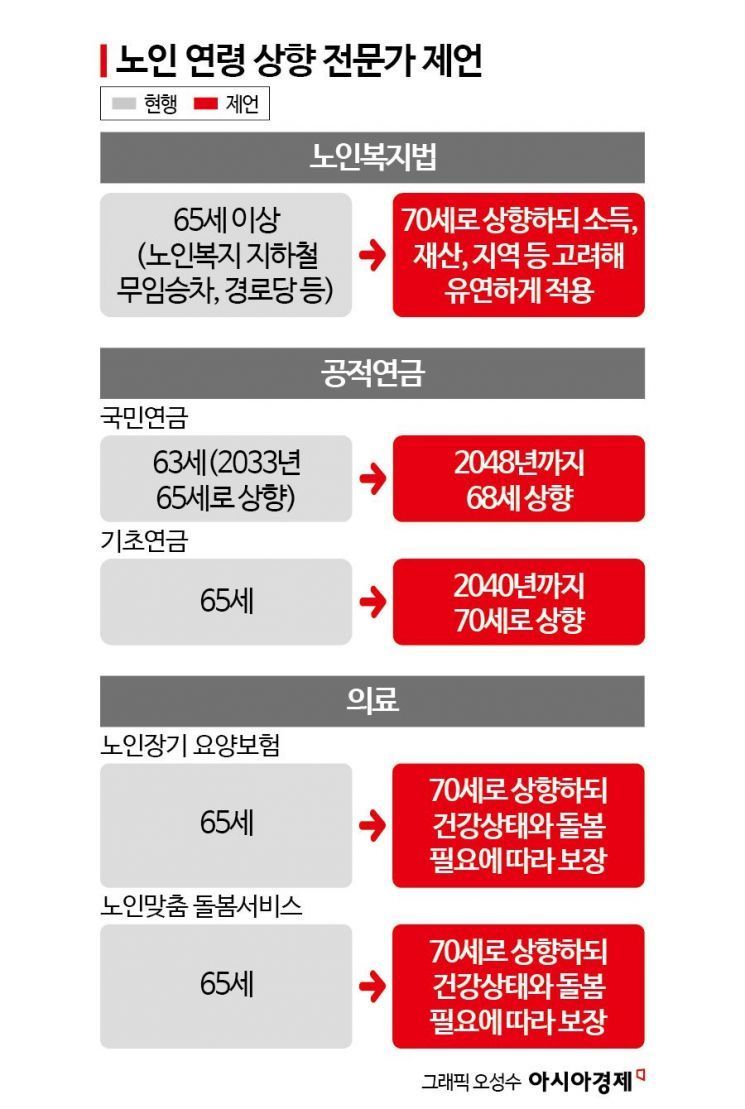
On May 9, expert organizations such as the Korean Senior Citizens Association, the Korean Gerontological Society, and the Korean Federation of Gerontology and Geriatrics Societies presented a “Private Expert Social Proposal on the Age Standard for Seniors” at KG Tower in Jung-gu, Seoul, making this recommendation to the government. The experts stated, “The current Elderly Welfare Act and related laws, which set the senior age at 65, should be revised to gradually raise the senior age standard to 70.” They explained that as the healthy lifespan increases and the rapid aging of the population leads to a significant rise in elderly welfare costs, the legal age standard for seniors should be raised to 70, but the pace and timing of this adjustment should differ by system.
The experts agreed that the National Pension eligibility age should be gradually raised to 68 by 2048. They noted, “The current eligibility age is 63, and it is scheduled to be raised to 65 by 2033. Therefore, as proposed by the 5th National Pension Financial Calculation Committee, a plan to raise the age to 68 by 2048 can be considered.” However, they emphasized that “institutional flexibility must be ensured so that individuals can selectively choose early receipt, deferred receipt, or partial receipt according to their personal circumstances.”
For the Basic Pension, they suggested raising the eligibility age by one year every two years starting in 2030, reaching 70 by 2040. However, they stressed, “Adjustments to the pension subscription age and eligibility age should be made in conjunction with improvements to conditions for elderly participation in economic activities, to ensure that income gaps do not arise for older adults.”
They also argued that the age standard for “those aged 65 or older,” who are eligible for preferential treatment under the Elderly Welfare Act, should be gradually raised to 70. The Elderly Welfare Act affects systems that provide free or discounted fares for public transportation (subways, buses, trains, etc.) and admission to public facilities such as palaces and museums. However, the experts said, “The application should be flexible, taking into account income and assets,” and recommended, “For low-income groups, differentiated application should be considered, and local governments should be allowed autonomy in adjusting the senior age standard and operating preferential treatment systems according to local conditions.” They also proposed that long-term care and medical services should continue to be guaranteed based on health status and care needs, even if the age standard for seniors is raised.
The experts further noted that, along with raising the senior age standard, it is necessary to extend the employment period for main jobs, such as by raising the retirement age. They emphasized, “Raising the senior age standard means extending the period during which middle-aged and older adults actively participate in the labor market,” and stressed, “It is essential to extend employment periods so that people can stably secure labor income until they enter old age.”
© The Asia Business Daily(www.asiae.co.kr). All rights reserved.
![A Woman Who Jumps Holding a Stolen Dior Bag... The Mind-Shaking, Bizarre Con of a "Human Knockoff" [Slate]](https://cwcontent.asiae.co.kr/asiaresize/183/2026021902243444107_1771435474.jpg)
















