Capable of Detecting Hazardous Gases...
Potential Applications in Disease Diagnosis Also Considered
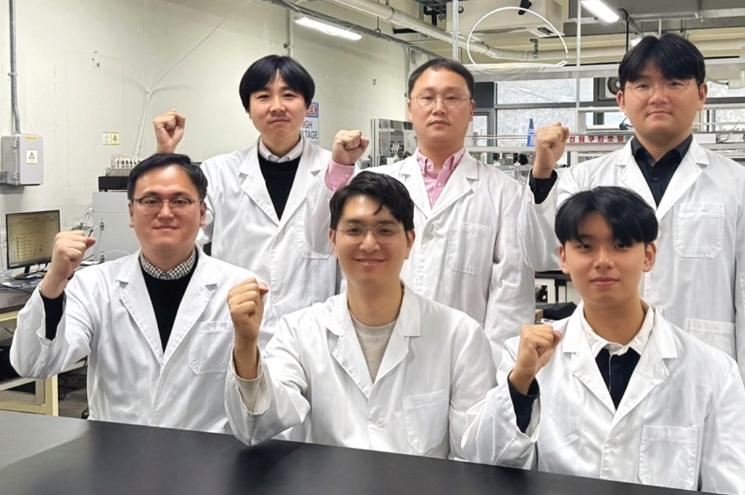
Korea University of Technology and Education announced on May 8 that the research team led by Professor Shim Youngseok has developed an artificial olfactory system that combines artificial intelligence (AI) and nanosensor technology.
The results of this research were published in the May online edition of the international journal Advanced Science, issued by Wiley-VCH in Germany.
The title of the paper is "Artificial Olfactory System Enabled by Ultralow Chemical Sensing Variations of 1D SnO₂ Nanoarchitectures."
The research team coated one-dimensional tin oxide (SnO₂)-based nanostructures with gold (Au) and palladium (Pd) nanocatalysts, and applied surface functionalization and thermal aging processes to reduce sensor signal variability to an average of less than 3%.
The developed system utilizes a deep learning algorithm (ResNet) and data augmentation techniques to classify seven types of gases?acetone, ethanol, hydrogen, carbon monoxide, propane, isoprene, and toluene?with an accuracy of over 99.5% even in environments with relative humidity above 80%. The detection concentration is at the ppt (parts per trillion) level.
This research involved participation from master's student Cho Yunhaeng (first author) and Professor Shim Youngseok (corresponding author) from the Department of Energy, New Materials and Chemical Engineering, as well as researchers from the Korea Research Institute of Chemical Technology, Sangmyung University, Korea Institute of Industrial Technology, and Hongik University.
Professor Shim Youngseok stated, "We are considering applications not only for detecting hazardous gases in industrial sites, but also in disease diagnosis using exhaled breath, such as for lung diseases and diabetes."
© The Asia Business Daily(www.asiae.co.kr). All rights reserved.
![Clutching a Stolen Dior Bag, Saying "I Hate Being Poor but Real"... The Grotesque Con of a "Human Knockoff" [Slate]](https://cwcontent.asiae.co.kr/asiaresize/183/2026021902243444107_1771435474.jpg)











