Macroeconomic and Financial Issues Meeting
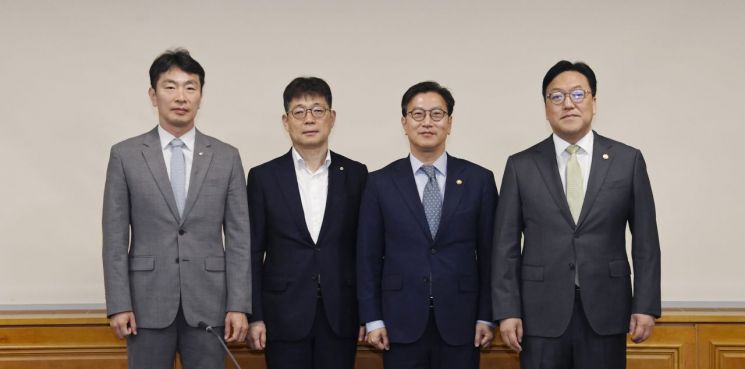 Kim Beomseok, Acting Minister of Economy and Finance (third from left), is taking a commemorative photo before the start of the "Macroeconomic and Financial Issues Meeting" held at the Bankers' Hall in Jung-gu, Seoul on the morning of the 8th. From the left, Lee Bokhyun, Governor of the Financial Supervisory Service; Yoo Sangdae, Deputy Governor of the Bank of Korea; Kim Byunghan, Chairman of the Financial Services Commission.
The government announced that it will respond with vigilance to both domestic and international uncertainties, including the Federal Open Market Committee (FOMC)'s decision to keep its policy rate unchanged and tariff negotiations among major countries.
Kim Beomseok, Acting Minister of Economy and Finance, stated at the Macroeconomic and Financial Issues Meeting on the 8th, "Since uncertainties both at home and abroad, such as major countries' trade negotiations and geopolitical conflicts, continue to persist, we will hold the Macroeconomic and Financial Issues Meeting once a week going forward to closely monitor trends in the financial and foreign exchange markets and manage the economy in a stable manner."
During the meeting, which was attended by Kim Byunghan, Chairman of the Financial Services Commission; Lee Bokhyun, Governor of the Financial Supervisory Service; and Yoo Sangdae, Deputy Governor of the Bank of Korea, participants reviewed the impact of the FOMC's decision to keep rates unchanged on both domestic and international financial and foreign exchange markets, and discussed response strategies.
The FOMC, which convened overnight, kept its policy rate unchanged at the current level (4.25~4.50%) as expected. In its statement, the FOMC noted that economic outlook uncertainties have increased further and that risks to U.S. employment and inflation have risen. Jerome Powell, Chair of the Federal Reserve, said at a press conference that it is necessary to watch the economic situation with patience and that there is no need to rush adjustments to monetary policy.
As President Donald Trump continues to pressure Chair Powell to cut rates, the market now expects the next rate cut to occur around September, rather than in June.
The global financial markets largely viewed the meeting's outcome, including the decision to keep rates unchanged, as expected, and key indicators such as stock prices and interest rates generally showed limited movement.
Participants agreed that, although the stock and bond markets have generally shown stable trends recently, external uncertainties remain, including concerns about a slowdown in the U.S. economy, U.S.-China tensions, and tariff negotiations. They also recognized that the sharp fluctuations in the value of some Asian currencies over the past weekend had an additional impact on foreign exchange market volatility.
Furthermore, with major events such as the first official U.S.-China trade negotiations scheduled to take place in the international financial markets in the future, participants agreed to maintain vigilance and continue 24-hour monitoring of the financial and foreign exchange markets.
© The Asia Business Daily(www.asiae.co.kr). All rights reserved.

















