Ipapnamu Trees in Full Bloom Across Streets in May
Outstanding Aesthetic Value and Strong Resistance to Pollution and Pests
Decline in Ginkgo and London Plane Trees... Ipapnamu Up 45%
Over the past five years, the trend in Seoul's street trees has changed significantly. While the ginkgo tree, known for its resistance to pests and diseases, had long been the representative street tree, its numbers have declined due to frequent complaints about the distinctive smell of its fruit in autumn. In contrast, the Ipapnamu tree, notable for its striking white blossoms in May, has seen a rapid increase.
As of May 8, the cumulative number of Ipapnamu-related hashtags (#) on the social networking service Instagram reached 46,000. This surge is attributed to the blooming season of the Ipapnamu tree, which has drawn increased attention to famous Ipapnamu spots such as the Ipapnamu Road at the Seoul National Cemetery, as well as locations in Jeonju, North Jeolla Province; Dalseong County, Daegu; and Jincheon County, North Chungcheong Province.
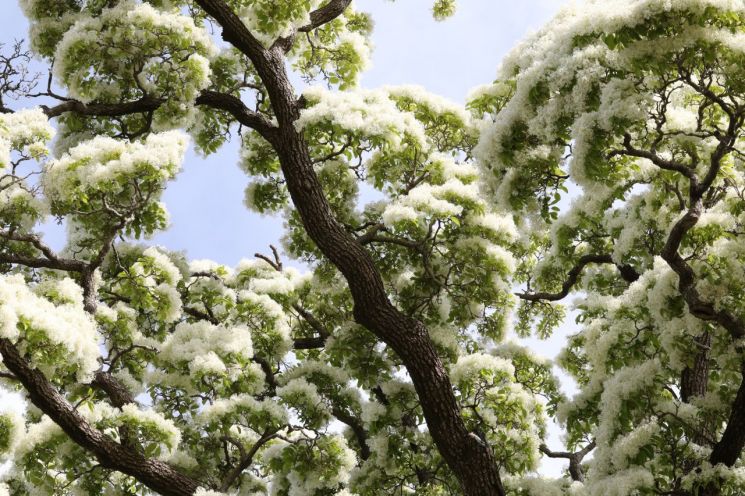
It is said that the Ipapnamu tree was once called the "Ibapnamu" because, when in full bloom, the entire tree turns white and resembles a mound of cooked rice. The name later changed to Ipapnamu. During May and June, when the flowers are in full bloom, the trees are covered in white as if sprinkled with rice, and when the petals are blown by the wind, the scene resembles falling snow. Although many people worry about pollen allergies, the stamens of the Ipapnamu flower are enclosed within the corolla, making it difficult for the pollen to be dispersed by the wind.
In addition to its aesthetic appeal, the Ipapnamu tree is highly resistant to pollution and pests, which has contributed to its growing popularity as a street tree. According to the "Seoul Street Tree Status Statistics" from the Seoul Open Data Plaza, as of 2023, there were 294,668 street trees planted throughout Seoul, of which 25,613 were Ipapnamu trees. This represents a 45% increase compared to five years ago, when there were only 17,639 Ipapnamu trees. By district, Songpa-gu has the highest number with 3,011 trees, followed by Gangseo-gu (1,872), Yeongdeungpo-gu (1,450), Guro-gu (1,398), and Seongdong-gu (1,361).
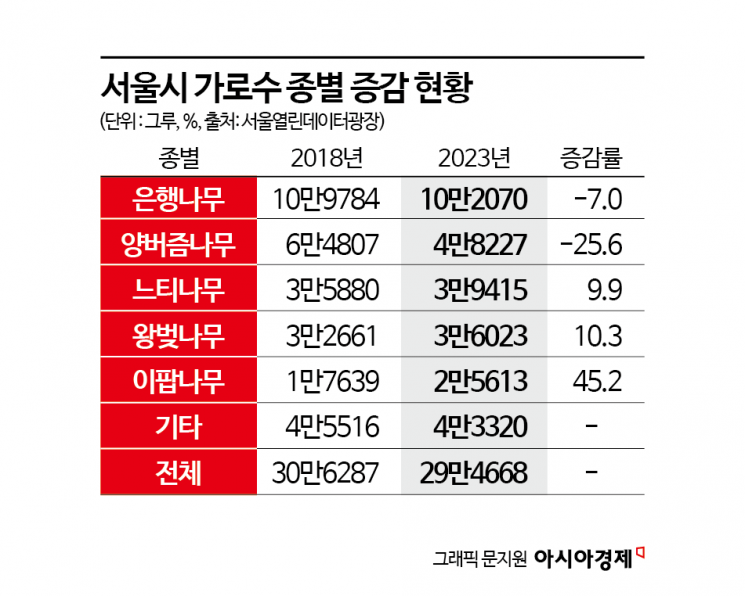
On the other hand, the number of ginkgo trees and London plane trees, which once dominated as Seoul's representative street trees, has decreased by 7.0% and 25.6%, respectively, compared to five years ago. Ginkgo trees were widely planted in the past because of their beautiful autumn foliage and their resistance to pollution and pests. However, persistent complaints from citizens about the smell of ginkgo fruit in autumn have led to continuous requests for their replacement.
The London plane tree, along with the horse chestnut and tulip tree, is known as one of the world's three major street trees. It has been widely planted because it withstands pollution and cold well and grows quickly. However, it has been found to be vulnerable to falling during natural disasters, leading to its recent replacement with other tree species.
Meanwhile, the district with the largest number of street trees in Seoul is Gangnam-gu, with 23,201 trees. This is followed by Songpa-gu (22,964), Dongjak-gu (18,466), Gangdong-gu (17,043), and Seocho-gu (15,998). In contrast, Gangbuk-gu (6,028), Gwangjin-gu (6,215), Geumcheon-gu (6,782), and Seongdong-gu (6,976) have relatively fewer street trees.
© The Asia Business Daily(www.asiae.co.kr). All rights reserved.


















