Wildfires Spread Rapidly Even from Small Outbreaks
Small-Scale Wildfires Handled by Local Governments
"Initial Response Should Also Be Led by the Korea Forest Service and National Fire Agency"
As the risk of massive wildfires increases due to climate change, there have been calls to comprehensively overhaul the wildfire response system. Experts suggest that, given how rapidly wildfires can spread, initial response should be shifted from local governments to the National Fire Agency and the Korea Forest Service.
According to the National Assembly Research Service's report, "Key Issues and Future Tasks Related to Recent Wildfire Response," released on May 8, the nature of wildfires in South Korea has changed compared to the past, but the response system has not fully adapted. Since the 2020s, wildfires have become larger and the extent of damage has increased. Compared to the 2010s, the area damaged by wildfires in the 2020s has increased by 7.8 times, and the number of large wildfires over 1 million square meters has risen by 3.7 times. The wildfire in the Yeongnam region in March also spread rapidly due to strong winds, with the affected area reaching 104,000 hectares.
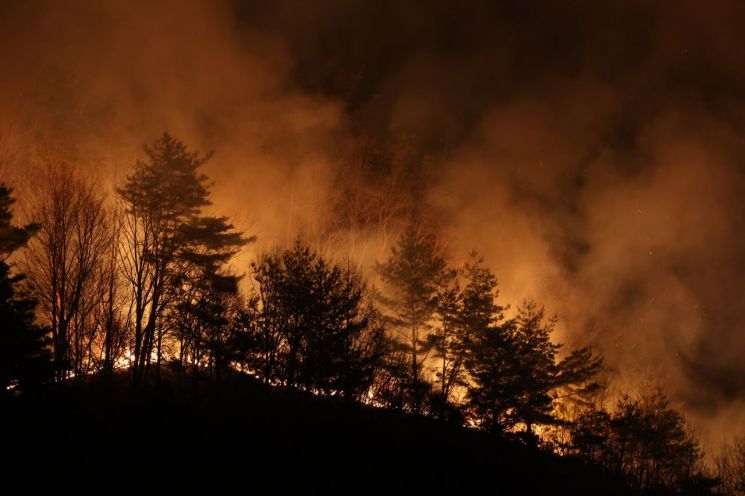
Despite these conditions, which allow wildfires to spread quickly and on a large scale even in the early stages, current laws and guidelines designate local governments as the responsible authorities for small-scale wildfires or initial response. The "Framework Act on the Management of Disasters and Safety" specifies the Korea Forest Service as the main agency for wildfire response. However, according to the Forest Protection Act, the head of each local government is designated as the commander of the integrated on-site command post depending on the scale of the wildfire. For medium and small wildfires, special city mayors, provincial governors, city mayors, county governors, and district chiefs are responsible for commanding the on-site response.
According to the Korea Forest Service's "2025 National Comprehensive Wildfire Prevention Plan," even at the lowest response level, the "initial response" stage, the command authority remains with local government heads such as city mayors, county governors, and district chiefs. In particular, only 50 personnel?including 45 wildfire prevention and suppression team members and 5 wildfire officials?along with local suppression helicopters, are deployed. Legislative researcher Yoo Jebum stated, "In cases like the recent wildfire disaster, where strong winds cause rapid spread in the initial stages, it is questionable whether initial response at the city, county, or district level is effective under the current response standards," adding, "While joint response with fire departments is possible if necessary, it may be difficult to secure timely cooperation in urgent situations."
For this reason, it has been suggested that the Korea Forest Service and the National Fire Agency, which have sufficient suppression capabilities, should be involved even in the initial response phase. Researcher Yoo emphasized, "To ensure early suppression of wildfires, initial response should be led by the Korea Forest Service, the National Fire Agency, or at the provincial level, rather than by city, county, or district governments. In addition, the number of response stages should be reduced from four to two or three to improve efficiency."
© The Asia Business Daily(www.asiae.co.kr). All rights reserved.












