"Approaching Pharmaceutical Super Intelligence"
"Korea Should Focus on Age-Related Diseases"
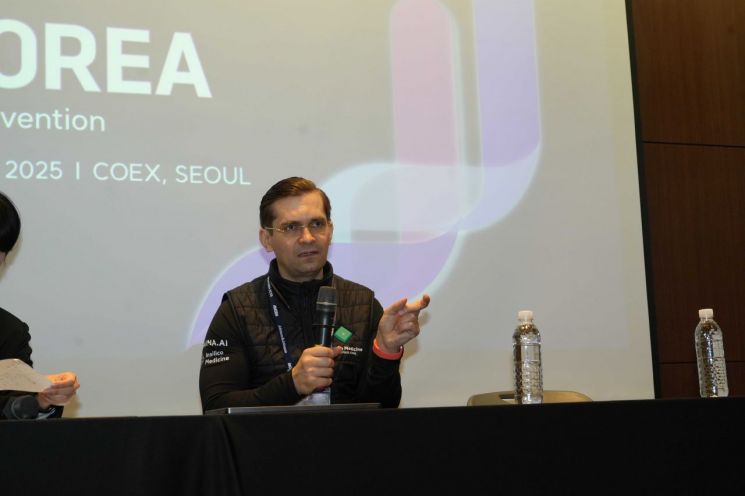 Alex Zaboronok, CEO of Insilico Medicine, is speaking at the 'Bio Korea' press conference held at COEX in Gangnam-gu, Seoul on the 7th. Korea Health Industry Development Institute
"We have come close to achieving 'pharmaceutical super intelligence,' which enables drug development from candidate discovery to clinical trial design without the need for human experts."
Alex Zaboronok, CEO of Insilico Medicine and a pioneer in AI-driven drug development, made this statement at the 'Bio Korea' press conference held at COEX in Gangnam-gu, Seoul on May 7. The 'pharmaceutical super intelligence' mentioned by Zaboronok refers to the integration of pharmaceutical companies and AI. As a comparable example, he cited 'Suno,' a generative AI for music composition and creation. Suno is a generative AI that can create music with just a simple prompt input. Zaboronok believes that as AI-driven drug development becomes more active, it will become possible to develop dual-target therapies that can simultaneously address aging and diseases?areas humanity has yet to conquer.
Zaboronok began developing AI for the bio sector in 2014, using generative AI to discover new drug candidates. Over the past four years, Insilico Medicine has developed ten new drug candidates using its generative AI platform 'Pharma.AI' and has licensed out two of these drugs. The combined value of the two licensing agreements reached $1.2 billion (approximately 1.6764 trillion KRW). For the first time, an AI-driven drug development case has advanced to Phase 2 clinical trials. Based on these achievements, Insilico Medicine is collaborating with various global pharmaceutical companies, including Sanofi and Pfizer.
Zaboronok explained, "AI-driven drug development has advanced to the point where we can enter preclinical trials just 13 months after starting development, and it took about 25 to 30 months to reach Phase 1 clinical trials. In the past, this process would have taken about 5 to 10 years, so we have significantly shortened the timeline."
He emphasized that aging research is the most important area for human advancement. Zaboronok stated, "To solve the problem of population collapse, we must address aging. The solution lies in dual-purpose therapies. We need a new approach that can tackle both aging and diseases simultaneously. 'Dual-target' therapies that allow people to live healthy lives without disease for up to 20 years are necessary. I believe pharmaceutical super intelligence can make this possible."
He added, "I do not think that a large workforce is necessary for drug development. Currently, 20% of new drug candidates worldwide come from Basel, Switzerland, where about 150,000 people work. What is needed is culture. I believe Korea has that culture and the opportunity."
Zaboronok also suggested that drug development in Korea should focus on diseases related to aging. He said, "Korea and Japan are facing rapid aging and declining birth rates. To solve this population collapse, we must address aging. It would be beneficial to focus on Alzheimer's, Parkinson's, Lou Gehrig's disease, and other age-related diseases using AI."
Zaboronok also urged investors and media to focus on the drug development capabilities and pipelines of AI drug development companies, rather than just their references or track records. He said, "Currently, when it comes to AI drug development, the spotlight is only on founders, investment amounts, revenue, and contracts with big pharma. Instead of focusing on existing track records, I hope more attention will be paid to how meaningful the pipelines are."
© The Asia Business Daily(www.asiae.co.kr). All rights reserved.











