Joint Response Plans Including Sharing of Wage Negotiation Status
"It Is Appropriate to Restructure the Wage System"
Local governments operating the semi-public bus system held a joint countermeasure meeting to address the issue of ordinary wages. The meeting was convened in response to a shared understanding that the recent breakdown of wage negotiations for Seoul city bus drivers, due to the issue of ordinary wages, is likely to become a point of contention in other local governments as well, making joint action necessary.
On May 7, 2025, at 2:00 p.m., the Seoul Metropolitan Government held a meeting at Seoul City Hall to respond to the impact of the Supreme Court's ruling on ordinary wages on the semi-public bus system at the local government level. This meeting was initiated at the suggestion of Incheon City, and was attended by representatives from Busan, Daejeon, Daegu, Gwangju, Ulsan, Gyeonggi Province, Jeju Province, and Changwon.
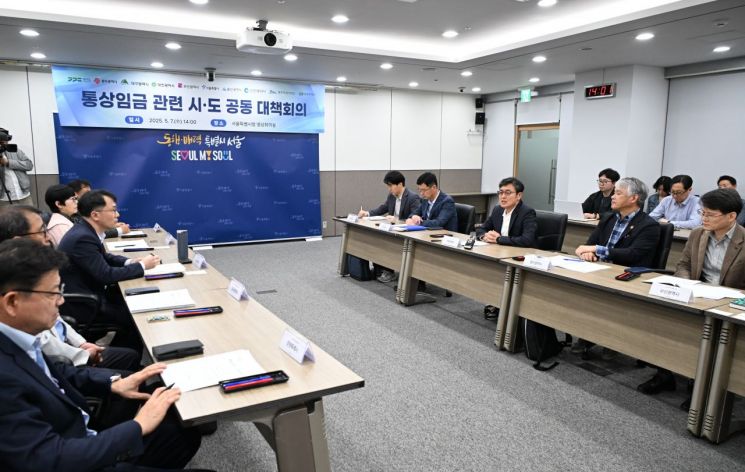 On the afternoon of the 7th, at the 'Joint Countermeasure Meeting on Ordinary Wages for Cities and Provinces' held at Seoul City Hall, Jangkwon Yeo, Director of Transportation of Seoul City (third from the left at the right table), is giving an opening remark. Provided by Seoul City
At the meeting, Jangkwon Yeo, Director of Transportation of Seoul City, stated, "Last December, the Supreme Court's precedent, which had been maintained stably, was changed, resulting in situations that are difficult to accept under the existing wage system. Based on a comprehensive review of recent guidelines from the Ministry of Employment and Labor, we interpret that the intention is not to simply 'pay more wages' while maintaining the existing wage system, but rather to reorganize the wage system in accordance with the new ruling."
Previously, the Supreme Court's full bench ruled in December of last year that regular bonuses must be included in ordinary wages. The Seoul Metropolitan Government estimates that if bonuses are reflected in ordinary wages in addition to the base salary increase demanded by the Seoul city bus union, labor costs will rise by approximately 300 billion won. The Seoul Bus Transportation Business Association, representing management, maintains that the existing wage system was designed on the premise that bonuses were not included in ordinary wages, and therefore the wage system must be revised in accordance with the Supreme Court's legal change. On the other hand, the union argues that this issue is currently under review by the courts and the Ministry of Employment and Labor, and therefore cannot be addressed in collective bargaining.
At the meeting, the local governments plan to discuss the main points and issues of the Supreme Court's ordinary wage ruling, the current status of wage and collective bargaining negotiations in each local government, ways to strengthen inter-governmental cooperation, and joint countermeasures. They will also address the potential ripple effects of a widening wage gap between bus drivers and other transportation sectors due to a sharp rise in city bus drivers' wages, and the possibility that the results of wage negotiations in one local government may set a precedent for others.
In addition, they will discuss institutional measures to prevent a sharp increase in transportation costs resulting from wage negotiations under the semi-public system. Due to the nature of the semi-public system, rising transportation costs may lead to an increased burden on citizens.
The local governments attending the meeting plan to hold regular meetings in the future and to jointly respond to common issues such as ordinary wages.
© The Asia Business Daily(www.asiae.co.kr). All rights reserved.












