Construction Over the Sea and Weak Ground Conditions
Explanatory Document to Be Submitted to the Ministry of Land, Infrastructure and Transport This Week
Hyundai Engineering & Construction has cited "safety" as the specific reason for deciding to extend the construction period for the Gadeokdo New Airport site development by two years beyond the originally proposed schedule. It is reported that the company plans to submit an explanatory document to the government as early as this week.
According to industry sources on May 7, Hyundai Engineering & Construction, which leads the consortium for the Gadeokdo New Airport site development project, has concluded that 108 months, an extension of two years from the original 84-month schedule, is the minimum period required for safety. The company explained that building an airport more than twice the size of Yeouido on the sea is an extremely challenging project, and the weak ground conditions at the site mean that the original government schedule cannot guarantee safety.
The Ministry of Land, Infrastructure and Transport received the basic design documents for the new airport site development from Hyundai Engineering & Construction on April 28. The design documents were submitted with an extended construction period but without specific explanations. In response, the ministry requested that Hyundai supplement the design and provide a detailed explanation for the different construction period submitted.
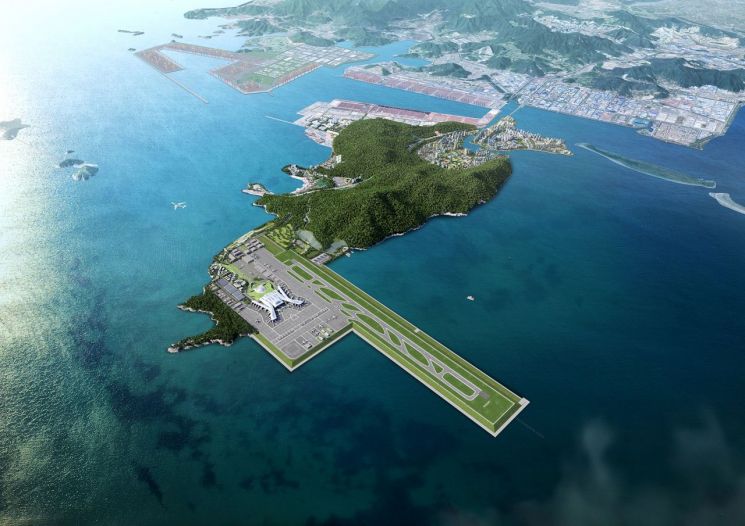
Hyundai Engineering & Construction maintains that the scale and complexity of the project must be reflected in the construction period. The Gadeokdo New Airport is a massive project, involving the development of a 6.67 million square meter site, the construction of a 3,500-meter runway, and a 1 million square meter apron. The runway section will essentially be built over the sea. The project also requires reinforcing the weak seabed, relocating a mountain to reclaim land from the sea, and installing marine structures. The process includes blasting a mountain peak three times the size of Namsan to produce large quantities of earth and rock.
The project site is located in an offshore area where waves can reach up to 12 meters during typhoons, so construction methods that ensure safety against typhoons and high waves must be applied. To address this, Hyundai Engineering & Construction has decided to install caissons (hollow concrete structures) to block high waves before proceeding with land reclamation. The company estimates that installing the caissons will require an additional seven months.
In addition, the company believes that the time required to improve the ultra-weak seabed, which reaches depths of up to 60 meters, as well as reclamation work at depths of 25 meters and heights of up to 70 meters, must also be factored into the construction period. For the runway section, additional work is needed to ensure stability and prevent ground subsidence due to the clay layer used for ground improvement and the reclaimed structures.
A company representative explained, "About 250 experts in airport, port, and design fields participated in reviewing the design over a period of approximately six months," adding, "We have established the construction plan by prioritizing safety and quality, and by reflecting an appropriate construction period that meets these standards."
© The Asia Business Daily(www.asiae.co.kr). All rights reserved.












