Uncertainty Persists Over Trump's Tariff Policies
U.S. Economic Indicators Send Mixed Signals
CNBC: "Fed Expected to Remain in Wait-and-See Mode"
As the U.S. Federal Open Market Committee (FOMC) begins its two-day meeting, the prevailing expectation is that the Federal Reserve (Fed) will maintain its stance of keeping the benchmark interest rate unchanged. This is largely due to the continued uncertainty stemming from President Donald Trump's tariff policies, as well as the mixed signals being sent by recent U.S. economic indicators, which are complicating the Fed's decision-making process. Since this meeting will not include the release of the Fed's quarterly economic growth projections or the dot plot outlining future rate expectations, market attention is focused on Fed Chair Jerome Powell's remarks.
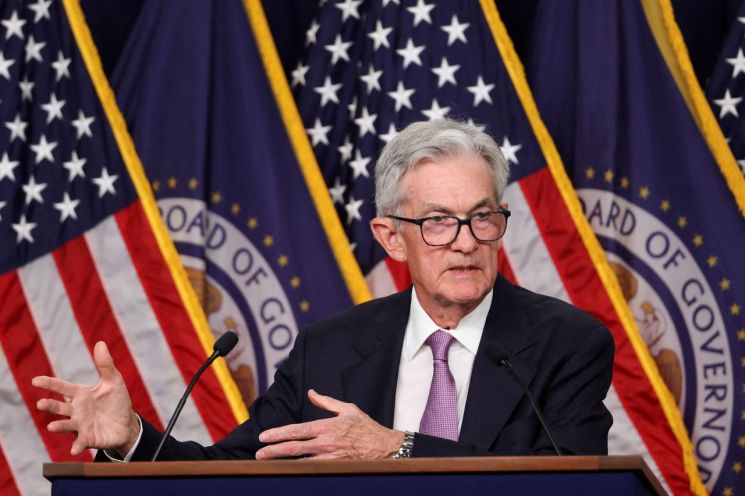
On May 6 (local time), U.S. financial media outlet CNBC predicted, "The Fed is expected to remain in 'wait-and-see' mode with no policy changes at the FOMC meeting scheduled for Wednesday, the 7th." In fact, according to the CME Group's FedWatch tool, the likelihood of a rate cut at this meeting is very low, and the probability of a rate cut at the June meeting stands at only 30%.
This is attributed to the recent U.S. economic indicators sending mixed signals to the market, as well as President Trump's inconsistent stance on tariff policy. The U.S. GDP for the first quarter of this year recorded -0.3%, indicating negative growth. However, this is interpreted as a result of companies rapidly increasing imports to secure inventory before the tariff announcement on April 2. In contrast, the number of nonfarm payroll jobs in April increased by 177,000 compared to the previous month, indicating a robust employment trend.
This balanced economic situation is actually deepening the Fed's dilemma. Lowering rates in advance out of concern for tariff-induced inflation could in fact intensify inflationary pressures, while waiting until economic indicators actually worsen carries the risk of exacerbating a recession. Chair Powell also commented last month that "it will be a very difficult decision," noting that the Fed could face a situation where its dual mandate of price stability and maximum employment come into conflict.
The Wall Street Journal (WSJ) described the Fed as being caught in a "goalkeeper's dilemma," stating, "The Fed faces a difficult decision between accepting a recession or managing stagflation (rising prices amid economic stagnation)."
While most Fed officials believe that a rate cut would be premature, there is internal division regarding the potential for inflation driven by tariffs and supply chain instability.
Fed Governor Christopher Waller emphasizes that "the inflation caused by tariffs will be limited to this year" and argues that "it is necessary to cut rates quickly to support the economy." He insists that the Fed must avoid repeating the mistake of the pandemic era, when it misjudged inflation as "transitory" due to excessive caution and raised rates too late.
However, there are a significant number of officials who oppose his view. Beth Hammack, President of the Federal Reserve Bank of Cleveland, said, "It's better to move slowly in the right direction than to move quickly in the wrong direction."
The Fed is also deliberating over the messaging for not only the interest rate decision but also future policy responses. Chair Powell is scheduled to explain the Fed's policy direction at a press conference immediately following the meeting. No economic growth projections or dot plot will be released at this meeting. Instead, clues about the future path of monetary policy will be gleaned from the meeting statement and Powell's remarks.
Vincent Reinhart, a former senior Fed official and economist at BNY Investment, said, "The Fed has not yet decided what to do in June," adding, "Chair Powell will have no choice but to give a generic answer that 'all options are on the table.'" This suggests that it may be difficult for Powell to deliver a clear message. A dovish (monetary easing) message would signal a willingness to cut rates or provide liquidity, with the intention of preventing economic slowdown and stimulating consumption and investment. However, policy uncertainty such as tariffs or trade wars could cause companies to postpone investment altogether, resulting in a sluggish response even if rates are lowered.
On the other hand, a hawkish (inflation-fighting) message would signal an intention to raise rates or maintain rate hikes to curb inflation. However, this could send a signal to companies to refrain from raising prices, potentially influencing corporate pricing decisions and dampening inflation expectations.
Robert Kaplan, a former Fed official and former President of the Dallas Fed, said, "Even if you are considering cutting rates, you need to make hawkish comments to anchor market inflation expectations."
© The Asia Business Daily(www.asiae.co.kr). All rights reserved.












