Tax rates similar in the past...
But benefits for families with children have increased amid low birth rates
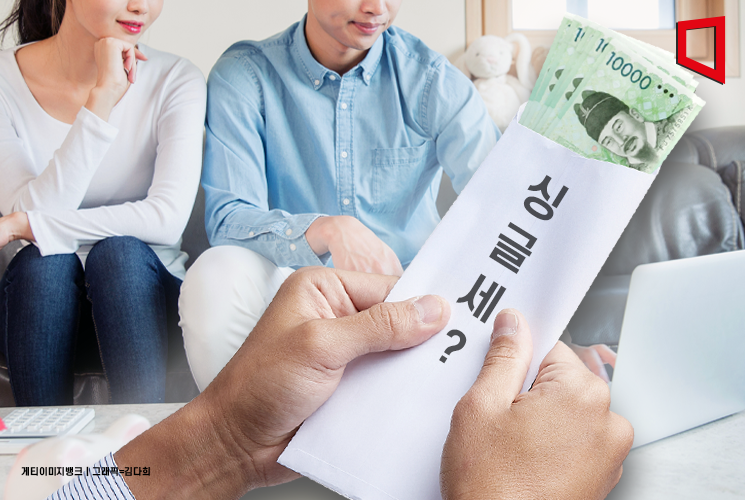
A recent study has found that single workers in South Korea face a tax burden more than 12 percentage points higher than workers with two children. Although tax incentives for childbirth and child-rearing have been significantly expanded, the overall structure of earned income tax has not been reformed, effectively resulting in single-person households paying what amounts to a "singles tax."
According to the "Taxing Wages 2025" report recently published by the Organisation for Economic Co-operation and Development (OECD) on May 8, the "net average tax rate" for a single-person household earning the average income in South Korea last year was 16.3%. This means that if a single worker earns 1 million won, they actually receive 837,000 won after taxes.
The net average tax rate is an indicator that measures how much of a worker's wage remains as real income. It takes into account not only the taxes and social security contributions paid by the worker, but also any cash benefits received by the worker. A higher number means that the tax burden on workers is heavier or that the benefits received are smaller. Unlike "tax wedge" statistics, which also include employer contributions, or "effective tax rate" indicators, which do not reflect social benefits, the net average tax rate provides an accurate measure of a worker's actual income.
For a single-earner household with two children, the net average tax rate was 3.9%. This means that, for the same income, a single-person household bears a tax burden 12.4 percentage points higher than a two-child household. The OECD explained, "Taking into account child-related allowances and tax provisions, this is the 34th lowest level among OECD countries," and added, "On average, married workers with two children in South Korea received 96.1% of their gross wages."
Tax rates were similar... but benefits for families with children have increased amid low birth rates
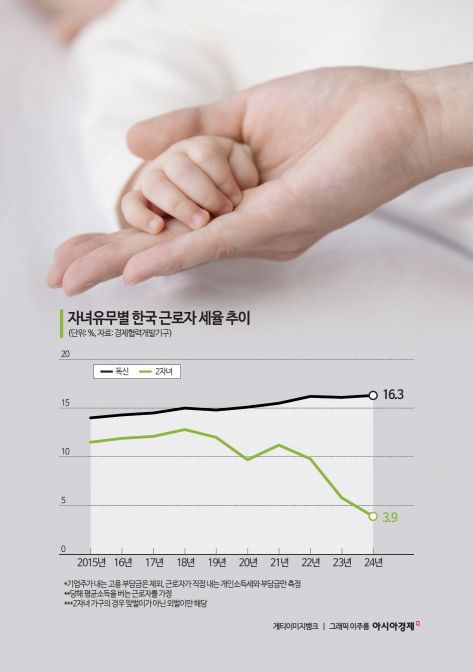
The gap in tax rates between single-person households and households with children is widening. Over the past 10 years, the net average tax rate for single-person households has increased by 2.3 percentage points, while for two-child households it has dropped by 7.6 percentage points. In 2015, the tax rate for single-person households was 14%, and for two-child households it was 11.5%, a difference of only 2.5 percentage points. In 2018, the gap narrowed further to 2.2 percentage points. However, starting in 2019, the tax rate for single-person households has continued to rise, while that for two-child households has begun to fall sharply.
The increased tax burden on single-person households is also related to the earned income tax system, which has remained unchanged for more than a decade. Since there are no separate tax benefits, when wages increase, workers are naturally pushed into higher tax brackets. For example, the proportion of workers earning more than 80 million won in total salary has nearly doubled over the past 10 years, from 6.2% to 12.1%. Although nominal wages have increased every year, the "tax base of 88 million won" threshold has not changed since 2008.
In contrast, two-child households have seen their burden significantly reduced thanks to government tax incentives for childbirth and child-rearing, as well as various direct cash benefits. Last year, the government increased the child tax credit to 250,000 won for the first child, 300,000 won for the second child, and 400,000 won for the third child. Compared to when the policy was first introduced in 2014, this is an increase of 100,000 to 200,000 won. Families also benefit from deductions for childbirth and adoption, tax credits for postpartum care centers, child allowances, parental benefits, and child-rearing subsidies. Starting this year, childbirth support payments received by employees from their companies are also fully tax-exempt.
As a result, there are growing claims that single-person households are effectively paying a "singles tax." Lee Younghan, a professor of taxation at the University of Seoul, said, "When people get married, they can allocate income to the spouse with the lower marginal tax rate and receive various deductions, so in reality, singles end up bearing the singles tax burden." He added, "Since the tax burden on singles naturally increases, I don't think there is a need for any additional taxation."
© The Asia Business Daily(www.asiae.co.kr). All rights reserved.
!["The Woman Who Threw Herself into the Water Clutching a Stolen Dior Bag"...A Grotesque Success Story That Shakes the Korean Psyche [Slate]](https://cwcontent.asiae.co.kr/asiaresize/183/2026021902243444107_1771435474.jpg)

















