First Case in the Industry... 62.2 Billion Won Additional Allocation to Yeosu
Subsidies and Management Stabilization Funds Offer Relief to the Sector
Production Cuts and Workforce Reductions... Industry Conditions Worsen
With the government designating Yeosu City in Jeollanam-do as the first 'Preemptive Industrial Crisis Response Area' in the petrochemical sector, there are growing expectations that a full-scale restructuring may begin in the near future. There are also increasing calls for the government to directly intervene in the long-stagnant petrochemical industry to simultaneously promote investment and fundamental reform.
According to government and industry sources on May 7, the Ministry of Trade, Industry and Energy has decided to designate Yeosu as a support target for two years, from May 1, 2025, to April 30, 2027, with the aim of guiding industrial transformation. With this designation, Yeosu City will receive an additional 62.2 billion won in local allocation tax. Substantial financial support will also be provided, including up to 1 billion won in emergency management stabilization funds per company, as well as local investment promotion subsidies that cover 24% of facility costs and 50% of site acquisition costs. Furthermore, the ministry plans to include a mid- to long-term response strategy in the budget after 2026, covering research and development (R&D), management consulting, and employment stabilization.
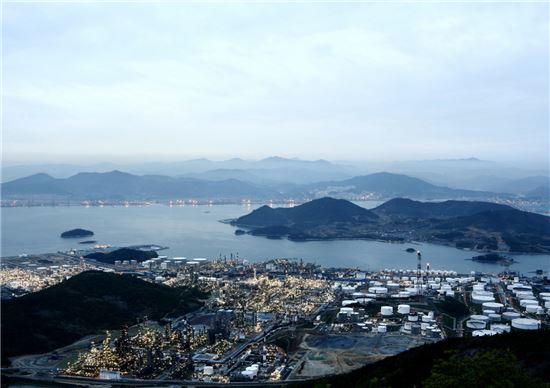 Yeosu City in Jeollanam-do was officially designated as an 'Industrial Crisis Preemptive Response Area' by the Ministry of Trade, Industry and Energy on the 1st. Photo shows the Yeosu Industrial Complex. Photo by Asia Economy DB
The Yeosu National Industrial Complex is the world's largest single-site petrochemical complex. Major domestic petrochemical companies such as LG Chem, Lotte Chemical, Yeocheon NCC, and Hanwha Solutions are located there. Due to an industry structure focused on commodity products with high fixed costs, timely restructuring has not been carried out. According to the Korea Petrochemical Industry Association, the average operating rate of major domestic naphtha cracking centers (NCC) last year was 73%, a decrease of 16 percentage points compared to 89% in 2018. Recently, Lotte Chemical has initiated a voluntary retirement program at its Ulsan plant, undertaking workforce restructuring, while other major companies are responding by postponing investments or reducing production volumes.
This measure is being evaluated not just as simple support, but as a signal for structural transformation. The Ministry of Trade, Industry and Energy plans to present a mid- to long-term restructuring direction within the first half of this year, based on reports such as a competitiveness enhancement report by global consulting firm BCG. The timing is expected to be after the presidential election on June 3. Jo Gye-won, a Democratic Party lawmaker representing Yeosu-si-eul, stated, "The petrochemical industry crisis is directly impacting the regional economy and employment," and emphasized, "The government must establish a pathway for structural transformation away from commodity product-focused operations."
Previously, since 2018, the government has designated a series of cities centered on the automobile and shipbuilding industries as industrial crisis areas in response to structural crises. In Gunsan, Jeollabuk-do, which suffered employment shocks due to the withdrawal of GM Korea, an electric vehicle-focused cluster was established. In Geoje and Tongyeong, Gyeongsangnam-do, which once faced a severe order drought, efforts were made to convert to eco-friendly shipyards. An industry official commented, "The current petrochemical industry is not merely experiencing a cyclical downturn, but is facing factors that could prolong the recession," and added, "With this government measure, we will be able to gauge the potential for fundamental reform across the entire petrochemical sector."
© The Asia Business Daily(www.asiae.co.kr). All rights reserved.
![Clutching a Stolen Dior Bag, Saying "I Hate Being Poor but Real"... The Grotesque Con of a "Human Knockoff" [Slate]](https://cwcontent.asiae.co.kr/asiaresize/183/2026021902243444107_1771435474.jpg)















