Assets held by elderly dementia patients
expected to triple by 2050
"Freezing of dementia money"
could disrupt the real economy
The total assets held by elderly dementia patients aged 65 and older have reached 154 trillion won, which is equivalent to 6.4% of South Korea's gross domestic product (GDP).
The Presidential Committee on Low Fertility and Aging Society, together with the National Health Insurance Service and Seoul National University Health Finance Center, released the results of a comprehensive survey on the assets of elderly dementia patients on May 6. This is the first time such a full-scale survey has been conducted in South Korea.
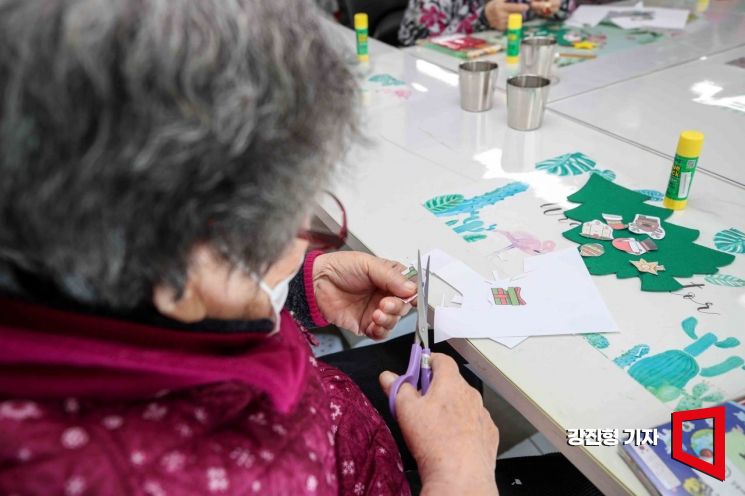 On the 6th, elderly people are engaged in craft activities at the Gireum Daycare Center in Seongbuk-gu, Seoul. The daycare center, commonly called "Nochwon" (Senior + Kindergarten), is a facility that cares for the elderly who are not yet in need of nursing home care but have difficulty with daily activities due to early dementia or other age-related illnesses (long-term care grades 1 to 5). Photo by Kang Jinhyung
In 2023, there were a total of 1,240,398 elderly dementia patients aged 65 and over in South Korea, and 61.6% of them, or 764,689 individuals, owned assets. The total assets held by these individuals amounted to 153.5416 trillion won, with an average of about 200 million won per person.
The research team estimated the number of "elderly dementia patients" for each year based on health insurance claim data from the past five years (2019 to 2023). Elderly dementia patients were defined as those aged 65 and older who had been diagnosed with a dementia-related disease code (F01-F03, G30) and had claimed health insurance from 2002 up to the reference year, excluding those who died before the reference year.
Subsequently, the team analyzed the total asset scale of these individuals by utilizing income data from the National Tax Service and the five major public pension institutions, as well as property data such as houses and land reported to local governments.
When dividing the assets of elderly dementia patients into income and property, total income amounted to 6.3779 trillion won, while total property reached 147.1637 trillion won, indicating that the majority of their assets were in property.
Breaking down the income figures further, earned income was 1.4758 trillion won, business income was 1.4348 trillion won, financial income was 850.8 billion won, and other income was 2.6165 trillion won.
Among property assets, financial assets were 33.3561 trillion won, real estate assets were 113.7959 trillion won, and other property assets totaled 11.7 billion won.
Financial assets were estimated by the Seoul National University Health Finance Center based on financial income data (interest and dividends) from the National Health Insurance Service. The research team explained that the National Health Insurance Service data does not capture individuals with annual financial income below 20 million won, so the actual figure may have been underestimated.
The Presidential Committee on Low Fertility and Aging Society stated, "Although elderly dementia patients account for only 2.4% of the total population, their assets represent 6.4% of the GDP, indicating a very high asset proportion relative to their population size. The freezing of assets due to dementia is likely to have a significant impact on the real economy."
The research team projects that the number of dementia patients will increase sharply to 1,787,000 in 2030, 2,851,000 in 2040, and 3,967,000 in 2050.
The assets of these dementia patients, referred to as "dementia money," are also expected to increase rapidly, reaching 488 trillion won in 2050?more than three times the current amount and equivalent to 15.6% of the projected GDP. As such, there are calls for measures to prevent fraud and a decline in investment.
Joo Hyunhwan, Vice Chairperson of the Presidential Committee on Low Fertility and Aging Society, explained the significance of this survey, stating, "For the first time in South Korea, we have conducted a comprehensive survey of the real assets and income of elderly dementia patients to determine the scale of 'dementia money,' and our data is more accurate than that of Japan."
He added, "Elderly dementia patients are at risk of exposure to fraud due to their inability to manage assets, and the freezing of assets among dementia patients could disrupt the virtuous economic cycle of investment and consumption. We will conduct related research and reflect support measures for managing dementia money in the 5th Basic Plan for Low Fertility and Aging Society, which will be announced at the end of the year."
The Presidential Committee on Low Fertility and Aging Society plans to analyze changes in the scale of dementia money annually, starting with this survey, and to discuss improvements to the private trust system, expansion of public guardianship for dementia patients, and the introduction of a public trust system.
© The Asia Business Daily(www.asiae.co.kr). All rights reserved.
![Clutching a Stolen Dior Bag, Saying "I Hate Being Poor but Real"... The Grotesque Con of a "Human Knockoff" [Slate]](https://cwcontent.asiae.co.kr/asiaresize/183/2026021902243444107_1771435474.jpg)











