Trump: "I Will Meet with Film Industry Representatives to Ensure Satisfaction with Tariff Plans"
Hollywood Films Overseas for Profitability... Tax Incentives in the UK, Australia, and More
On May 5 (local time), the White House stated, "No final decision has been made regarding tariffs on foreign films."
The White House made this announcement in a statement issued under the name of spokesperson Kush Desai, which was sent to USA Today, The Hollywood Reporter, and other outlets on the same day.
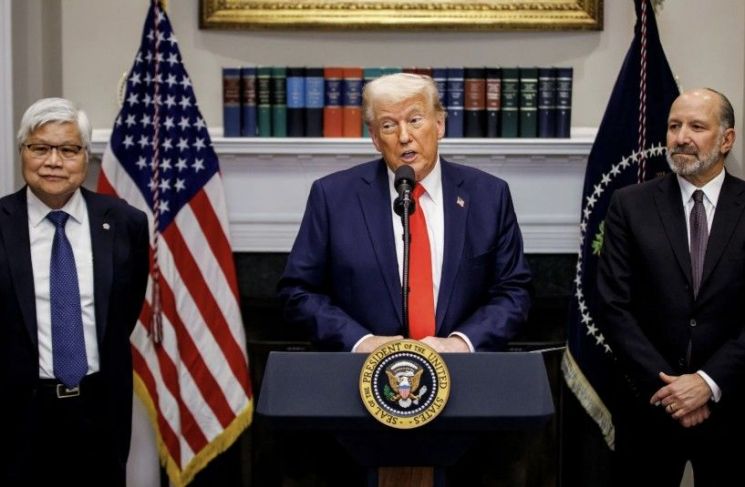
The White House also said, "The administration is reviewing all options to fulfill President Trump's directive to make Hollywood great again and to protect the national and economic security of the United States."
USA Today and other outlets analyzed that this position by the White House appears to be somewhat of a step back from President Donald Trump's previous stance.
Previously, President Trump announced in a post on social media the previous day that he had directed the Department of Commerce and the Office of the United States Trade Representative (USTR) to impose a 100% tariff on all films produced abroad.
In response, Secretary of Commerce Howard Lutnick posted on X (formerly Twitter) that the matter was "in progress."
However, he did not specify the exact scope of the films subject to tariffs, including whether online video services (OTT, Over the Top) would be included.
In this regard, President Trump was asked about tariffs on foreign films at a sports-related event held at the White House that day. He responded, "I will meet with industry representatives," and added, "I will make sure they are satisfied with it."
He continued, "The American film industry has been destroyed by other countries and by the incompetent (Democratic) Governor of California," adding, "It is a major industry that began in the United States but left the country. We will bring it back."
Meanwhile, some analysts have pointed out that President Donald Trump's plan to impose tariffs on foreign films is aimed at Hollywood's outsourcing production practices.
On the same day, the British daily The Guardian analyzed that President Trump's film tariffs appear to target not foreign films themselves, but rather the incentives that foreign governments provide to Hollywood.
Hollywood studios have increasingly filmed outside the United States over the past several decades to cut costs and to utilize interesting or unique backdrops.
As of last year, the North American box office revenue stood at $8.8 billion, still accounting for a significant portion, but falling short of the $21.1 billion in overseas revenue.
Hollywood, considering profitability, has adopted various strategies such as filming abroad, casting actors who can appeal to specific regional audiences, and holding premieres in multiple cities. Some countries also offer tax incentives to attract Hollywood location shoots.
According to the nonprofit organization Film LA, film production in Los Angeles has decreased by nearly 40% over the past decade.
Since the workforce and funding involved in film production are spread across many countries, there is a possibility that tariffs may be imposed not on specific films, but on the incentives provided by foreign governments to encourage Hollywood to film in their countries.
The Guardian and the Financial Times (FT) analyzed that, in this case, countries such as the United Kingdom, Australia, New Zealand, Hungary, and Italy, which have served as major hubs for American film production, would be hit hard.
The Guardian and FT also pointed out that, without overseas incentives, production costs would inevitably rise, making it impossible for small and medium-sized film productions to proceed, and that the impact on the American film industry would be significant.
As production costs increase, movie ticket prices are also expected to rise, which would increase the financial burden on consumers.
© The Asia Business Daily(www.asiae.co.kr). All rights reserved.
![Clutching a Stolen Dior Bag, Saying "I Hate Being Poor but Real"... The Grotesque Con of a "Human Knockoff" [Slate]](https://cwcontent.asiae.co.kr/asiaresize/183/2026021902243444107_1771435474.jpg)











