Number of Accounts Exceeding 1 Billion Won Surpasses 100,000 for the First Time
Total Balance of High-Value Deposit Accounts Exceeds 800 Trillion Won
Increase Driven by Corporate Deposits Amid Declining Interest Rates
Recently, the number of high-value deposit accounts with balances exceeding 1 billion won has surpassed 100,000 for the first time ever. The total balance of all high-value deposit accounts has also exceeded 800 trillion won for the first time. Most of these account holders are corporations, and this trend is analyzed as a result of companies depositing large sums in banks to prepare for further declines in market interest rates as the full-fledged interest rate cut cycle begins.
According to the Bank of Korea's Economic Statistics System on May 4, as of the end of last year, the number of bank time and savings deposit accounts with balances exceeding 1 billion won stood at 100,000, an increase of 3,000 accounts compared to the end of June last year. This is the first time the figure has surpassed 100,000 since related statistics began in 2002.
The number of high-value deposit accounts increased from 89,000 at the end of 2021 to 94,000 at the end of June 2022, and then remained at 95,000 until the end of 2023.
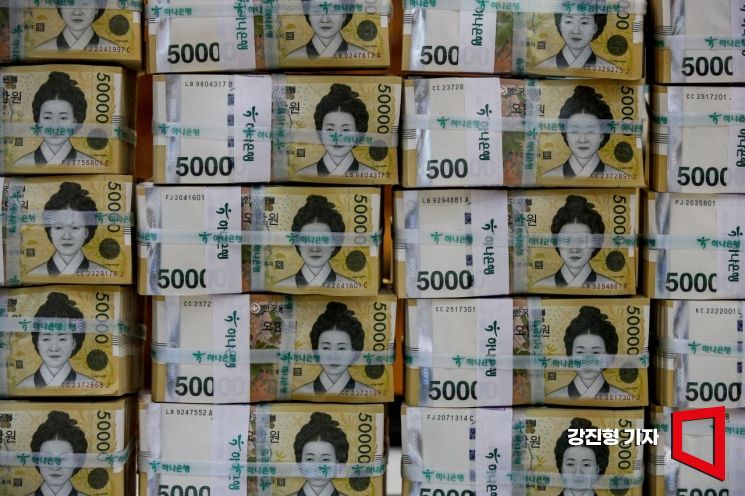 The Bank of Korea announced that last year, the gross national income per capita was $33,745, an increase of 2.6% compared to the previous year. The photo shows 50,000 won bills placed at the Hana Bank headquarters in Jung-gu, Seoul, on the 5th. Photo by Kang Jinhyung aymsdream@
This is also the first time the total balance has surpassed 800 trillion won. As of the end of last year, the total balance of accounts with more than 1 billion won in time and savings deposits was 815.81 trillion won, an increase of 34.578 trillion won (4.4%) from six months earlier (781.232 trillion won).
The balance of high-value deposit accounts increased to 796.348 trillion won at the end of 2022, then decreased to the low 770 trillion won range in early 2023, but has since rebounded sharply since last year.
In detail, as of the end of last year, the number of time deposit and savings deposit accounts exceeding 1 billion won stood at 61,000 and 5,000, respectively, maintaining the same level as six months prior. Meanwhile, the number of corporate free deposit accounts, which are used by corporations and others to temporarily deposit surplus funds in banks, jumped from 31,000 to 34,000.
It is estimated that, amid growing domestic and international uncertainties since the end of last year?such as the election of Donald Trump as President of the United States and the declaration of a state of emergency?companies have increased the opening of corporate free deposit accounts to accumulate cash reserves by postponing investments.
By type, the balance of time deposits, which accounts for the largest share, increased by 30.571 trillion won (5.6%) from 538.531 trillion won at the end of June last year to 569.102 trillion won at the end of last year.
The balance of savings deposits rose by 5.4% from 10.529 trillion won to 11.096 trillion won, while the balance of corporate free deposits increased by 1.4% from 231.556 trillion won to 234.825 trillion won.
The Bank of Korea lowered the base interest rate consecutively in October and November last year, and market interest rates had already been declining before that. Considering these factors, it is analyzed that there was a rush in demand for high-interest deposit products. As of the end of June last year, the base rate stood at 3.50% per annum, but has since dropped to 2.75%, with further cuts expected within the year to respond to the economic slowdown.
© The Asia Business Daily(www.asiae.co.kr). All rights reserved.
![Clutching a Stolen Dior Bag, Saying "I Hate Being Poor but Real"... The Grotesque Con of a "Human Knockoff" [Slate]](https://cwcontent.asiae.co.kr/asiaresize/183/2026021902243444107_1771435474.jpg)











