From Fossils to Handbags...
Artificial Leather Cultivation Project Begins
Could a handbag made from the leather of a Tyrannosaurus, a dinosaur that went extinct 68 million years ago, actually appear? While it may sound like something out of a fantasy, a research team in the United Kingdom has officially announced such a project, drawing significant attention.
Recently, British media outlets such as The Telegraph reported that a research team led by Professor Che Connon, a tissue engineering expert at Newcastle University, has launched a project to cultivate artificial leather using Tyrannosaurus collagen and create it into luxury fashion items.
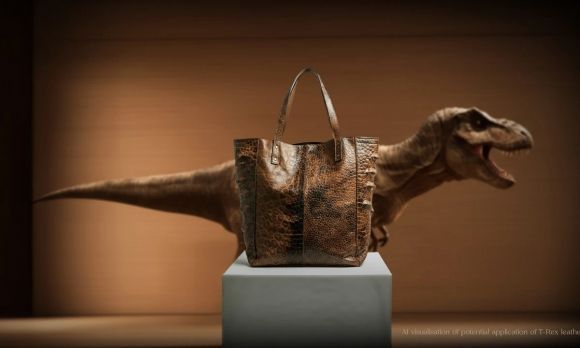 An AI-visualized image of a Tyrannosaurus leather luxury handbag for the Dinosaur Leather Handbag Project. VML Creative Agency website
The research team plans to collaborate with Lab-Grown Leather, a company specializing in artificial leather cultivation, and The Organoid Company, which specializes in organ cloning, to culture dinosaur leather based on collagen and blood proteins extracted from Tyrannosaurus fossil remains discovered in Montana, United States, in 1988.
Professor Connon stated, "We are opening up the possibility of restoring the leather of prehistoric animals in the laboratory, starting with the Tyrannosaurus." He claimed, "Laboratory-cultivated Tyrannosaurus leather is structurally identical to conventional animal leather, yet it is fully biodegradable."
According to his explanation, the research team plans to reproduce the genetic sequence of Tyrannosaurus collagen in the form of DNA, introduce it into leather cells, and then cultivate it in the laboratory. The ultimate goal is to commercialize a variety of 'dinosaur leather' products, including handbags, jackets, and car seats.
However, there are many skeptical views regarding this attempt. Tom Ellis, a synthetic genomics expert at Imperial College London, assessed, "This project may be more of a marketing show than actual science." He cited the fact that "current genomics is not advanced enough to design Tyrannosaurus-specific collagen genes." He further predicted that the properties of the collagen produced in this project would likely be similar to those of cow or chicken collagen, and ultimately, the resulting leather would be comparable to other alternative leathers.
© The Asia Business Daily(www.asiae.co.kr). All rights reserved.
![A Woman Who Jumps Holding a Stolen Dior Bag... The Mind-Shaking, Bizarre Con of a "Human Knockoff" [Slate]](https://cwcontent.asiae.co.kr/asiaresize/183/2026021902243444107_1771435474.jpg)
















