Generational Gaps Emerge in Family Conversations and Emotional Closeness
Younger Adults Report Higher Rates of Disconnection from Family
Life Plan Pressure and Comparisons Top List of Disliked Parental Nagging
Mutual Respect and Emotional Support Most Desired from Family Members
Financial Burden and Fatigue Common Ahead of Family Gatherings
Paid Family Leave Seen as Most Needed for More Family Time
PMI Emphasizes Importance of Mutual Respect and Empathy in Family Relationships
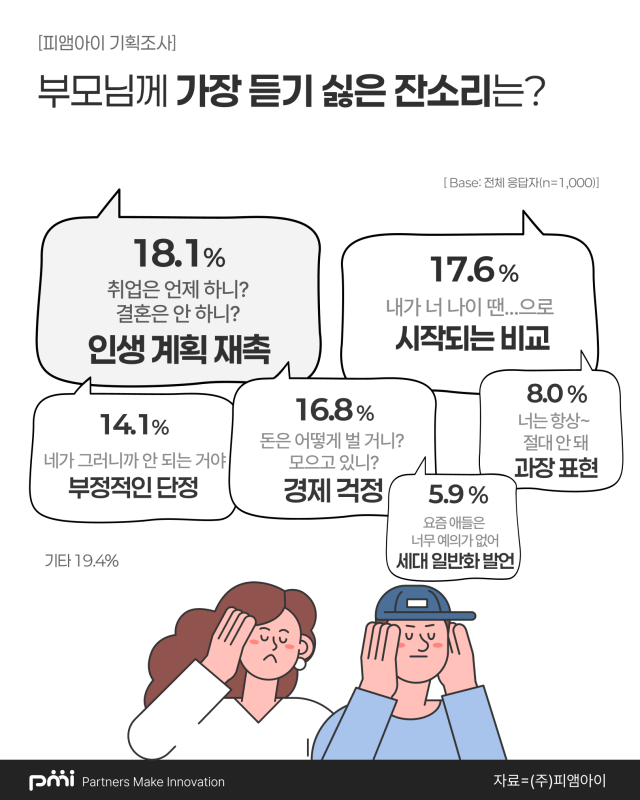
Although adult men and women often engage in conversations with their families, the survey revealed a clear generational gap in conversation topics and emotional closeness.
On May 1, data consulting firm PMI conducted a survey on family perceptions among 1,000 adults aged 19 to 69 nationwide to mark Family Month in May. According to the results, 12.4% of respondents said they "very frequently" talk with their family, 35.9% said "frequently," and 39.7% answered "average." While the majority maintain communication with their families, the combined percentage of those who "rarely talk" (9.3%) and "never talk" (2.6%) reached about 12%, indicating that more than one in ten experience family disconnection. Notably, the response rate for "never talk" was more than twice as high among those in their 20s (13.7%) compared to those in their 60s (5.0%).
The most common topic of conversation among family members was "daily life or recent events" (42.4%), followed by "health issues" (13.3%), "financial matters" (11.2%), "academics or education" (9.9%), and "social issues" (9.2%). On the other hand, the topic that respondents found most difficult to empathize with during family conversations was "political·social issues" (21.4%). In particular, more than 25% of respondents in their 50s and 60s reported difficulty empathizing with family members on political and social issues.
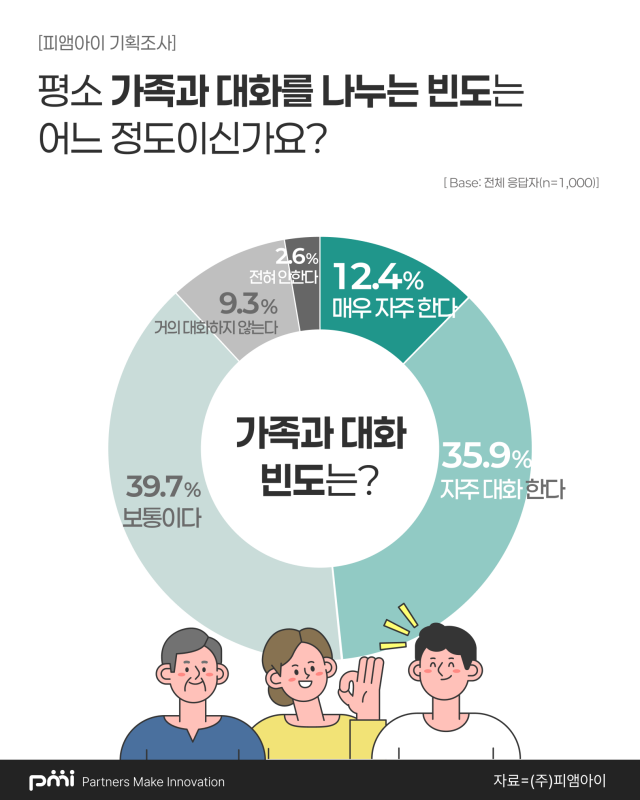
The most disliked nagging from parents was "When will you get a job? Aren't you going to get married?"?pressuring about life plans (18.1%), which ranked first. This was followed by comparisons beginning with "When I was your age..." (17.6%), nagging about financial concerns (16.8%), and negative judgments (14.1%). The most desired aspect from family members was "mutual respect" (31.4%), followed by "emotional support" (22.4%) and "spending time together" (17.1%). By age group, those in their 20s valued personal freedom more, while those in their 60s placed relatively greater importance on spending time together.
When asked about their feelings ahead of family gatherings or anniversaries, the most common response was "feeling burdened by costs or preparations" (28.6%). "Fatigue" (24.3%) and "wanting to pass quietly" (23.6%) were also reported at similar levels, while only 20.4% said they felt "warmth and anticipation." In particular, the proportion of respondents who felt anticipation was lowest among those in their 20s (11.8%) and more than three times higher among those in their 60s (37.4%), highlighting generational differences in perception.
The system considered most necessary for spending more time with family was a "paid family leave system" (45.1%). This was followed by "flexible work or remote work systems" (39.0%) and "family psychological·emotional counseling programs" (21.9%).
Regarding the survey results, PMI stated, "While family conversations themselves are ongoing, there are still gaps in emotional closeness and the values people expect from family relationships," adding, "Securing physical time together is important, but above all, what is needed is mutual respect and empathy among family members." The company further commented, "As we mark Family Month, it is important to reflect on family relationships and also to continue discussions on improving systems for work-life balance."
© The Asia Business Daily(www.asiae.co.kr). All rights reserved.
![Clutching a Stolen Dior Bag, Saying "I Hate Being Poor but Real"... The Grotesque Con of a "Human Knockoff" [Slate]](https://cwcontent.asiae.co.kr/asiaresize/183/2026021902243444107_1771435474.jpg)

















