ConvNeXt Model Achieves 100% Specificity
in Bone Scan Analysis for Cancer Patients
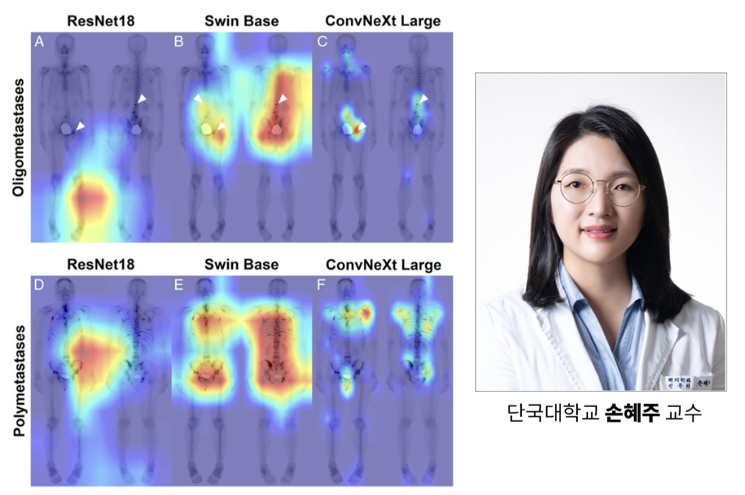
Dankook University Hospital announced on April 30 that Professor Son Hyeju from the Department of Nuclear Medicine and a joint research team from Hallym University College of Medicine were selected for the 'Hanbitsa (People Who Make Korea Shine)' list by the Biological Research Information Center (BRIC) for their research achievements in using artificial intelligence (AI) to diagnose bone metastasis in cancer patients.
The core of the research was the development of an AI-based model to determine the presence of bone metastasis from bone scan images, as well as the comparison and analysis of the diagnostic accuracy of the latest AI algorithms.
Bone scans are tests that can quickly assess the condition of bones throughout the body. Due to their low cost, they are widely used for patients with prostate cancer or breast cancer. However, automated diagnostic technology for bone scans has remained in its early stages of development.
The research team trained their model using a total of 6,175 bone scan images, and enhanced reliability by conducting cross-validation with 1,185 images collected from external hospitals at Hallym University. Through this process, they demonstrated the potential of an AI-based classification model that can be reproduced in real clinical settings.
The AI models used for comparison were: ▲ResNet-50 ▲ViT (Vision Transformer) ▲ConvNeXt.
Among these, ConvNeXt?the most advanced model?achieved a sensitivity of 79% (indicating how well it detects positive cases) and a specificity of 100% (indicating how well it detects negative cases), outperforming the existing ResNet model (sensitivity 63%, specificity 90%).
The research team also applied the 'Grad-CAM' technique, which visually presents the basis for AI decisions, thereby enabling medical professionals to trust the results and utilize them in clinical practice.
The results of this study were published in Clinical Nuclear Medicine (IF 10.0), a journal ranked in the top 1.9% in the field of radiology, and received the 'Young Investigator Award' at the 63rd Annual Fall Conference of the Korean Society of Nuclear Medicine.
Professor Son Hyeju stated, "Through AI-based diagnostic technology, we have confirmed the possibility of reducing the variability in conventional image interpretation and providing patients with more accurate and consistent diagnoses."
© The Asia Business Daily(www.asiae.co.kr). All rights reserved.
![Clutching a Stolen Dior Bag, Saying "I Hate Being Poor but Real"... The Grotesque Con of a "Human Knockoff" [Slate]](https://cwcontent.asiae.co.kr/asiaresize/183/2026021902243444107_1771435474.jpg)











