Following the Increase in Youth Tomorrow Savings Account Limit,
Targeting the 2030 Generation for Two Consecutive Days
Raising the Income Threshold to 3 Million Won
Unconditional Repayment Deferral for Up to 12 Months
Introducing a Corporate Proxy Repayment System
On April 30, former People Power Party leader Han Donghoon, who advanced to the third round of the party's presidential primary, announced a set of pledges aimed at easing the student loan repayment burden for young people. These pledges include raising the income threshold for mandatory student loan repayment, introducing a new repayment deferral system allowing up to 12 months of 'repayment leave,' and establishing a corporate proxy repayment system for student loans. This announcement follows his pledge the previous day to expand public sector youth internships to 30,000 positions and raise the limit for the Youth Tomorrow Savings Account to 30 million won, signaling a clear strategy to target the votes of the 2030 generation by addressing student loan issues.
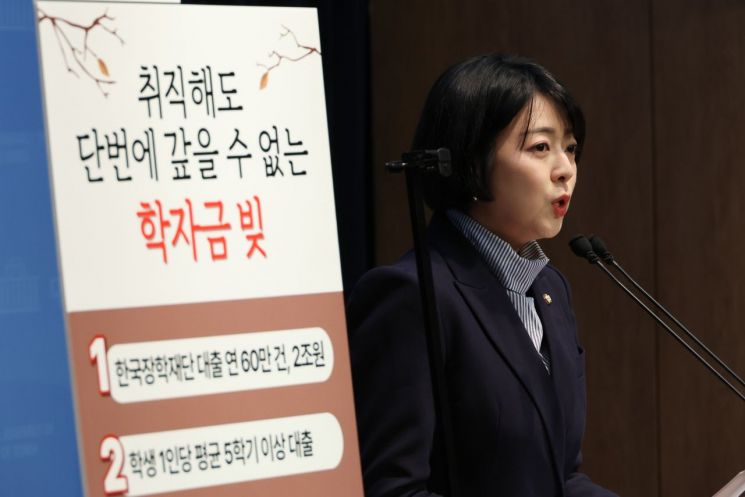
Bae Hyunjin, the chief strategy officer of Han Donghoon's 'People First Camp' and a member of the National Assembly, held a press conference at the National Assembly's communication center that morning to announce the youth student loan policy pledges. She pointed out, "Even after landing a job through great effort, the reality for young people just starting their careers is that their salaries barely cover high rent, utility bills, and other living expenses."
According to Bae, student loans for university students through the Korea Student Aid Foundation amount to 600,000 cases and 2 trillion won annually, with a significant number of applicants relying on these loans for more than five semesters during their studies. As a result, many graduate with at least 10 million won in student loan debt. However, last year, the amount of overdue and delinquent student loans reached 191.3 billion won, and the delinquency rate was as high as two out of every five eligible borrowers. Bae stated, "The weight of student loans, carried from university in order to become a member of society, inevitably feels overwhelming."
Han Donghoon pledged to support youth independence by raising the income threshold that triggers student loan repayment obligations from 2.37 million won per month to 3 million won per month, and to introduce a 'repayment leave system' that would allow borrowers to defer student loan repayments for up to 12 months unconditionally. Under the current system, repayment deferral is only allowed in exceptional cases such as unemployment, disasters, or illness.
He also promised to implement a 'corporate proxy repayment system,' in which companies repay student loans on behalf of employees. To encourage voluntary participation by companies, incentives such as corporate tax reductions would be provided. Bae explained that a similar system was introduced in Japan in 2021, with around 3,000 companies currently participating. Bae stated, "The government will ensure the stability of student loans, young people will see their repayment burdens reduced, and companies will be able to secure talented employees, creating a mutually beneficial cooperation system."
Bae further appealed to young people, saying, "We will share the burden, increase opportunities, and walk together toward the future so that young people can overcome current hardships and grow quickly," adding, "The nation will wait until you are ready to grow."
After the announcement, when asked by a reporter whether the proxy repayment system might primarily benefit large corporations and leave out young workers at small and medium-sized enterprises, Bae responded, "Large corporations will take the lead and generate a positive response," adding, "Through a trickle-down effect, many small and medium-sized enterprises will also be able to participate."
© The Asia Business Daily(www.asiae.co.kr). All rights reserved.












