97 Alley-Type Shopping Districts Designated in Gwangju, Over 13,000 Stores
Vacancy Rate Doubled After Chonnam National University Back Gate Designation
Low Onnuri Gift Certificate Affiliation... Few Support Projects Implemented
"Merchant Association Differences... Plans to Strengthen Promotion"
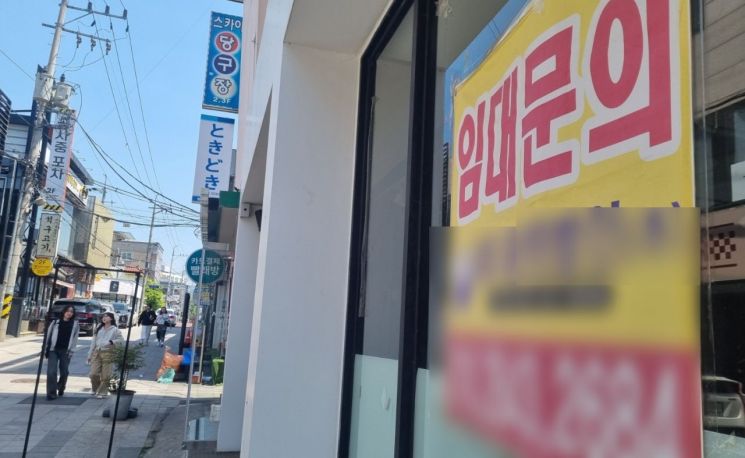 On the morning of the 29th, a rental inquiry banner is posted at a store in the alley-type shopping district near the back gate of Chonnam National University in Buk-gu, Gwangju. Photo by Min Chanki
Recently, as regulations have been eased, "alley-type shopping districts"?an initiative aimed at revitalizing struggling commercial areas?have been designated rapidly throughout the Gwangju region. However, some of these districts are actually seeing an increase in vacant stores, with little sign of positive impact.
The main benefit of alley-type shopping districts is the ability to accept Onnuri gift certificates, but the rate of participating merchants remains low. As a result, additional support projects have not been implemented, and critics argue that the original intent of promoting the unique characteristics of each commercial area is being lost.
As of April 29, according to the five autonomous districts of Gwangju, there are 97 alley-type shopping districts in the region, encompassing a total of 13,909 stores. By district, there are 34 in Buk-gu, 32 in Gwangsan-gu, 17 in Seo-gu, 13 in Nam-gu, and 1 in Dong-gu.
Under local ordinances, an alley-type shopping district can be designated if it is an area of up to 2,000 square meters with at least 15 stores operated by small business owners. Once designated, the two main benefits are: the ability to accept Onnuri gift certificates and eligibility to apply for central and local government support projects.
Despite the widespread designation of alley-type shopping districts in Gwangju, the closure rate among small business owners is actually increasing.
The alley-type shopping district near the back gate of Chonnam National University in Buk-gu was designated in December 2020. Immediately after designation, in the first quarter of 2021, the vacancy rate for medium and large stores in the area was 24.48%. However, due to the impact of COVID-19 and other factors, the vacancy rate soared to 48.7% by the fourth quarter of 2023. In the most recent three quarters, the vacancy rates were 35.14% in the third quarter of 2024, 37.71% in the fourth quarter of 2024, and 38.05% in the first quarter of 2025, showing a continued upward trend and highlighting the difficulty in finding any positive effects from the alley-type shopping district designation.
The vacancy rate for small stores also doubled, rising from 10.28% in the first quarter of 2021 to 19.72% in the first quarter of this year. Since 2021, a total of approximately 312.5 million won has been invested in five marketing support projects through initiatives such as the Ministry of SMEs and Startups' public offerings for the area near the back gate of Chonnam National University. Some store owners were not even aware of the alley-type shopping district designation, and others expressed little interest in the support benefits.
One store owner, Mr. A, who has operated an unmanned laundromat near the back gate of Chonnam National University for four years, said, "I was never informed that this area is an alley-type shopping district, and using Onnuri gift certificates depends on head office policy. I know the building next door has been vacant for a year. The situation is even more difficult now than during COVID-19."
In order to apply for central or local government support projects, a certain proportion of registered stores must be Onnuri gift certificate affiliates. However, most shopping districts do not meet this requirement and are therefore unable to apply for support projects.
As of April 29, among the five autonomous districts in Gwangju, Buk-gu had the highest number of support projects for alley-type shopping districts, with 35 projects and a total budget of approximately 1.495 billion won.
In contrast, Gwangsan-gu and Nam-gu each had only two support projects, such as the market management package support project, while Dong-gu and Seo-gu had not implemented any projects yet. The low level of support projects is attributed to both a lack of interest among merchant associations in each shopping district and the low rate of Onnuri gift certificate affiliation.
The head of one alley-type shopping district merchant association explained, "Many stores in the district are one-person shops without employees, and owners are too busy with daily operations to pay attention to support projects. Even though the Onnuri gift certificate is the biggest benefit, some stores refuse to join for various reasons, such as seeing no significant difference in income."
Officials from Dong-gu and Seo-gu explained, "We registered our first alley-type shopping districts last year, and we plan to identify the specific needs of each district and implement support projects accordingly in the future."
In response, there are growing calls for measures to ensure that alley-type shopping districts, which were established to revitalize depressed commercial areas and strengthen the competitiveness of each district, can fulfill their original purpose.
Regarding this, an official from one of the autonomous districts stated, "The rate of Onnuri gift certificate affiliation and participation in support projects often varies depending on the enthusiasm of each merchant association. We plan to strengthen promotional efforts so that both new and existing store owners, as well as citizens, can become more aware of alley-type shopping districts."
© The Asia Business Daily(www.asiae.co.kr). All rights reserved.