Carney Fills Trudeau's Vacancy
Unites Support Base as "Anti-Trump"
Fails to Secure Majority of Seats
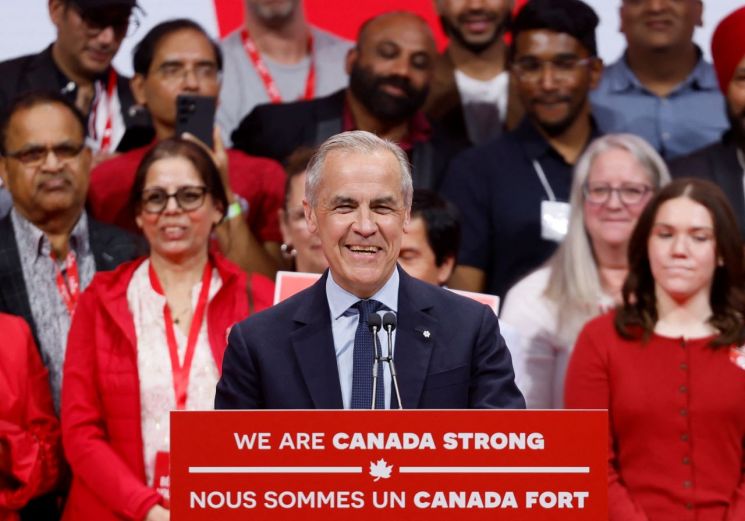 The Liberal Party led by Prime Minister Mark Carney won the Canadian general election on the 28th (local time). Prime Minister Carney is giving a speech at the Ontario Ottawa headquarters. Photo by Reuters Yonhap News
On the 28th (local time), the Liberal Party led by Prime Minister Mark Carney succeeded in extending its rule by winning the Canadian general election. Although the party failed to secure a majority of seats, the Liberals managed to pull off a dramatic turnaround in an unusually short period of time.
Canadian public broadcaster CBC and CTV News reported after the polls closed that the Liberal Party was expected to win the most seats and retain power.
CTV News projected around midnight that while the Liberals would remain the largest party, they would not secure a majority. According to CTV, the Liberals were winning or leading in 156 out of the 343 seats in the House of Commons, while the opposition Conservative Party was winning or leading in 145 constituencies. A majority requires 172 seats.
Although the Liberals failed to secure a majority, they still managed to claim victory. Previously, under the leadership of former Prime Minister Justin Trudeau for over nine years, the party had seen its approval ratings decline due to dissatisfaction with high inflation and rising housing prices. Moreover, as recently as the beginning of this year, the main opposition Conservatives had widened their lead over the ruling Liberals to around 20 percentage points, making it appear likely that Pierre Poilievre, the Conservative leader, would become the next Prime Minister of Canada.
Additionally, the pressure of tariffs and former President Trump's threat to annex Canada as the 51st state of the United States fueled anti-American sentiment among Canadians, which worked in favor of the Liberals in the general election. Prime Minister Carney rallied patriotic sentiment by vowing that Canada would not become part of the United States in any form, standing up to the Trump administration's tariffs and threats to Canadian sovereignty. In contrast, Conservative leader Poilievre struggled with the "Canada's Trump" image that had been attached to him, which weakened his support base, and his inability to provide a sense of stability during the economic crisis proved to be a decisive factor in his defeat.
By securing re-election amid unprecedented diplomatic and economic uncertainty, Prime Minister Carney now faces the heavy responsibility of minimizing the economic shock from tariffs while addressing a host of domestic challenges.
Despite lacking political experience and having relatively low public recognition, Carney distanced himself from former Prime Minister Trudeau's policy direction and presented himself as a stable leader and economic expert capable of responding to the Trump administration's tariff threats, thereby earning the trust of voters. He previously served as Governor of the Bank of Canada in February 2008, where he was credited with defending the Canadian economy relatively successfully during the global financial crisis. From 2013 to 2020, he also became the first foreigner to serve as Governor of the Bank of England (BOE), where he responded to the economic shock caused by Brexit.
© The Asia Business Daily(www.asiae.co.kr). All rights reserved.
!["I'd Rather Live as a Glamorous Fake Than as a Poor Real Me"...A Grotesque Success Story Shaking the Korean Psyche [Slate]](https://cwcontent.asiae.co.kr/asiaresize/183/2026021902243444107_1771435474.jpg)
















