Competition Begins to Secure Rice Harvested in the Fall
Purchase Prices Set 30 to 40 Percent Higher Than Last Year
As rice prices in Japan continue to rise due to factors such as a shortage in supply, agricultural cooperatives (JA) across the country have begun an unusually early competition to secure rice to be harvested in the fall.
The Nihon Keizai Shimbun (Nikkei) reported on the 29th, "However, some regional JAs have set the purchase price for rice this year 30 to 40 percent higher than last year, so even when the new harvest is released to the market, retail rice prices are unlikely to fall significantly."
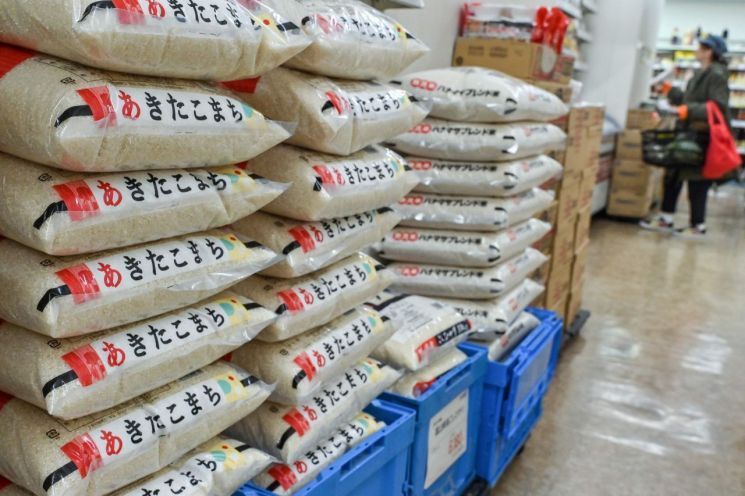
JA purchases rice from producers and sells it to wholesalers and retailers. It handles about 40 percent of the country's total rice production. The regions where JA has raised the purchase price for rice from producers are Akita, Niigata, and Fukui prefectures on Honshu.
In these regions, JA plans to purchase this year's rice at around 23,000 yen (about 230,000 won) per 60 kilograms. Compared to last year's prices, this represents an increase of 37 percent in Akita, 35 percent in Niigata, and 28 percent in Fukui, respectively.
In Japan, rice purchase prices are usually set in August or September, just before the harvest. However, this year, discussions have begun even before the rice planting season has fully started, due to concerns over supply shortages, according to Nikkei.
According to a survey by the Ministry of Agriculture, Forestry and Fisheries, private sector rice inventories in Japan stood at 2.05 million tons at the end of February, which is 16 percent less than the same period last year.
Nikkei reported that although government-released reserve rice began appearing in stores from late March, there is still a strong sense of product shortage. The report added, "Due to JA's preemptive actions, competition to purchase rice among private companies and wholesalers is intensifying."
Since around last summer, rice prices in Japan have been steadily rising, prompting the government to release reserve stocks one after another. However, the upward trend has yet to be curbed.
According to data released by the Ministry of Agriculture, Forestry and Fisheries the previous day, the national average retail price for rice at supermarkets between April 14 and 20 was 4,220 yen (about 42,600 won) per 5 kilograms, up 3 yen (about 30 won) from the previous week. The rise in rice prices has continued for 16 consecutive weeks.
The Asahi Shimbun reported, "Although it has been more than two months since the government announced the release of reserve rice, prices remain high," citing expert opinions that if JA and others continue to purchase rice from producers at high prices, retail prices may not fall.
Recently, as rice prices in Japan have soared, the country decided to import rice from South Korea. This is the first official import of Korean rice into Japan, except for relief purposes during the 2011 Great East Japan Earthquake and the following year, since Japan began keeping export statistics on Korean rice in 1990?a span of 35 years. Due to tariffs and shipping costs, Korean rice was sold in Japan at 9,000 yen (about 90,000 won) per 10 kilograms. On the 10th, 2 tons of rice were shipped, and on the 20th, an additional 10 tons were sent, reportedly selling out completely.
© The Asia Business Daily(www.asiae.co.kr). All rights reserved.

















