Significant Differences Over Wage Increase Rate
Possibility of a 'Full-Scale Strike'
The Seoul city bus union held a vote on whether to stage industrial action on the 30th, and the proposal passed with 84.9% of all union members in favor.
The Seoul City Bus Labor Union, part of the Korean Automobile & Transport Workers’ Federation, announced on the 28th that 96.3% of those who participated in the vote supported industrial action.
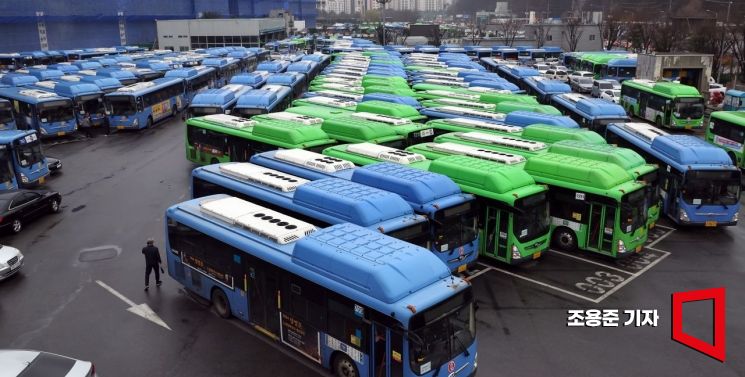 On the 28th, when the Seoul city bus union went on a general strike for the first time in 12 years, buses were parked at a bus garage in Eunpyeong-gu, Seoul. Photo by Jo Yongjun jun21@
As a result, if final negotiations with management break down, the union will be able to legally stage industrial action on the 30th. The Seoul city bus union and management will hold last-minute mediation at the Seoul Regional Labor Relations Commission at 5 p.m. on the 29th. If an agreement is not reached by midnight on the 29th, the union plans to proceed with a strike.
Previously, the bus union and the Seoul Bus Transportation Business Association, representing management, held nine rounds of main negotiations since December last year, but failed to reach an agreement. As a result, the mediation process began, but it is reported that there was little progress even in the first round of mediation on the 23rd.
The Seoul bus union and management remain at odds on several issues, including the wage increase rate. The union has proposed an 8.2% wage increase reflecting the inflation rate, while management insists on a wage freeze. Additionally, the union is demanding that the current retirement age of 63 be raised to 65, as is the case in neighboring Gyeonggi Province, but management is refusing to accept this demand.
The Seoul Metropolitan Government expects that if the union launches industrial action such as a 'work-to-rule' or 'safe driving campaign,' delays in bus operations may occur. In preparation, the city plans to take immediate measures in cooperation with the Seoul Metropolitan Police Agency if irregularities arise in bus intervals, operating speeds, or stop times. During peak commuting hours, traffic police will be deployed to major congestion areas, and the city will request police permission for following buses to overtake in dedicated bus lanes if delays occur.
However, the city believes there is a possibility that industrial action could escalate into a 'full-scale strike' due to the significant differences between labor and management over this year's wage increase. Accordingly, the city has established emergency transportation measures. Seoul City, local districts, and the bus association have formed an Emergency Transportation Countermeasures Headquarters, and have pre-established cooperation systems with organizations such as Seoul Metro and Seoul Metro Line 9 to implement transportation measures.
The number of subway train operations will be increased by a total of 173 runs per day. The main rush hour periods will be extended by one hour compared to current schedules to allow for more trains, and the last subway trains will run until 2 a.m. the following day. To support subway commuting, all 25 districts of Seoul will operate free shuttle buses. In areas where city bus routes are suspended and village buses do not operate, about 500 public and private vehicles will be deployed to connect passengers to the subway.
In addition, to prepare for a prolonged strike, the city plans to ask schools, public institutions, and private companies to adjust start times for classes and work by one hour. This is intended to disperse commuting demand during peak hours.
Yeo Jangkwon, head of the Seoul Metropolitan Government's Transportation Bureau, stated, "We will continue discussions between labor and management to prevent a full-scale industrial action as much as possible," and added, "We will also do our utmost to minimize inconvenience to citizens by thoroughly preparing emergency transportation measures in case of any contingency."
© The Asia Business Daily(www.asiae.co.kr). All rights reserved.
![User Who Sold Erroneously Deposited Bitcoins to Repay Debt and Fund Entertainment... What Did the Supreme Court Decide in 2021? [Legal Issue Check]](https://cwcontent.asiae.co.kr/asiaresize/183/2026020910431234020_1770601391.png)
















