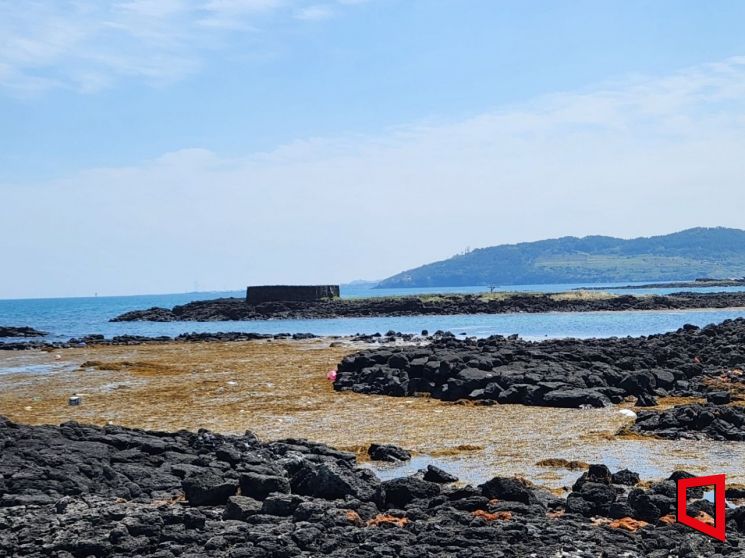
 On the 28th, the influx of Sargassum horneri along the coastal area near Hamdeok, Jocheon-eup, Jeju City, covered the black basalt region, creating a beautiful landscape with Seoubong in the background that is now suffering. Photo by Park Changwon
Every year around this time, the unwelcome visitor Sargassum horneri returns to cover the coastlines of Jeju, and this year is no exception.
On the morning of the 28th, seaweed was observed covering the sea and tidal rocks along the coast near Jocheon-eup, Jeju City. The brownish Sargassum horneri, spreading over the black basalt region, is not only spoiling the coastal landscape but also causing unpleasant odors and posing a threat to the marine ecosystem, raising concerns.
A local resident who visited the site said, "It started washing ashore little by little since last week, but the amount increased dramatically this morning," and added, "Within a day or two, tourists quickly leave the area because of the smell."
Sargassum horneri is known to originate from the coastal waters of China and Japan and drifts to the coast of Jeju on ocean currents. This year, the influx is expected to be similar to last year's level. On the morning of the 28th, the Jeju Special Self-Governing Province began immediate collection efforts for the Sargassum horneri.
An official from the province stated, "We are monitoring the situation using satellite images provided by the National Marine Satellite Center. Since the 24th, Sargassum horneri has been observed floating near the Korean Peninsula, and today, the influx to the Jeju coastline increased sharply." The official added, "We will respond swiftly to minimize damage."
Meanwhile, Sargassum horneri can also cause losses to shellfish and fish farms, so complaints from fishermen are expected to follow.
© The Asia Business Daily(www.asiae.co.kr). All rights reserved.

















