"Need to Rethink Global Strategy"
Due to the US-China trade war, foreign manufacturers operating in China are facing the threat of "double tariffs." According to a report by the Financial Times (FT) on the 27th (local time), these companies are required to pay a 125% tariff when importing parts or raw materials from the United States, and then again a 145% tariff when exporting finished products back to the United States.
Many foreign companies, ranging from large US corporations such as Apple and Tesla to small-scale manufacturers, use China as a manufacturing base. These companies import raw materials or parts from countries including the United States, assemble them in China, and then export the finished products.
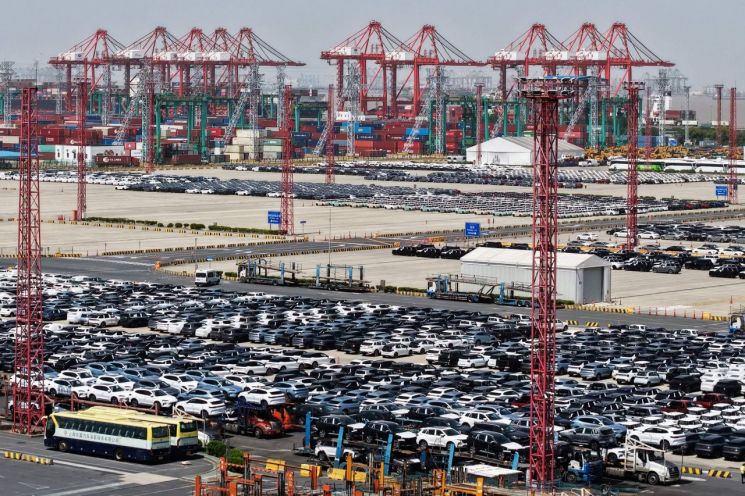
Economists explained that if President Donald Trump imposes a 145% tariff on all Chinese imports, and China retaliates, these companies could be forced to pay tariffs to both sides for a single product. Tang Heiwai, director of the Asia Global Institute at the University of Hong Kong, stated, "Foreign companies are under significant pressure in the Chinese market," adding, "They must pay tariffs to China when importing goods, and then pay tariffs to the United States when exporting to the US."
According to data from China's General Administration of Customs and FT estimates, as of last year, foreign-owned or partially foreign-owned companies in China accounted for one-quarter of total exports and more than one-third of total imports.
Michael Hart, president of the American Chamber of Commerce in China, said, "Many foreign companies operating in China are not American companies, but they depend on US-made raw materials, so they are affected as well."
China provides partial tariff exemptions for companies importing parts and raw materials for re-exported products under a method known as "processing trade." Some large US manufacturers, such as smartphone makers, have also received temporary tariff exemptions from the Trump administration. However, small-scale manufacturers continue to face difficulties. Jacob Rothman, CEO of kitchenware manufacturer Velong Enterprise, pointed out that China exempts tariffs if products made from US raw materials are exported to the United States within a certain period, but does not grant exemptions if these products are exported to countries other than the US.
Economists predict that the trade war could further reduce foreign direct investment inflows into China. According to China's Ministry of Commerce, foreign direct investment inflows last year, measured in yuan, fell by 27.1% compared to the previous year.
Chu Dongxiao, professor of economics at Lingnan University in Hong Kong, said, "Companies entering the Chinese market may still choose to do so," but added, "However, if they are targeting other markets, especially the US market, they will suffer significant losses. They will need to reconsider their global strategy."
© The Asia Business Daily(www.asiae.co.kr). All rights reserved.
!["The Woman Who Threw Herself into the Water Clutching a Stolen Dior Bag"...A Grotesque Success Story That Shakes the Korean Psyche [Slate]](https://cwcontent.asiae.co.kr/asiaresize/183/2026021902243444107_1771435474.jpg)
















