Accelerating the Expansion of Hydrogen Charging Stations and Stabilizing Supply Networks
The cumulative number of hydrogen electric vehicles in South Korea is expected to surpass 50,000 units within this year. There are calls for national-level support to secure hydrogen supply networks, including urban charging stations, in order to popularize hydrogen electric vehicles.
According to industry sources as of March 31, the number of hydrogen electric vehicles supplied stood at 39,216 units. With the launch of the new model of the passenger hydrogen electric vehicle 'NEXO' this year and the government's confirmation of purchase subsidies for 13,000 units, it is expected that the era of 50,000 units will soon arrive.
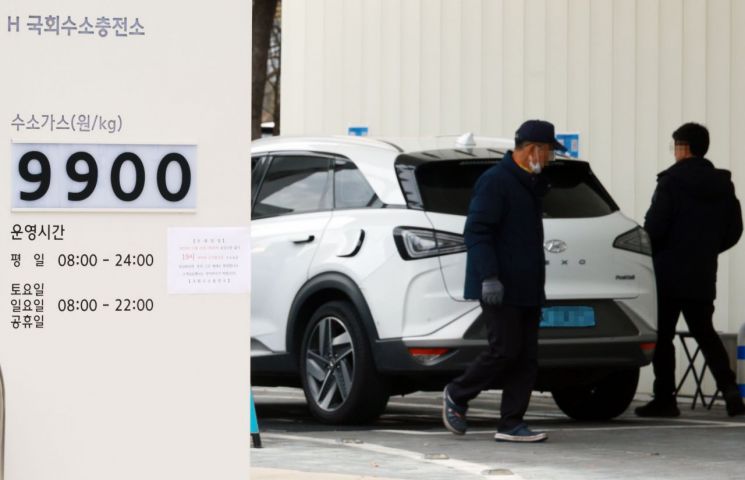
Since the launch of the NEXO in 2018, the cumulative number of hydrogen electric vehicles in South Korea exceeded 10,000 units in 2020 and reached 30,000 units in 2023. By vehicle type, there are 37,227 passenger hydrogen electric vehicles, 1,939 hydrogen electric buses, and 50 hydrogen electric trucks.
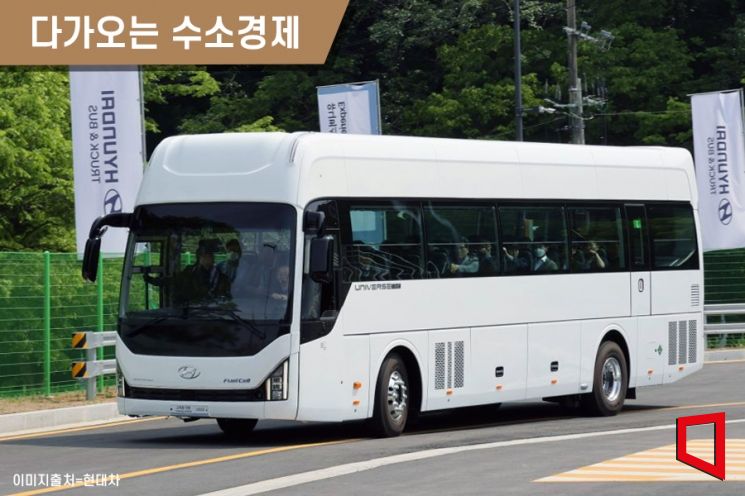
Hydrogen electric vehicles have a long driving range per charge, making them advantageous for long-distance travel. As a result, their supply has been expanding to include intercity buses, city buses, corporate commuter buses, and tour buses.
Hyundai Motor introduced the urban hydrogen electric city bus 'Elec City FCEV' in 2019, followed by the launch of the high-speed large bus 'Universe Hydrogen Electric Bus' equipped with a hydrogen fuel cell system in 2023. The government plans to provide purchase subsidies for 2,000 hydrogen electric buses this year. In the case of trucks, Hyundai Motor established the world's first mass production system for large hydrogen electric trucks in 2020 and has been expanding overseas supply, starting with Switzerland and exporting to 10 countries including the United States, Germany, France, the Netherlands, and Saudi Arabia.
Although the supply of hydrogen electric vehicles is increasing, hydrogen charging stations remain insufficient. As of the end of April, there are a total of 218 hydrogen charging stations nationwide. Gyeonggi Province has the most with 38 stations, followed by Gyeongnam with 23, and Chungbuk with 22. In Seoul, there are only nine locations, including the National Assembly building in Yeouido.
Hyundai Motor has recently developed a 'high-pressure mobile hydrogen charging station,' which faces fewer installation restrictions. However, there are calls for support measures such as tax benefits at the government and local government levels to help charging businesses secure sites and overcome operational difficulties.
Stable management of the hydrogen supply network is also necessary. Currently, the management of South Korea's hydrogen distribution network is handled by several ministries and agencies, including the Ministry of Trade, Industry and Energy, Korea Petroleum Quality & Distribution Authority, and Korea Gas Corporation. However, there is no dedicated agency that comprehensively manages the entire supply chain with the goal of stabilizing hydrogen energy prices.
Hydrogen has a high proportion of private sector involvement in its supply and distribution processes, and policy intervention tools are limited. This creates the possibility of significant instability in supply and large fluctuations in distribution costs. In contrast, countries such as the United States, Japan, and China have designated hydrogen as an important alternative energy source and have national-level agencies dedicated to overseeing hydrogen.
In Japan, the Agency for Natural Resources and Energy under the Ministry of Economy, Trade and Industry oversees hydrogen policy. Since establishing the world's first basic hydrogen strategy in 2017, Japan has steadily implemented various policies to realize a hydrogen society. With policy support such as government subsidies, 25 automobile manufacturers and infrastructure companies are participating in 'JHyM,' which systematically manages the construction, operation, and maintenance of hydrogen charging stations.
 Jang Jaehoon, President of Hyundai Motor Company (second from right), Lee Sangyeop, Vice President (second from left), and other development executives are unveiling the hydrogen electric vehicle concept car 'INITIUM' for the first time at Hyundai Motorstudio Goyang in Gyeonggi-do on the 31st. Photo by Jo Yongjun
An industry official stated, "For hydrogen electric vehicles to become mainstream, it is essential to enhance competitiveness not only through purchase subsidies but also by improving charging infrastructure and hydrogen prices from the perspective of total cost of ownership for users." The official also emphasized, "It is urgent to unify the entities responsible for hydrogen supply and price management, and to establish a national-level agency dedicated to hydrogen energy."
© The Asia Business Daily(www.asiae.co.kr). All rights reserved.
![Clutching a Stolen Dior Bag, Saying "I Hate Being Poor but Real"... The Grotesque Con of a "Human Knockoff" [Slate]](https://cwcontent.asiae.co.kr/asiaresize/183/2026021902243444107_1771435474.jpg)


















