Chonnam National University Research Team Discovers
Novel Microorganism and Enzyme Capable of Degrading Polycarbonate
Potential for Environmentally Friendly Plastic Waste Treatment and Resource Recovery
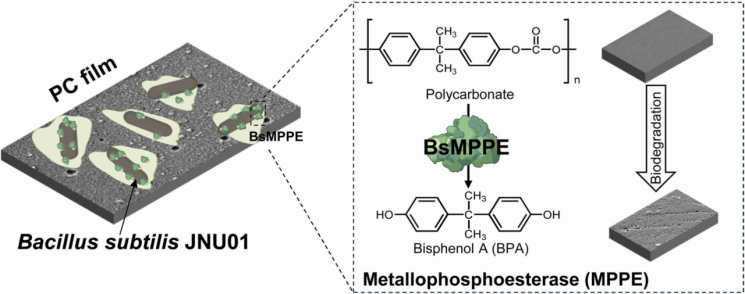 A joint research team from the Department of Biological Science and Technology at Chonnam National University has isolated a novel microorganism capable of using polycarbonate (PC) as the sole carbon source from soil at the Gwangju Metropolitan Sanitary Landfill. Provided by Chonnam National University
On April 25, a joint research team consisting of Professor Sujin Yeom and Professor Choongu Park from the Department of Biological Science and Technology, and Professor Wonseok Ji from the Department of Polymer Science and Engineering at Chonnam National University announced that they had isolated a novel microorganism capable of using polycarbonate (PC) as the sole carbon source from soil at the Gwangju Metropolitan Sanitary Landfill.
Through transcriptome analysis, the team identified a novel enzyme, MPPE, expressed in this microorganism and demonstrated that this enzyme efficiently cleaves the carbonate ester bonds of polycarbonate to produce the monomer bisphenol A. In addition, various physical and chemical analyses confirmed structural changes in PC and a decrease in its mechanical properties, thereby quantitatively proving the enzyme-mediated degradation mechanism.
Every year, more than 400 million tons of plastic are produced worldwide, and a significant portion of this is not properly processed, accumulating in oceans and soil.
In particular, non-degradable plastics remain in nature for decades, eventually breaking down into microplastics, which pose long-term threats to ecosystems and human health. Polycarbonate is a high-performance plastic widely used in industries such as optical devices, electronics, and medical equipment, and is one of the most difficult polymers to degrade. This study is significant as it presents the possibility of developing environmentally friendly biodegradation technologies based on an understanding of the polycarbonate degradation mechanism.
The results of the study were published online on April 17 in the Journal of Hazardous Materials, a leading international journal in the field of environmental hazardous substances and waste management.
This research was conducted with the joint participation of Hyunwoo Kim and Sungmin Kim, integrated master's and doctoral program students in the Department of Biological Science and Technology at Chonnam National University, and Jieun Lee, a master's student in the Department of Polymer Science and Engineering. The study was supported by grants from the National Research Foundation of Korea for the Mid-Career Researcher Program, Next-Generation Biorefinery Core Technology Development, Synthetic Biology Core Technology Development, and Bio-Medical Technology Development projects.
Professor Sujin Yeom stated, "The significance of this study lies in the discovery of a previously unreported polycarbonate-degrading microorganism and enzyme, and in proving the degradation activity of the enzyme through various analytical methods," adding, "We expect that this research will serve as a foundation for the development of biological treatment and resource recovery technologies for recalcitrant plastics."
© The Asia Business Daily(www.asiae.co.kr). All rights reserved.
!["The Woman Who Threw Herself into the Water Clutching a Stolen Dior Bag"...A Grotesque Success Story That Shakes the Korean Psyche [Slate]](https://cwcontent.asiae.co.kr/asiaresize/183/2026021902243444107_1771435474.jpg)
















