National Assembly Forum Discusses Solutions to Successive Ground Subsidence Accidents
"Repeated Subsidence in Areas of Underground Excavation Work"
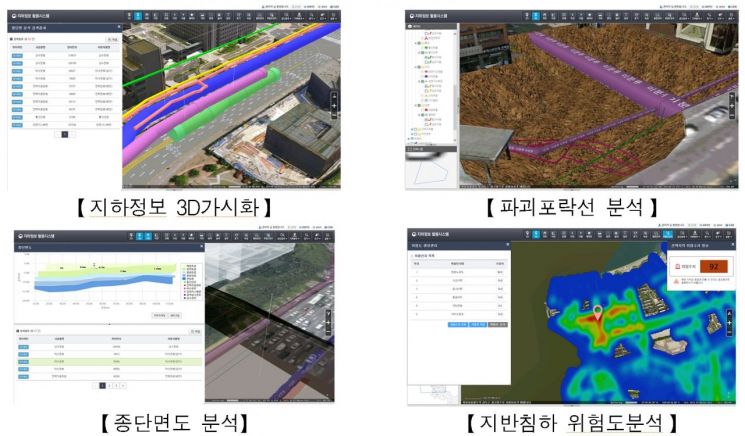 3D model-based integrated underground space map. Provided by the Ministry of Land, Infrastructure and Transport
As the Seoul Metropolitan Government has kept its self-produced "Ground Subsidence Safety Map" confidential, public anxiety is growing. Meanwhile, the Ministry of Land, Infrastructure and Transport has begun reviewing ways to provide information about high-risk areas to a certain extent.
At the emergency forum "What Is the Solution to the Successive Ground Subsidence Accidents?" held on the 24th by Park Yonggap, a member of the National Assembly Land, Infrastructure and Transport Committee from the Democratic Party of Korea, Park Dongju, Director of Construction Safety at the Ministry of Land, Infrastructure and Transport, stated, "The Seoul Metropolitan Government has created its own ground subsidence safety map, but has not disclosed it to the public, which has led to ongoing criticism." He added, "We are also reviewing, together with the Korea Infrastructure Safety and Technology Corporation, the criteria for selecting high-risk areas and setting exploration priorities." He continued, "Even if we do not provide a full map, we are considering how to disclose information in a way that will allow citizens to walk or drive with greater peace of mind."
In the "Second National Underground Safety Management Basic Plan (2025-2029)" announced at the end of last year, the Ministry of Land, Infrastructure and Transport stated that the Korea Infrastructure Safety and Technology Corporation would conduct joint ground surveys for local governments lacking sufficient personnel, budget, or equipment. After the forum, Director Park told reporters, "We are conducting ground-penetrating radar (GPR) surveys in consultation with local governments, starting with areas at high risk of ground subsidence. We are currently discussing to what extent the results should be made public." He further explained, "It is realistically difficult to create a detailed nationwide map, so we are focusing our surveys and management efforts on high-risk areas first."
He also mentioned, "We are considering using the 'Integrated Underground Space Map' established in 2022 to analyze the risk of ground subsidence and for ground surveys, especially to analyze the risk levels of densely clustered or aging pipeline sections." This map visualizes a total of 16 types of underground information in three dimensions (3D), including underground utilities such as water supply, sewage, telecommunications, electricity, gas, heating, and oil pipelines, as well as underground structures such as subways, underground walkways, shopping malls, and parking lots, and ground data such as drilling, wells, and geology. He stated, "Because information about underground installations could pose a risk of terrorism or security threats, this map is operated confidentially. However, it is provided only if the requester clearly states the purpose and specifies a particular area."
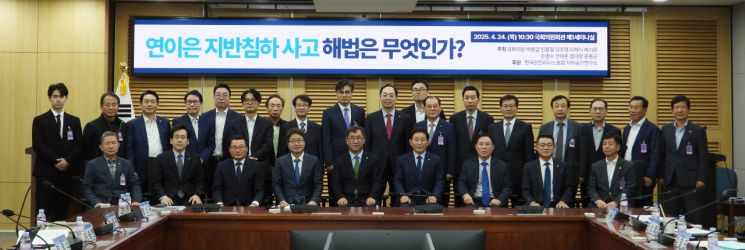 Members attending the emergency forum "What Is the Solution to the Successive Ground Subsidence Accidents?" held on the 24th by Park Yonggap of the Democratic Party, a member of the National Assembly Land, Infrastructure and Transport Committee, are taking a commemorative photo. Photo by Park Yonggap's office
At the forum, experts pointed out that "large-scale excavation work can directly disturb ground structures, potentially leading to subsidence accidents." Lee Ho, President of the Korea Underground Safety Association, stated, "All of the recent large-scale ground subsidence accidents occurred near excavation sites," and added, "As large construction projects such as the Greater Seoul Metropolitan Express Railway (GTX), which require digging as deep as 70 to 80 meters underground, increase, there are growing concerns that the larger the scale of development, the greater the potential damage from subsidence." Choi Myungki, a professor at the Korea Industrial Field Professors Association, said, "Subsidence is repeatedly occurring in areas where underground excavation work is taking place," and added, "It is difficult to explain these accidents with only aging water pipes as the cause."
Poor groundwater management was also cited as a major cause. Experts explained that when groundwater is removed, the water pressure supporting the ground decreases, making it more difficult for the ground to bear weight, which can lead to subsidence or collapse. Cho Bokrae, Director of the Underground Space Research Institute, said, "The apartments, buildings, and subways where we live and work are pumping out tens of thousands to hundreds of thousands of tons of groundwater every day," and added, "Since ground subsidence occurs during the process of pumping groundwater, we must prevent groundwater from being pumped out."
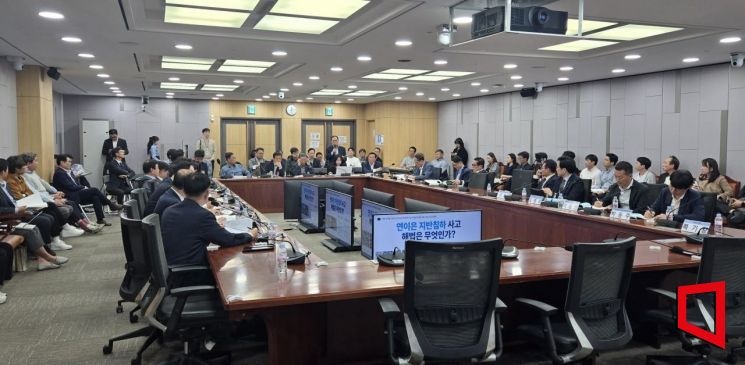 Park Yonggap, a member of the National Assembly Land, Infrastructure and Transport Committee from the Democratic Party, is speaking during the Q&A session at the emergency forum "What is the solution to the consecutive ground subsidence accidents?" held on the 24th. The forum lasted about two hours, and many attendees stayed until the end. Photo by Choi Seoyoon
An Dongkwon, CEO of CMSCO and a victim of the ground subsidence accident at Bugok Industrial Complex in Dangjin, Chungcheongnam-do, stated, "Groundwater outflow can only be detected by monitoring, but most sites use manual methods, which are susceptible to manipulation." He continued, "When I personally installed an automatic monitoring device at my own expense, I received immediate alerts even when only a small amount of water was lost, and I could check the situation in real time on my mobile phone 24 hours a day. If these devices were installed at intervals of 100 to 300 meters in each construction section, we could prevent casualties. I cannot understand why this is not being done." An explained that installing four automatic monitoring devices cost about 25 million won.
Despite nearly 190 ground subsidence accidents occurring annually, there was also criticism that the government lacks an integrated response system. Ahn Sangro, co-chairman of the Korea Safety Leaders Forum, said, "Even when disasters or accidents occur, there is no consistent command system," and emphasized, "A control tower such as a Presidential Disaster Safety Committee or a National Safety Agency is urgently needed." Choi Myungki, a professor at the Korea Industrial Field Professors Association, stated, "A dedicated underground safety organization is needed to take responsibility for the entire process, from receiving complaints to investigation and action."
© The Asia Business Daily(www.asiae.co.kr). All rights reserved.














