Premature Policies Revealed Without Official Campaign Review
Short-Term Election Groups Raise Questions Over Appointments and Costs
Calls Grow for Policy-Focused Think Tanks
There is growing attention on the think tank "Growth and Integration," which had drawn notice as the think tank for Lee Jaemyung, the Democratic Party's presidential primary candidate, as it has reportedly suspended its activities just eight days after its launch on the 24th.
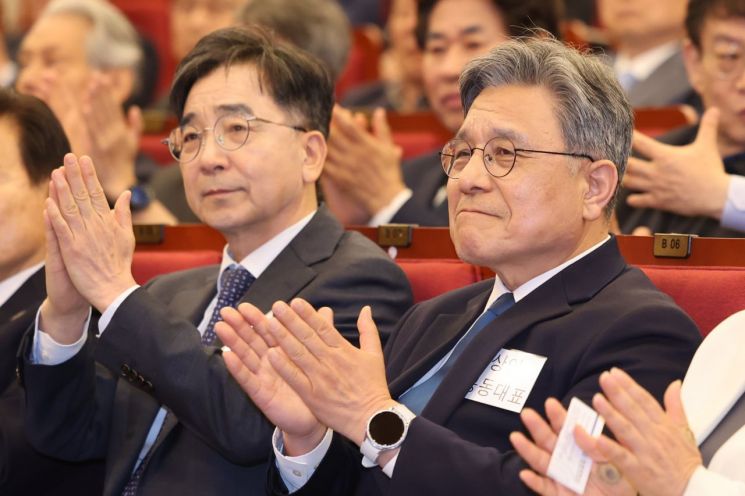 On the 16th, at the grand auditorium of the National Assembly Library in Yeouido, Seoul, Yoo Jongil (left) and Heo Min, co-executive directors, are applauding at the launch ceremony of the Democratic Party's former leader Lee Jaemyung's think tank "Growth and Integration." Photo by Yonhap News
Within "Growth and Integration," there are differing opinions as to whether this is a complete dissolution or a temporary suspension for organizational restructuring. However, regardless of the final decision, there is a prevailing view that it will be difficult for the think tank to resume normal operations.
At the time of its launch on the 16th, "Growth and Integration" attracted attention as a potential "talent pool" for the next administration, with the participation of over 500 experts and former and current officials from various fields, including Yoo Jongil, honorary professor at the KDI School of Public Policy and Management.
The group was initially launched under the pretext of leading a policy-driven election. However, as time passed, issues began to arise as discussions held within the think tank were reported externally as if they were official policies of Lee Jaemyung's campaign.
Within the Democratic Party, there were complaints that content not discussed with the official campaign was being packaged and spread as "pledges," potentially causing confusion among voters. There were also criticisms that this did not align with Lee's strategy of running a "quiet campaign." The situation was further complicated by unfounded rumors that some members of the think tank might be appointed to key positions in the next administration.
In response, it is reported that Lee's campaign indirectly conveyed its wish for "Growth and Integration" to refrain from further activities. The leadership also repeatedly issued messages expressing concern about premature policies being reported through unofficial channels rather than the official policy committee, effectively issuing indirect "warnings" aimed at private think tanks.
Within political circles, this case is being analyzed as a clear example of the limitations of think tanks formed for short-term activity during the presidential election season. On the other hand, some argue that, given the nature of the next administration, which may have to launch without a transition committee due to the early presidential election, the emergence of think tanks centered on scholars and officials is inevitable. However, there is stronger support for the assessment that unvetted ideas being perceived as the official stance of the campaign can lead to a reversal of priorities and pose a greater "risk" than expected. Some also argue that, rather than think tanks operated for a short period before elections, there is a need for long-term policy research organizations like the Brookings Institution or the Heritage Foundation in the United States, which can conduct sustained policy research and have a real impact on policy implementation.
© The Asia Business Daily(www.asiae.co.kr). All rights reserved.

![Clutching a Stolen Dior Bag, Saying "I Hate Being Poor but Real"... The Grotesque Con of a "Human Knockoff" [Slate]](https://cwcontent.asiae.co.kr/asiaresize/183/2026021902243444107_1771435474.jpg)















