Besant: "If China Wants Trade Rebalancing, Let's Do It Together"
Urges World Bank to Stop Lending to China
On Reports of Tariff Reductions: Mentions "Reciprocal Reductions"
U.S. Treasury Secretary Scott Besant stated that there is an opportunity for a "big deal" between the United States and China, which are currently engaged in a tariff war. However, he clarified that the United States has never unilaterally proposed reducing tariffs on China.
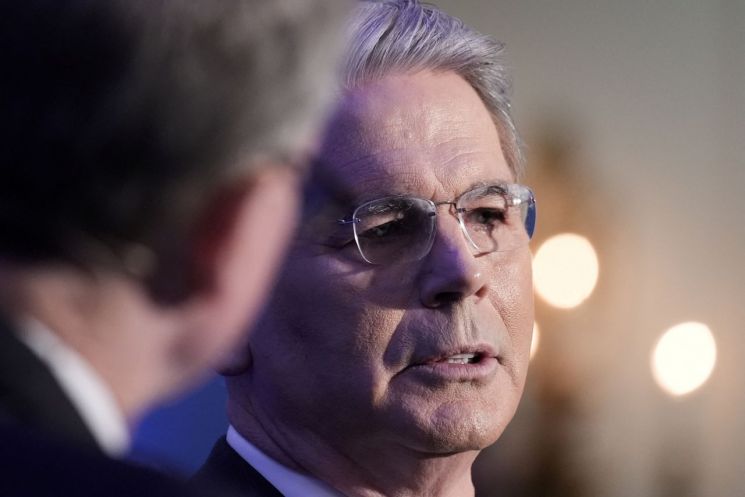
On the 23rd (local time), speaking at a dialogue hosted by the Institute of International Finance (IIF) in Washington, D.C., Secretary Besant said, "If they (China) want (trade) rebalancing, let's do it together."
He added, "This is truly an amazing opportunity," and remarked, "If Ray Dalio, the founder of Bridgewater, were to write something about this, he would call it a beautiful rebalancing."
Previously, on the 13th, Dalio warned in an NBC News interview that President Trump's tariff and economic policies threaten the global economy and could lead to a situation "more serious than a recession."
Secretary Besant's remarks on this day can be interpreted as an optimistic outlook on the possibility of reaching a comprehensive agreement regarding the U.S.-China trade war, which has taken on the characteristics of a game of chicken. The previous day, he had also delivered a conciliatory message, stating that the U.S.-China tariff war is unsustainable and that "the situation will ease in the very near future."
Secretary Besant said, "More than 100 countries have approached us to help rebalance global trade," adding, "We are engaged in meaningful discussions. We also look forward to discussions with China and others."
Additionally, he presented a "blueprint for restoring balance" that calls for redefining the roles of the International Monetary Fund (IMF) and the World Bank (WB). He urged that these two organizations should return to focusing on their core mandates of macroeconomic stability and development, rather than becoming overly involved in issues such as climate change.
He stated, "The IMF and WB have strayed from their course due to mission expansion, but the Bretton Woods institutions must implement key reforms to serve their stakeholders. Due to the deliberate policy choices of other countries, U.S. manufacturing has declined and major supply chains have been damaged, putting our national and economic security at risk."
He particularly called for the WB to stop lending to major economies like China. He also pointed out that it is unreasonable to classify China, the world's second-largest economy, as a developing country.
Secretary Besant emphasized, "This diverts resources that should be allocated to higher-priority projects and hinders the development of private markets," and added, "The WB must establish a clear graduation schedule for countries that met the graduation criteria long ago."
Later, speaking with reporters, Secretary Besant stated that President Trump would never unilaterally propose lowering tariffs on China. On the same day, The Wall Street Journal (WSJ) reported that President Trump is considering reducing tariffs on China from the current 145% to between 50% and 65%.
When asked by reporters whether President Trump had proposed lowering tariffs on China, he replied, "Absolutely not," and added, "As I have said many times, the current tariff levels are not sustainable for either side. So it would not be surprising if both sides were to lower tariffs in a reciprocal manner." This suggests that the United States and China could simultaneously reduce their tariff rates.
© The Asia Business Daily(www.asiae.co.kr). All rights reserved.
!["The Woman Who Threw Herself into the Water Clutching a Stolen Dior Bag"...A Grotesque Success Story That Shakes the Korean Psyche [Slate]](https://cwcontent.asiae.co.kr/asiaresize/183/2026021902243444107_1771435474.jpg)
















