Signaling Easing of China Tariffs Amid Comprehensive Crisis
All Three Major New York Indexes Surge Sharply
On April 22 (local time), President Donald Trump emphasized optimism regarding trade negotiations with China and stated that he would not dismiss Jerome Powell, the Chair of the U.S. Federal Reserve (Fed). As stock prices plunged and a wave of "Sell America" sentiment swept through U.S. Treasuries and the dollar, President Trump appeared to take a more conciliatory stance. Following his remarks, expectations for market stabilization grew, and all three major New York stock indexes surged by more than 2% on the day.
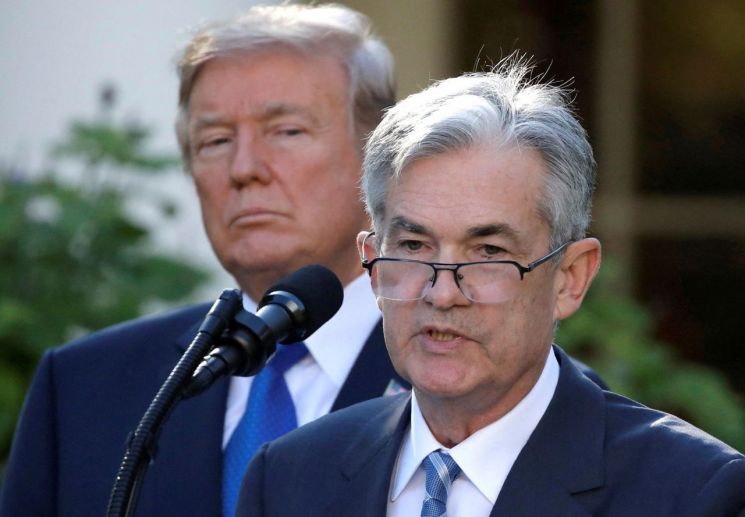
Tariffs on China "Will Drop Significantly"... Dismisses Powell Firing Rumors
At a ceremony in the White House Oval Office that afternoon for the appointment of Paul Atkins as Chairman of the U.S. Securities and Exchange Commission (SEC), President Trump acknowledged to reporters that the 145% tariff on Chinese goods was "very high." He added that if negotiations proceed, "it will not remain that high, and it will drop significantly." However, he also noted, "It will not go to zero (0%)." This suggests that the intense U.S.-China tariff war could enter a thaw depending on the negotiation outcomes. He repeatedly mentioned having a good relationship with Chinese President Xi Jinping, and assessed that negotiations with China are "going well."
Scott Besant, Secretary of the Treasury and head of the Trump administration's external trade negotiations, also reinforced the optimistic outlook by expressing a positive view on trade talks with China. According to Bloomberg, at a private investor event hosted by JP Morgan, Secretary Besant said that the stalemate with China caused by tariffs is not sustainable and that he expects the situation to de-escalate.
President Trump dismissed rumors that he was pushing to fire Chair Powell, which had fueled market instability. He said, "I have no intention of removing him," but added, "I wish he would be more proactive with the idea of cutting rates." By stating this publicly, he effectively guaranteed Powell's term until May of next year.
Nevertheless, he once again urged the Fed to cut rates. He reiterated that prices for groceries and other goods had fallen, stating, "The Fed should lower rates. Now is the right time," and added, "We want the Fed Chair to act early, not late."
Until just the previous day, President Trump had sharply criticized Chair Powell, calling him a "loser" and "Mr. Too Late," and pressed him to lower interest rates. On April 17, he said, "If I wanted him (Chair Powell) to resign, he would step down very quickly," applying pressure for Powell to quit. In response, Chair Powell consistently stated that he would serve his full term and maintained his position that he would determine the rate path only after confirming the impact of tariffs.
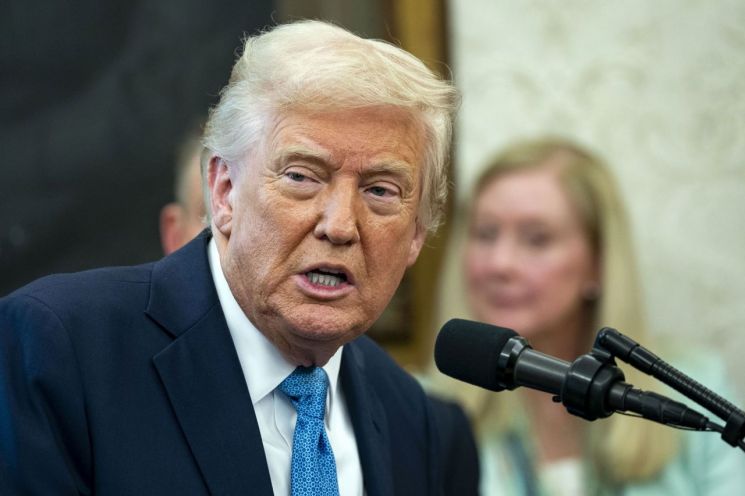
Trump Moves to Contain Triple Weakness in U.S. Stocks, Treasuries, and Dollar... All Three Major New York Indexes Surge Over 2%
President Trump's sudden change in attitude appears to be a self-rescue measure to contain the aftermath of the "tariff bombardment," which led to a triple weakness in U.S. stocks, Treasuries, and the dollar. When President Trump once again pressed for a rate cut and clashed with Chair Powell the previous day, the market became apprehensive. The combination of uncertainty over tariff policy and concerns about intervention in monetary policy led not only stocks but also safe assets such as Treasuries and the dollar to weaken. The value of the dollar fell to its lowest level in three years.
Mark Spindel, head of an investment management firm and co-author of a history of Fed independence, warned, "He (President Trump) realized that firing Chair Powell would be a fatal own goal," adding, "If the Fed's independence is undermined, investors will worry that the central bank cannot set rates autonomously, which could sharply increase borrowing costs for households, businesses, and the government."
With optimism over U.S.-China trade negotiations and the resolution of the controversy over Fed independence, the New York stock market rebounded and closed higher. The Dow Jones Industrial Average (Dow) ended the session at 39,186.98, up 1,016.57 points (2.66%) from the previous close. The S&P 500 index rose 129.56 points (2.51%) to 5,287.76, and the tech-heavy Nasdaq Composite closed at 16,300.42, up 429.52 points (2.71%).
The Wall Street Journal (WSJ) analyzed, "President Trump gave relief to investors unsettled by the White House's recent hardline actions by stating he has no plans to fire Chair Powell and suggesting that tariffs on China could be lowered."
© The Asia Business Daily(www.asiae.co.kr). All rights reserved.

![A Woman with 50 Million Won Debt Clutches a Stolen Dior Bag and Jumps... A Monster Is Born [Slate]](https://cwcontent.asiae.co.kr/asiaresize/183/2026021902243444107_1771435474.jpg)
















