"Five Mega-Polis Candidate Sites?
Careful Deliberation Needed"
Han Donghoon, former leader who advanced to the second round of the People Power Party presidential primary, commented on reaching the legal fundraising limit of approximately 2.9 billion won within just 11 hours of starting the campaign, saying, "I am truly surprised and feel a sense of awe," and added, "I will deeply reflect on what this means."
On the KBS radio program 'Jeonggyeok Sisa' on the 23rd, Han said, "It wasn't one or two major donors who contributed large sums, but rather, the average donation was about 80,000 won," and continued, "I'm not even the sole candidate of the party, so I was very surprised that so many people came together to support me. I will work hard."
Regarding his strategy for the second round of the People Power Party primary scheduled for the 29th, he emphasized, "I will do my utmost to secure a majority of the votes so that we can move directly to the final election without a runoff." Han explained, "If no candidate wins a majority in the four-person race, a runoff will be held, and many people are concerned that this could lead to lingering wounds and conflict among candidates," adding, "I will do my best so that we can face Lee Jaemyung and the Democratic Party without a runoff." This is interpreted as a concern about negative campaigning among candidates as the runoff atmosphere intensifies.
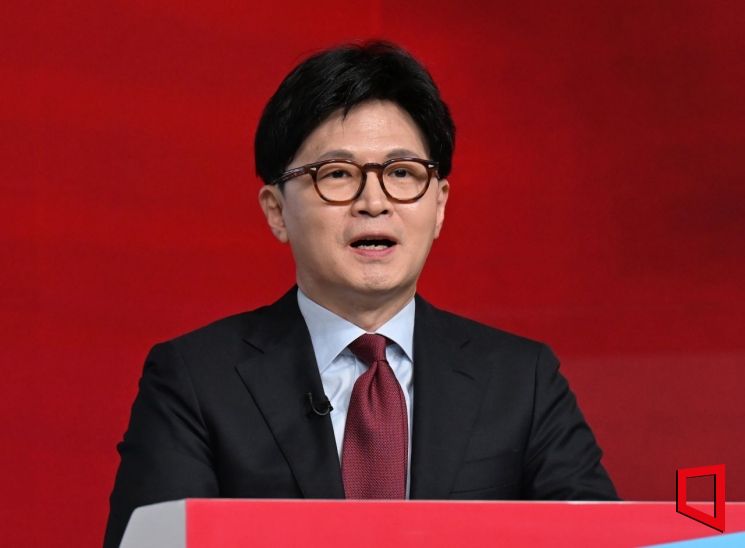 On the 20th, candidate Han Donghoon of Group B is speaking at the first round group debate for the 21st presidential candidate of the People Power Party held at ASSA Art Hall in Gangseo-gu, Seoul. Photo by National Assembly Press Photographers Group
Regarding his major pledge, the 'Five Mega-Polis Strategy,' he explained, "One of the major problems in Korea is the concentration in Seoul and the capital region," and continued, "Simply relocating public institutions to the regions as a central government measure has failed so far. The policy is to create five Seouls nationwide and focus strategies on them." He added, "The idea is to attract proper industries, create a livable environment, and nurture advanced talent. We should establish several mega-polises centered on major cities and apply regulatory exemptions only to those regions. For each area, such as AI, bio, energy, future vehicles, and semiconductors, we will create special zones and completely abolish related industrial regulations only in those regions."
He further stated, "When trying to relocate specific companies to a region, persuasion and pressure are often needed, but if there are special regulatory benefits limited to that area, companies will be willing to move. The UK has a regulatory free zone system, and the Boston bio cluster in the US is a successful example," he added. However, regarding the candidate locations for the five mega-polises, he said, "We will listen to local voices and make careful decisions."
Regarding the 'incorporation of Gimpo City into Seoul,' which the People Power Party promoted during last year's 22nd general election, he said, "It can be reconsidered," and explained, "We are in an era where mega-cities are growing, and surrounding areas develop under their influence." Han emphasized, "Gimpo City in Gyeonggi Province is, in effect, part of the Seoul living area, and many Gimpo residents want this as well," adding, "When it comes to local governance issues, it is extremely important to reflect the will of the residents."
© The Asia Business Daily(www.asiae.co.kr). All rights reserved.












