Jahyung Yoo's Team Develops Protein Degradation Technology with Enhanced Targeting of Cancer Cells
Reduction in PD-L1 Protein Levels and Tumor Size, Published in Advanced Science
A technology has been developed that destroys cancer cells by degrading the proteins they use to evade immune attacks.
A research team led by Professor Jahyung Yoo from the Department of Chemistry at UNIST has developed a complex assembly technology that degrades proteins used by cancer cells for immune evasion.
 Research team (clockwise from top left): Dohyun Kim, Researcher (first author), Jahyung Yoo, Professor, Kyungsuk Yang, PhD (first author), Jaemo Lee, Researcher, Yoojung Shim, PhD, Gaeun Park, Researcher. Provided by UNIST
The principle involves trapping immune evasion proteins inside the complex and delivering them to lysosomes, where protein degradation occurs. This is expected to create an environment in which the immune system can recognize and eliminate cancer cells, thereby enhancing the effectiveness of cancer treatment.
Cancer cells produce more of a protein called PD-L1 than normal cells and display it on their surface. This protein sends a "do not attack" signal to immune cells, allowing cancer cells to evade the body's immune surveillance and proliferate rapidly.
The research team developed a technology based on acetazolamide that selectively degrades only the PD-L1 of cancer cells. Acetazolamide binds to the CAIX enzyme, which is distributed on the surface of cancer cells, forming a protein nano complex that brings immune evasion proteins like PD-L1 into the cell. Once inside, the nano complex is recognized as an abnormal protein and is degraded in the lysosome, the cell's waste disposal organelle. Since the CAIX enzyme is almost absent in normal cells, this reaction occurs only in cancer cells.
Cancer cells that have lost the PD-L1 protein become targets of immune cell attacks. In animal experiments using mice, the group injected with this complex showed a reduction in tumor size to less than half, and the level of PD-L1 protein also decreased significantly.
Dohyun Kim, the first author, explained, "We plan to further investigate the pathways through which the immune system directly attacks cancer."
There have previously been technologies that degrade such proteins. These include technologies using chimeric molecules known as PROTAC or LYTAC. Chimeric molecules, like the mythical creature Chimera?a combination of a lion, goat, and snake?are multifunctional molecules composed of several functional components. Typically, they consist of a molecule that targets the specific protein and another that induces protein degradation.
However, these chimeric molecules are often large and have difficulty entering cells, or their complex structures limit their design and synthesis. In this study, the researchers proposed a new method that allows the molecules to self-assemble in the body, overcoming the limitations of existing technologies.
Professor Jahyung Yoo stated, "This is a new form of targeted protein degradation technology that overcomes the limitations of conventional polymer-based chimeric technologies," adding, "In the future, it could be used in combination with immuno-oncology drugs or applied to the treatment of various intractable solid tumors."
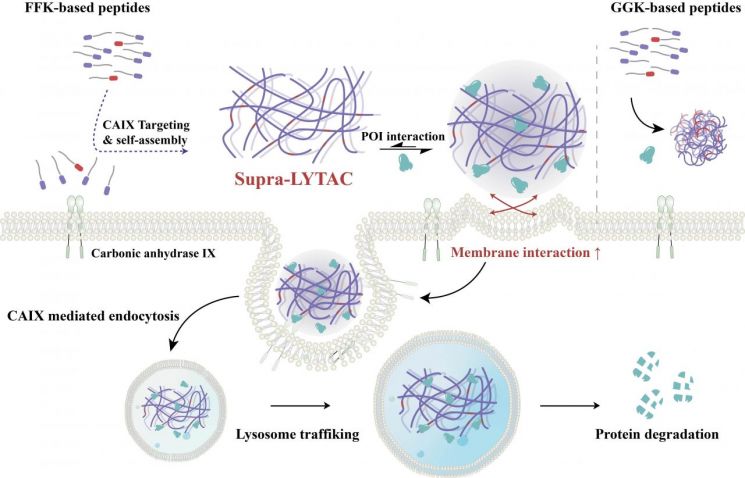 In vivo formation process of a nano complex targeting cancer-specific enzymes and the mechanism of immune barrier protein degradation.
The research results were published in the international journal Advanced Science on April 3, 2025. The study was supported by the Ministry of Science and ICT and the National Research Foundation of Korea.
© The Asia Business Daily(www.asiae.co.kr). All rights reserved.

![Clutching a Stolen Dior Bag, Saying "I Hate Being Poor but Real"... The Grotesque Con of a "Human Knockoff" [Slate]](https://cwcontent.asiae.co.kr/asiaresize/183/2026021902243444107_1771435474.jpg)
















