Lee's Pledge to Establish a Public Medical School Faces Skepticism from Medical Community
"Even the Moon Administration Failed with This Policy"
"Intent Is Understood, but Efficiency Compared to Investment Is in Question"
Lee Jae Myung, the Democratic Party of Korea's presidential primary candidate, has unveiled a set of healthcare policy pledges that include determining the scale of medical school enrollment increases through social consensus and establishing a public medical school. This has put the medical community on high alert. There are concerns that if the Democratic Party succeeds in a change of government in the early presidential election scheduled for June, the ongoing conflict between the government and medical professionals?sparked by the Yoon Suk Yeol administration's expansion of medical school admissions and lasting for nearly 15 months?could shift to a new controversy over the pros and cons of establishing a public medical school.
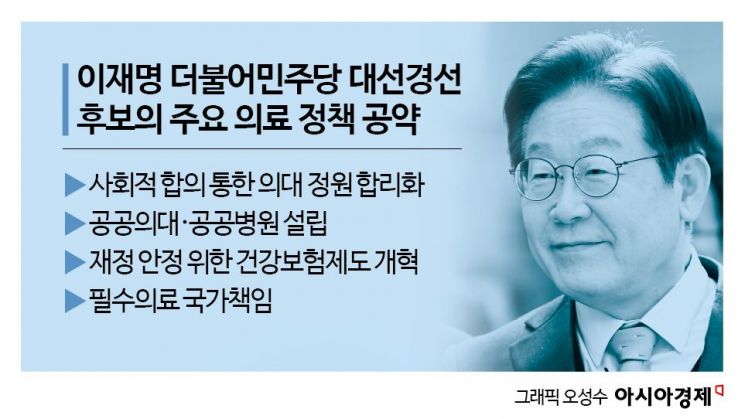
According to political circles and the medical community on the 23rd, Lee's healthcare policy statement, released the previous day, only mentioned "rationalizing medical school admissions quotas" without specifying any concrete numbers or plans. While he left open the possibility of increasing admissions, it appears he intends to delegate the task of finding a compromise to the Medical Workforce Supply and Demand Estimation Committee, which is currently being formed.
Lee stated, "The recent medical crisis left everyone in pain. The government's unilateral decision closed the door to dialogue with the medical community, and ultimately, the public suffered the most. Now, we must end conflict, confrontation, and political strife, and everyone must come together with a focus on the lives and health of the people." While criticizing the prolonged government-medical community conflict?which is considered a major failure of the previous administration?and emphasizing the distinctiveness of his policies, Lee has refrained from disclosing specific figures for the enrollment increase, likely in an effort to avoid provoking backlash from the medical community ahead of the election.
Lee also pledged to "strengthen public healthcare," stating, "We will establish a public medical school to train public, essential, and regional medical personnel, and expand public hospitals equipped with next-generation public healthcare systems based on digital infrastructure." He added, "The state will take responsibility for essential medical services such as emergency care, childbirth, and trauma treatment, and will reduce regional disparities in healthcare. To ensure the stability and efficient use of the National Health Insurance Fund, we will reform the health insurance system and strengthen the medical system to prioritize and guarantee patients' rights and safety."
The public medical school mentioned by Lee was a policy proposed by the Moon Jae In administration in 2018 but abandoned due to fierce opposition from the medical community. At the time, the government planned to establish a public medical school in Namwon, North Jeolla Province, with the goal of opening in 2022, and to require graduates to work for at least 10 years in regional public medical institutions. The government tried to persuade the medical community by explaining that it would use the admissions quota (49 students) from the now-closed Seonam University Medical School, so there would be no net increase in medical school admissions, but the plan ultimately fell through. In 2020, the government again proposed establishing a public medical school as part of a plan to increase medical school admissions by 400 students per year for 10 years (a total of 4,000 students), but this was met with large-scale strikes by doctors and was not realized.
Lee also announced the same pledge during the 2022 presidential election. The Democratic Party also introduced the "Act on the Establishment and Operation of Public Health Medical Schools" last year and has recently been accelerating efforts to pass the bill. The core of the bill is to require students who graduate from public health medical schools and graduate schools to serve in medical institutions in underserved areas for 10 years.
Civil society organizations have also consistently called for the establishment of a public medical school. On the 21st, the Korean Health and Medical Workers' Union included "the introduction of a regional doctor system and the establishment of a public medical school" as one of its top 10 policy demands at a press conference calling for these to be adopted as presidential campaign pledges.
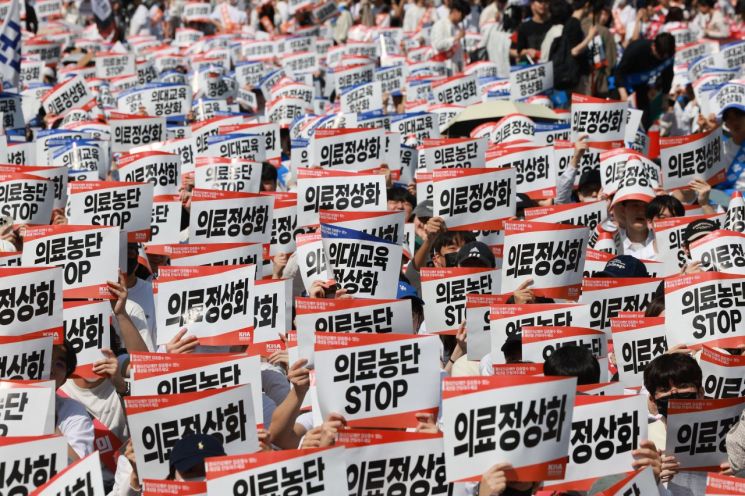 On the 20th, near Sungnyemun in Jung-gu, Seoul, the Korea Medical Association held the "National Doctors' Rally for Medical Normalization" on Sejong-daero. Participants shouted slogans condemning the government's medical school expansion policy and the operation of the Special Committee on Medical Reform. Photo by Yonhap News
Medical Community: "Even if Established, It Will Take 10 Years to Produce Doctors"
The medical community partially agrees with the intent and necessity of the public medical school proposed by Lee, but sees it as a difficult task to realize, given that previous administrations also had to back down in the face of strong opposition from doctors. Moreover, they argue that since the establishment of a public medical school itself means an additional increase in medical school admissions, it is difficult to discuss the two issues separately.
Kim Sung Geun, spokesperson for the Korean Medical Association, said, "Lee is talking about a major agenda, not presenting specific plans, so it's too early to state our position. Looking at the agenda itself, it cannot be said to be wrong. Public healthcare and regional healthcare are both important issues for the medical community as well."
Jung Jae Hoon, professor of preventive medicine at Korea University College of Medicine, pointed out, "Expanding public hospitals can serve as the foundation for a national responsibility system for essential medical services, but if we increase the number of hospital beds without addressing the already excessive and distorted bed structure, overall demand and expenditure may simply explode. We must first consider converting existing private hospital beds to essential medical services or reallocating the functions of large hospitals. It is essential to conduct a thorough cost-benefit analysis to determine how much expanding public hospitals will improve accessibility and equity, and at the same time, how much it may reduce efficiency."
Professor Jung added, "Establishing a public medical school is a long-term response at best. Even if a public medical school is established, it will take more than 10 years to actually produce doctors, and it is difficult to predict how factors such as regional depopulation and fiscal deterioration will affect the situation during that time."
Park Eun Cheol, professor of preventive medicine at Yonsei University College of Medicine, advised, "Given that about 230 national and public hospitals across the country are already not functioning properly, I am skeptical about how much public health will actually improve relative to the investment if we simply build more public hospitals. Rather than increasing the number of public hospitals, it may be more efficient to support private hospitals that are already serving public roles so that they can fulfill those roles more effectively."
A medical student attending a university in Seoul commented, "Many people around me are reminded of 2020 when they hear about Lee's healthcare policy pledges. If Lee's policy is 'Moon Jae In Care Season 2,' it will inevitably face backlash from the medical community. Policies that simply increase the number of doctors and impose obligations, selection processes that ignore fairness, and a lack of sufficient communication with professional groups are unlikely to be realized."
© The Asia Business Daily(www.asiae.co.kr). All rights reserved.













