Two Months After the White House Summit
"Reviewing Progress in Bilateral Relations"
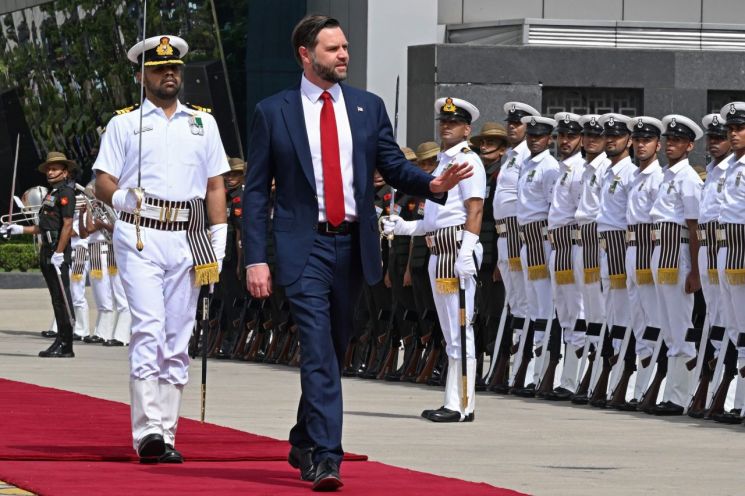 J.D. Vance, Vice President of the United States, is walking under the escort of an honor guard after arriving at Indira Gandhi International Airport in New Delhi, India, on the 21st (local time). Photo by AFP Yonhap News
As the United States and India are engaged in negotiations to conclude a trade agreement, U.S. Vice President J.D. Vance visited India on the 21st (local time), according to reports by AP and the Hindustan Times.
Arriving in India on the morning of the same day for a four-day, three-night visit, Vice President Vance is scheduled to meet with Indian Prime Minister Narendra Modi at the Prime Minister's residence in New Delhi in the afternoon to discuss bilateral trade issues and geopolitical relations.
The Indian Ministry of External Affairs stated on the 16th, "Vice President Vance's visit will provide an opportunity to review the progress in bilateral relations and the implementation of the India-U.S. joint statement announced during Prime Minister Modi's visit to the United States." The ministry also noted that the two sides would exchange views on regional and international issues.
Vice President Vance's visit to India comes approximately two months after the summit between U.S. President Donald Trump and Prime Minister Modi held at the White House in February.
At that time, the two leaders agreed to begin negotiations with the goal of concluding a trade agreement to reduce the U.S. trade deficit. India also pledged to expand purchases of U.S.-made weapons and increase energy imports from the United States.
President Trump and Prime Minister Modi have developed a close personal relationship, often described as a "bromance," since the first Trump administration. However, President Trump has strongly criticized India's high tariffs when it comes to trade issues.
India records an annual trade surplus of $45 billion (approximately 64 trillion won) with the United States. The U.S. government, after announcing the introduction of reciprocal tariffs worldwide, stated that it would impose a 26% reciprocal tariff on India, but on the 9th of this month, postponed its implementation for 90 days.
© The Asia Business Daily(www.asiae.co.kr). All rights reserved.