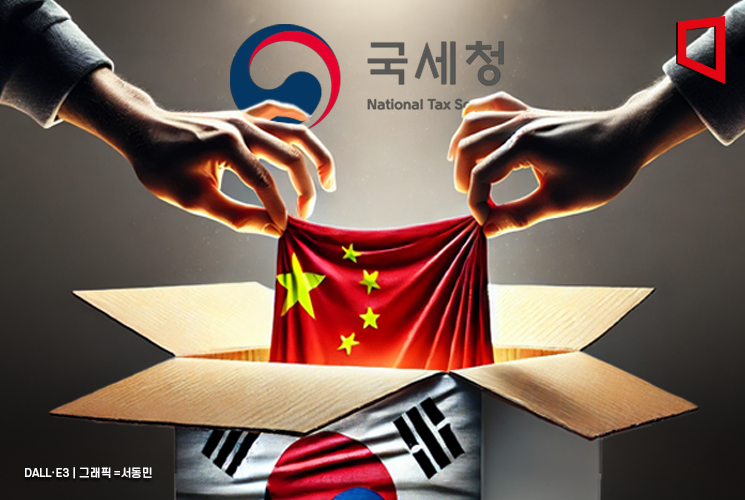
The Korea Customs Service is strengthening its crackdown on illegal circumvention exports. Illegal circumvention exports refer to cases where goods from countries with higher tariffs than Korea are routed through Korea, disguised as Korean-made products, and then exported to destinations such as the United States.
On April 21, the Korea Customs Service announced the launch of a Special Trade Security Investigation Team (hereinafter referred to as the Special Investigation Team) to intensify its crackdown on circumvention exports that exploit differences in U.S. country-specific tariff rates.
The Special Investigation Team will be established at the Korea Customs Service headquarters, with eight dedicated investigation teams set up at customs offices nationwide. The main targets of the crackdown are goods subject to high tariffs, such as those under U.S. anti-dumping duties and countervailing duties, as well as goods subject to import restrictions.
The Korea Customs Service plans to strengthen its crackdown due to concerns that illegal activities?such as relabeling and document forgery (falsification of country of origin)?will become more frequent in an attempt to evade tariffs and import restrictions on these goods.
Such circumvention exports via Korea have been frequent in the past. In fact, from 2021 to March of this year, the Korea Customs Service uncovered a total of 176 cases of illegal circumvention exports, amounting to 467.5 billion won. Previously, the main purposes of circumvention exports were to evade anti-dumping duties, avoid high tariff rates, circumvent import restrictions, gain premium profits from Korean-made products, and, in some cases, to leak strategic materials or core technologies from the exporting country.
However, recent changes in U.S. trade policy are expected to increase attempts to evade different countervailing duties and import restrictions imposed by each country.
As evidence of this trend, in November of last year, a case was uncovered in which a Chinese national used a company established in Korea to bring 1.2 million Chinese-made mattresses (worth 74 billion won) into the company's bonded warehouse. Export documents, including re-export declaration certificates and certificates of origin, were then falsified to claim the goods were Korean-made in an attempt to export them illegally.
In another case this January, to avoid high tariffs on Chinese products, a Chinese national used a company established in Korea to import cathode materials for secondary batteries (subject to a 25% tariff) into Korea, changed the packaging, disguised the country of origin as Korean, and attempted to export them illegally to destinations such as the United States.
In March of this year, there was a continued trend of cases where parts such as intelligent CCTV components were imported from China, assembled in Korea, and then illegally exported by disguising the country of origin as Korean-made.
In response, the Korea Customs Service plans to strengthen its crackdown by having the Special Investigation Team share risk information with related agencies through the "Joint Public-Private Meeting for Crackdown on Circumvention Exports to Protect Domestic Industry." This will establish a system of information-sharing and cooperation, as well as expand joint investigations and information cooperation with domestic and international intelligence agencies.
The joint meeting, presided over by Lee Myunggu, Deputy Commissioner of the Korea Customs Service, included the Special Investigation Team, the U.S. Homeland Security Investigations (HSI), U.S. Customs and Border Protection (CBP), and major industry associations affected, such as the Korea Iron & Steel Association, Korea Nonferrous Metals Association, and Korea Customs Logistics Association.
Koh Kwanghyo, Commissioner of the Korea Customs Service, stated, "There are growing concerns that acts of disguising the country of origin of foreign-made products as Korean-made and exporting them through circumvention will increase." He pointed out, "Such acts can undermine the external credibility of Korean export goods, leading to expanded non-tariff barriers such as strengthened import restrictions and customs inspections by importing countries."
He added, "Going forward, the Korea Customs Service will take the lead through the Special Investigation Team in conducting intensive crackdowns on circumvention exports, country-of-origin laundering, and technology leakage, while also actively supporting domestic companies by providing preemptive risk assessments."
© The Asia Business Daily(www.asiae.co.kr). All rights reserved.
![User Who Sold Erroneously Deposited Bitcoins to Repay Debt and Fund Entertainment... What Did the Supreme Court Decide in 2021? [Legal Issue Check]](https://cwcontent.asiae.co.kr/asiaresize/183/2026020910431234020_1770601391.png)