'Bucheon and Incheon Sejong Hospitals' perform over 1,400 heart surgeries annually
Cardiology specialists on-site 24/7 and operate a 'Cardiovascular Network'
"Appropriate compensation is needed for hospitals responsible for regional and essential medical care"
On April 16, a man in his 50s who was intubated at a hospital in Asan, South Chungcheong Province, exhibited symptoms of acute moderate mitral regurgitation and was transferred to the emergency medical center at Bucheon Sejong Hospital. Mitral regurgitation is a condition in which the mitral valve between the left atrium and left ventricle of the heart does not close properly, causing blood to flow backward. When it occurs acutely due to a myocardial infarction or infectious endocarditis, patients often complain of shortness of breath and their condition can deteriorate rapidly. Dongjin Kim, chief of the hospital’s department of cardiovascular and thoracic surgery, and Dalsu Lim, chief of cardiology, quickly diagnosed the patient. The next day, they successfully performed mitral valve replacement and tricuspid valve repair. The patient recovered so quickly that the breathing tube was removed on the day of surgery and he was transferred to a general ward. He is currently receiving medical treatment.
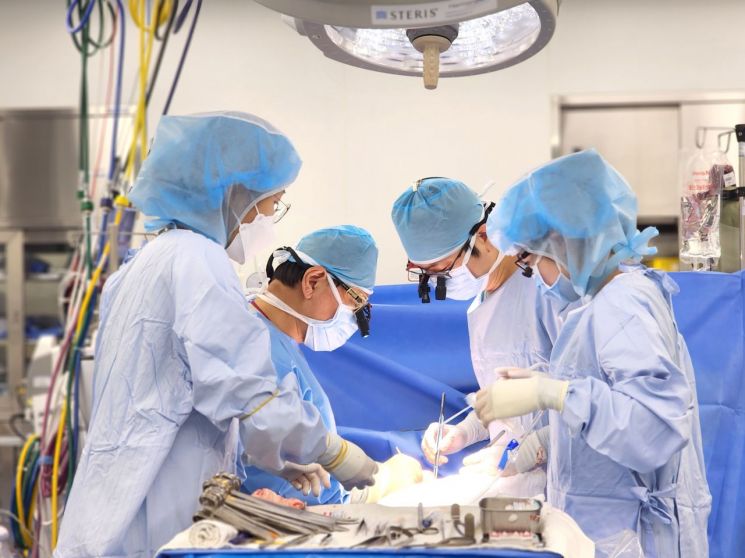 Medical staff at Incheon Sejong Hospital are performing surgery on a patient with heart disease. Sejong Hospital
Heart disease is a medical emergency in which every second counts. The chances of survival increase significantly if the patient arrives at the hospital as soon as possible and receives appropriate treatment or surgery. In South Korea, more than 30,000 people die from heart disease each year, making it the second leading cause of death after cancer. Bucheon Sejong Hospital is the only 'specialized heart hospital' in the country. Incheon Sejong Hospital, which is also part of the Hyewon Medical Foundation, is likewise specialized not only in essential medical services, but also in the treatment of severe and emergency heart disease and heart transplantation. Both hospitals were designated last year as 'regional responsible medical institutions' for providing high-quality essential medical care to their communities.
Jinsik Park, chairman of Sejong Hospital, told reporters on April 17, "We are the only hospital in Korea where cardiologists, thoracic surgeons, and pediatric cardiologists are on-site 24 hours a day. As a result, emergency patients diagnosed with myocardial infarction or aortic dissection are brought here from all over the country, and severe patients whose condition has worsened to the point that university hospitals can no longer treat them are also transferred to us. Although there are not many hospitals nationwide capable of performing heart surgery, our hospital is on par with Seoul's 'Big 5' hospitals (Samsung Seoul, Seoul National University, Seoul St. Mary's, Asan Medical Center, and Severance) when it comes to cardiac care," he said with pride. Last year alone, Bucheon Sejong Hospital successfully performed about 1,000 heart surgeries (both open and non-open heart surgeries) and 5 heart transplants, while Incheon Sejong Hospital performed 425 heart surgeries and 15 heart transplants, all with successful outcomes.
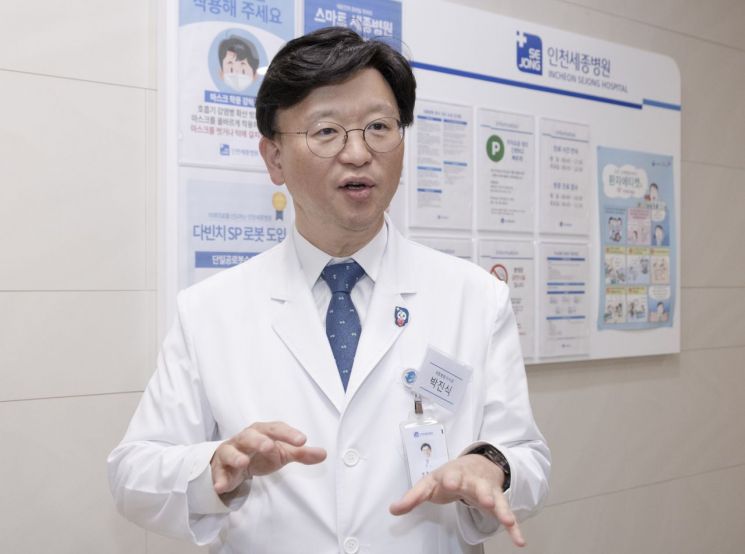 Jinsik Park, Chairman of Sejong Hospital, is answering reporters' questions at Incheon Sejong Hospital on the 17th. Ministry of Health and Welfare
The 'Sejong Cardiovascular Network (SJ-CCN),' operated by Bucheon Sejong Hospital as a central hub, plays a crucial role in this process. By establishing a cooperative treatment system with 43 secondary and tertiary medical institutions nationwide, the network eliminates complicated patient referral procedures for cases requiring cardiovascular and thoracic surgery. Patients are rapidly transported via a hotline both inside and outside the hospitals to receive appropriate treatment as quickly as possible. After successful surgery at Sejong Hospital, patients are returned to their original medical institutions for follow-up care according to their recovery progress.
Chairman Park explained, "The goal of the Sejong Cardiovascular Network is to ensure that patients with severe cardiovascular diseases always receive treatment within the golden hour. Based on the operational know-how we have accumulated, we plan to further streamline the patient referral and acceptance system, and through this, take responsibility for a key sector of essential medical care in Korea."
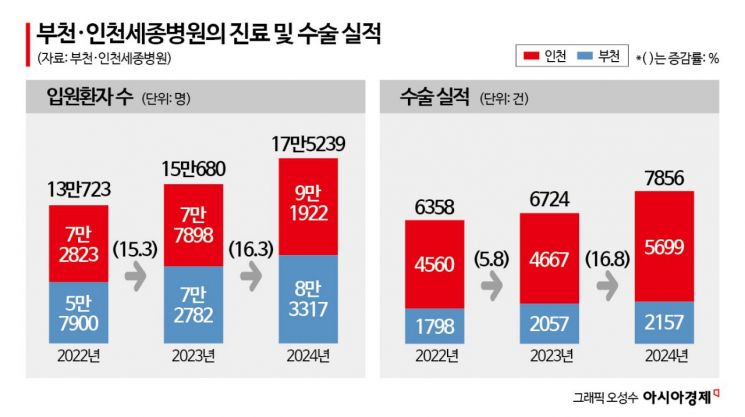
Incheon Sejong Hospital also performs a large number of surgeries and procedures for cerebrovascular diseases, which are closely related to heart disease, and since this year has taken on the role of a 'regional cardio-cerebrovascular disease center.' The hospital provides 24-hour acute-phase definitive treatment for cardio-cerebrovascular patients, operates a stroke intensive care unit with patient monitoring equipment comparable to an intensive care unit and staffed with specialized medical personnel, and has established a robust medical response system. In addition to cardiovascular and thoracic surgery and cardiology, the hospital operates 30 departments, including internal medicine, neurosurgery, orthopedics, and psychiatry, serving as a core institution for regional and essential medical care. As a result, even amid the collective resignation of medical residents that began last year, the hospital has absorbed local demand for emergency and outpatient care, helping to minimize medical service gaps. In 2024, the number of inpatients at Bucheon and Incheon Sejong Hospitals was 175,239, an increase of 16.3% over the previous year, while the total number of surgeries was 7,856, up 16.8%.
However, policy support remains insufficient. Under the current national health insurance reimbursement system, secondary hospitals (general hospitals) like Sejong Hospital receive less compensation than tertiary general hospitals for performing the same tests or procedures. Additional reimbursement for treating severe patients is also very limited compared to tertiary general hospitals.
Chairman Park said, "Although we are responsible for essential medical care in the community, the current reimbursement system makes it difficult to operate the hospital sustainably. We try to provide care within the reimbursed services as much as possible to minimize the financial burden on patients, but sometimes I am tempted to expand non-reimbursed services to improve the hospital's finances." He continued, "The government should establish an appropriate compensation system commensurate with hospitals specializing in severe care and strengthen working conditions necessary to maintain a 24/7, 365-day care system. In particular, the government should increase national support for the highly complex and rare field of pediatric cardiology and provide policy backing for the Sejong Cardiovascular Network."
Starting this year, the government plans to designate capable general hospitals that have comprehensive capabilities to solve regional healthcare problems in cooperation with tertiary general hospitals and perform essential services such as emergency care as 'comprehensive secondary hospitals,' investing 2 trillion won over three years.
Byunghee Oh, director of Incheon Sejong Hospital, suggested, "Secondary hospitals are originally supposed to serve as a bridge between primary and tertiary general hospitals, but in the case of heart and cerebrovascular diseases, our hospital can provide all necessary care. To ensure that patients and their families do not feel the need to seek out another tertiary general hospital, the government could, for example, subdivide and support specialized hospitals that perform highly complex medical procedures as tertiary general hospitals by medical field."
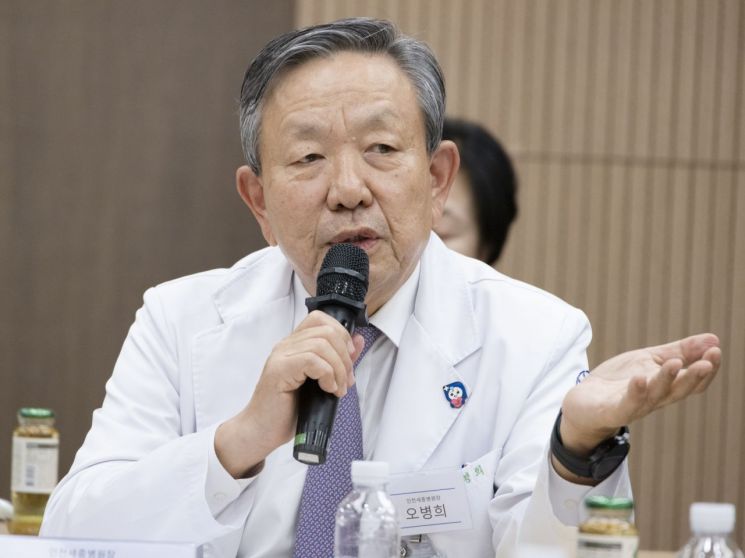 Oh Byunghee, director of Incheon Sejong Hospital, explained on the 17th about Incheon Sejong Hospital, which is the top level in the field of heart surgery and transplantation. Ministry of Health and Welfare
© The Asia Business Daily(www.asiae.co.kr). All rights reserved.














