Moon Hyungbae and Lee Miseon Retire on April 18... Emphasize the Constitutional Court's Mission of "Social Integration"
Diversifying the Composition of Justices, Deeper Dialogue, and Respect for Decisions Should Be Further Strengthened
State Institutions Urged to Comply with the Constitution... "Ad Hominem Criticism" Should Be Avoided Regarding Court Decisions
Behind the Record-Long Deliberation on Yoon's Impeachment: "Unanimity for Social Integration"
After completing their six-year terms and retiring on April 18, former Acting Chief Justice of the Constitutional Court Moon Hyungbae and former Justice Lee Miseon left behind the keywords of "tolerance," "restraint," and "social integration." They reflected on the unprecedentedly long deliberations?38 days?required to produce a unanimous decision on the impeachment of former President Yoon Seokyoul, which aimed to deliver a message of unity. They also emphasized that adherence to the Constitution by state institutions is a prerequisite for the existence of a liberal democratic nation. The messages they delivered resonated even more strongly in light of various controversies surrounding the presidential impeachment trial, related jurisdiction disputes, constitutional complaints, and public official impeachment cases.
In his farewell speech, which he memorized and delivered over three pages, former Acting Chief Justice Moon stated that, for the Constitutional Court to fulfill its constitutional mission of "social integration," three elements must be further strengthened: diversity in the composition of justices, deeper dialogue, and respect for decisions. This aligns with the "social integration function" explicitly stated in the Constitutional Court’s 2008 "Manual of Constitutional Adjudication Practice," and appears to reflect his own views as well.
The Constitutional Court has stated that, by functioning as the final bastion for peacefully realizing constitutional values within the constitutional order?rather than through power struggles among political forces?it opens a legitimate preventive channel before the state faces a crisis or the right to resist is exercised. In doing so, it acts as a catalyst for moderating the atmosphere of political confrontation and further activates the motivation for social integration.
Former Acting Chief Justice Moon first emphasized, "To avoid the pitfalls of groupthink and to examine issues from diverse perspectives, it is necessary to diversify the composition of justices." He suggested that the path to becoming a justice should be opened to constitutional researchers and professors with practical experience in constitutional law. This stems from the concern that a bench filled solely with career judges, who have spent their lives delivering verdicts from the bench, may find it increasingly difficult to set standards for the ever-diversifying social and political conflicts.
He also stressed the need to establish a rigorous process of debate based on diverse opinions before decisions are issued. There have been criticisms, both inside and outside the Constitutional Court, that the current short deliberation periods make it difficult to produce thoroughly reasoned outcomes. Moon stated, "Deeper dialogue is needed between justices, between the bench and the research department, and between current and former justices," adding, "This process should include listening to others’ opinions and, after listening, reflecting and revising one’s own views."
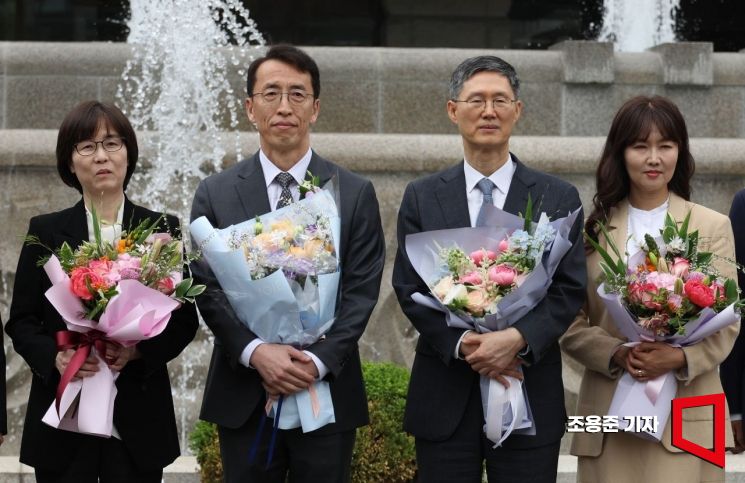 Moon Hyungbae, Acting Chief Justice of the Constitutional Court, and Lee Miseon, Justice, are entering to attend the retirement ceremony held at the Constitutional Court in Jongno-gu, Seoul on April 18, 2025. Photo by Jo Yongjun
"Avoid Ad Hominem Criticism... Constitutional Court Decisions Should Be Respected"
He also stated that "respect" is necessary regarding the decisions of the Constitutional Court. While academic criticism should naturally be allowed, he said, "Criticisms such as ad hominem attacks should be avoided." Ad hominem refers to the act of criticizing by pointing out a specific individual's career, tendencies, or ideology, and this comment is interpreted as a response to the attacks on justices that intensified during the impeachment trial of former President Yoon Seokyoul.
He continued, "According to the design of the Constitution, the Constitutional Court can resolve deadlocks by making factually and legally sound decisions in procedures such as jurisdiction disputes, and constitutional institutions can open the way to resolution by respecting those decisions." He added, "The path of the Constitution, based on checks and balances, will be further strengthened by respecting the decisions of the Constitutional Court."
He also pointed out that state institutions must respect the decisions of the Constitutional Court. During the impeachment trial of former President Yoon Seokyoul, Acting Presidents Han Ducksoo and Choi Sangmok withheld the appointment of justices elected by the National Assembly, citing the lack of bipartisan agreement. Justices Jung Gyesun and Cho Hanchang were eventually appointed on December 31 last year, but Justice Ma Eunhyuk was only able to take office on April 9, 104 days after being elected by the National Assembly. In the meantime, National Assembly Speaker Woo Wonshik filed a jurisdiction dispute against the acting president, and the Constitutional Court concluded that this constituted an unconstitutional act infringing on the National Assembly's right to elect justices. However, that was the extent of the response.
Although former Justice Lee Miseon did not directly cite specific cases in her farewell address, she stated, "State institutions must comply with the Constitution. This is the command of the sovereign people and a prerequisite for the existence of a liberal democratic nation." She added, "If state institutions fail to comply with or disregard the Constitution, the order that sustains our society may be shaken." She further requested, "I ask that the Constitutional Court, as it has always done, devote itself to protecting the basic rights of the people and to safeguarding and maintaining the constitutional order so that the normative force of the Constitution is not undermined."
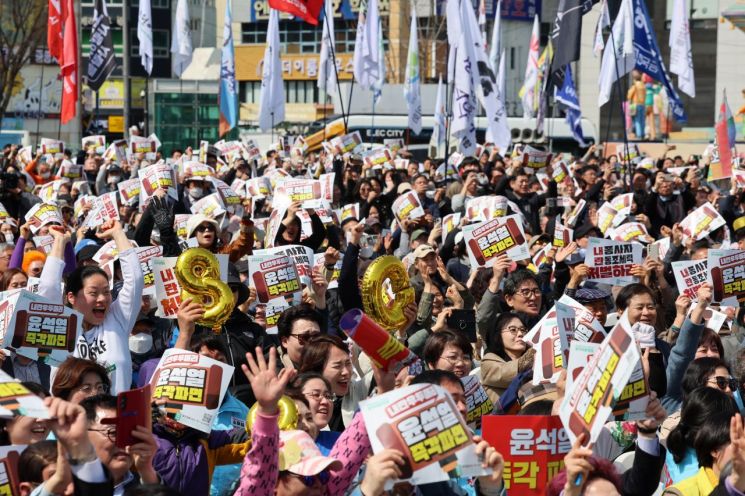
Unanimous Decision by Eight Justices After Lengthy Deliberation: "Tolerance and Restraint as Standards"
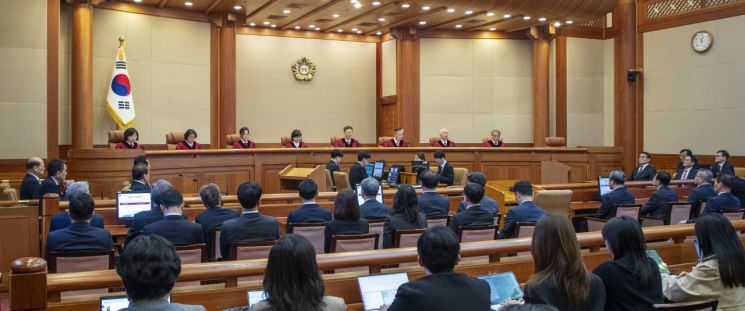
The "social integration" function of the Constitutional Court, mentioned by former Acting Chief Justice Moon in his farewell speech, was also a core value during the impeachment trial of former President Yoon Seokyoul. He explained the background of the record-long deliberation for the first time at a special lecture at Inha University on April 17, the day before his retirement ceremony. On April 4, 111 days after the National Assembly passed the impeachment motion, the Constitutional Court unanimously removed former President Yoon from office. The deliberation lasted 38 days after the conclusion of oral arguments, nearly three times longer than previous cases. During this period, unsubstantiated speculation and criticism from all sides swirled around the Constitutional Court.
At the special lecture, Moon reflected on the effort required to achieve unanimity, saying, "People say, 'Impeachment is the prerogative of the opposition, so there’s no problem,' or 'Isn’t martial law the president’s prerogative?' But you can’t find the answer that way." He continued, "The real question was whether tolerance and restraint had been exceeded. Up to this point, the impeachment motion had not crossed that line, but the declaration of martial law had, and that was our judgment."
This suggests that the focus of deliberation was not on the existence of authority itself, but on whether the actions in question had crossed the boundaries of "tolerance" and "restraint," which uphold democracy. He added, "We tried to uphold integration?that was the title of the impeachment verdict. That’s why it took so much time." This reveals the intense debate aimed at reaching a conclusion that would be acceptable to the sovereign people and contribute to social integration, regardless of political affiliation.
Former Justice Lee Miseon also said in her farewell speech, "With every case, I considered whether the scales were properly balanced, and sometimes I worried whether the ground on which those scales stood was tilted. There were days when the weight of those scales weighed heavily on my mind, but I remained vigilant to avoid bias and strove to ensure that constitutional adjudication fulfilled its function of guaranteeing the basic rights of the people and safeguarding the constitutional order."
Meanwhile, with the retirement of these two justices, only seven justices remain on the Constitutional Court. Acting President Han Ducksoo, after appointing Justice Ma Eunhyuk, nominated Lee Wankyu, Director of the Ministry of Government Legislation, and Ham Sanghoon, Chief Judge of the Seoul High Court, as successors. However, the Constitutional Court granted an injunction suspending the effect of these nominations. After the early presidential election on June 3, it is expected that the new president’s nominees will be appointed, restoring the nine-member system. In the meantime, according to the order of appointment, Justice Kim Hyungdoo will serve as Acting Chief Justice of the Constitutional Court.
© The Asia Business Daily(www.asiae.co.kr). All rights reserved.














