At the AmCham Energy Innovation Forum on the 18th,
Video messages from the Governor of Alaska and others
Ministry of Trade, Industry and Energy and Korea Gas Corporation: "Information is limited"
Some in the gas industry express cautious optimism
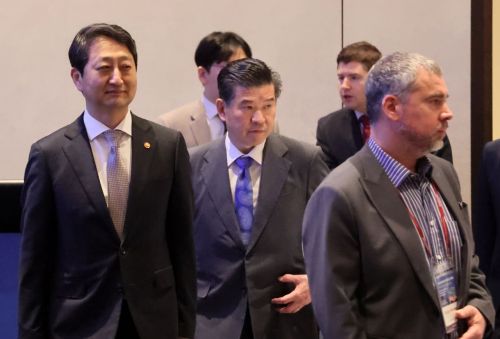 On April 18, at the AmCham Energy Seminar held at the Hyatt Hotel in Yongsan-gu, Seoul, Minister of Trade, Industry and Energy Deokgeun Ahn (left) and AmCham Chairman James Kim attended. 2025.04.18 Photo by Dongju Yoon
Energy has emerged as a key agenda item in tariff negotiations with a potential second Donald Trump administration. The U.S. side is continuously pressuring South Korea to participate in the Alaska liquefied natural gas (LNG) project. However, the Ministry of Trade, Industry and Energy, which has jurisdiction over the matter, maintains that gathering information on the project must come first.
The American Chamber of Commerce in Korea (AmCham) held the Energy Innovation Forum under the theme "Opportunities in the Korea-U.S. Partnership" at the Grand Hyatt Hotel Seoul on April 18. Although a variety of topics such as offshore wind power and fuel cells were discussed at the event, the Alaska LNG project drew the most attention.
Mike Dunleavy, Governor of Alaska, who recently visited South Korea, also delivered a congratulatory video message at the event. He emphasized, "Through the Alaska project, we can provide abundant natural gas to our allies and trading partners in the Pacific," adding, "This is not just about gas, but about further solidifying the relationship between our two countries through mutual trust between Korea and the United States."
Tommy Joyce, Acting Assistant Secretary at the U.S. Department of Energy, also requested in a video message that Korea increase its imports of U.S. LNG, noting, "The U.S. has recently signed two executive orders to simplify LNG exports and regulations."
President Trump, in a speech to the U.S. Congress on March 4, mentioned Korea and Japan's participation in the Alaska LNG development project, stating that they had agreed to invest trillions of dollars. Subsequently, Governor Dunleavy visited Korea at the end of March and met with Acting President and Prime Minister Han Ducksoo, Minister of Trade, Industry and Energy Deokgeun Ahn, and various industry representatives. On April 8, President Trump also discussed the Alaska LNG project with Acting President Han Ducksoo by phone, listing it as a major negotiation agenda item along with tariffs, shipbuilding, and defense cost-sharing.
However, both the relevant industry and the Ministry of Trade, Industry and Energy are maintaining a cautious stance regarding the Alaska LNG project. At the AmCham Energy Innovation Forum, Minister Deokgeun Ahn only made general remarks, saying, "Given our high dependence on energy, we plan to strengthen cooperation with major countries and expand reserves of essential resources such as natural gas and oil."
Despite the U.S. urging participation in the Alaska LNG project, it appears that South Korea’s current knowledge about the project is extremely limited.
A senior official at the Ministry of Trade, Industry and Energy stated, "The information our government has about the Alaska LNG project is fragmented and limited," and added, "Our first priority is to obtain specific and accurate information." A representative from Korea Gas Corporation, which is responsible for 80% of Korea’s LNG imports, also said, "All we have on the Alaska LNG project are publicly available materials."
On April 15, Korea Gas Corporation held a video conference with the Alaska state government and the Alaska Gasline Development Corporation (AGDC). The two sides discussed future methods and procedures for information exchange. However, it was reported that the U.S. side did not provide any concrete details or proposals about the Alaska project during this meeting either.
The domestic gas industry holds a predominantly negative view of the Alaska LNG project. This is because it is an unprecedented large-scale project, and its business viability is highly uncertain.
The project envisions transporting natural gas drilled from the North Slope gas field in northern Alaska via a 1,300 km pipeline to Nikiski in the south, then liquefying it for export to Asian countries such as Korea, Japan, and Taiwan. The total project cost amounts to $44 billion (about 62 trillion won). Securing financing is a major hurdle. For Korea Gas Corporation, which already carries about 47 trillion won in debt, participation would be a significant burden. Private companies are even more negative.
This region is permafrost for most of the year, and the actual construction period is limited to just two to three months. Even then, the abundance of lakes and swamps means the construction is expected to be extremely challenging. This is why major oil companies such as ExxonMobil and BP considered but ultimately abandoned the project.
AGDC estimates that the project could produce 20 million tons of natural gas annually. However, an industry insider noted, "This is merely the U.S. side's claim. The actual reserves and production capacity need to be reassessed." The Ministry of Trade, Industry and Energy and Korea Gas Corporation are also considering an on-site visit to Alaska to obtain accurate information. A ministry official explained, "No concrete schedule has been set, including who will visit and when."
The energy industry is closely watching the outcome of negotiations by Deputy Prime Minister and Minister of Economy and Finance Choi Sangmok and Minister of Trade, Industry and Energy Deokgeun Ahn, who will visit the U.S. next week. Kim Kwonjong, Executive Director at POSCO International, said at the forum, "We still do not know much about the Alaska LNG project. It would be best for the government and Korea Gas Corporation to verify specific information before proceeding with discussions."
Meanwhile, some see potential in the Alaska LNG project. Given its large scale, there may be opportunities for domestic companies in sectors such as pipelines and shipbuilding to participate.
Another positive aspect is that developing the Alaska LNG project could strengthen energy security. An industry insider commented, "If Alaska LNG volumes are supplied to the global market, it could help mitigate spot price volatility for LNG in Northeast Asia in the event of geopolitical risks. It could also contribute to diversifying LNG import sources for Northeast Asian countries such as Korea, Japan, and Taiwan."
© The Asia Business Daily(www.asiae.co.kr). All rights reserved.

















