"Division Incurs Costs... Inflation Outlook Raised for Some Countries"
Kristalina Georgieva, Managing Director of the International Monetary Fund (IMF), stated on the 17th (local time) regarding the global economic outlook, "Our new growth forecast will include a notable downward revision, but it does not include a recession."
On the same day, ahead of the IMF and World Bank (WB) Spring Meetings scheduled for April 21-26, Georgieva made these remarks during a speech at the IMF headquarters in Washington DC, addressing the tariff policies of the Trump administration and the global trade war.
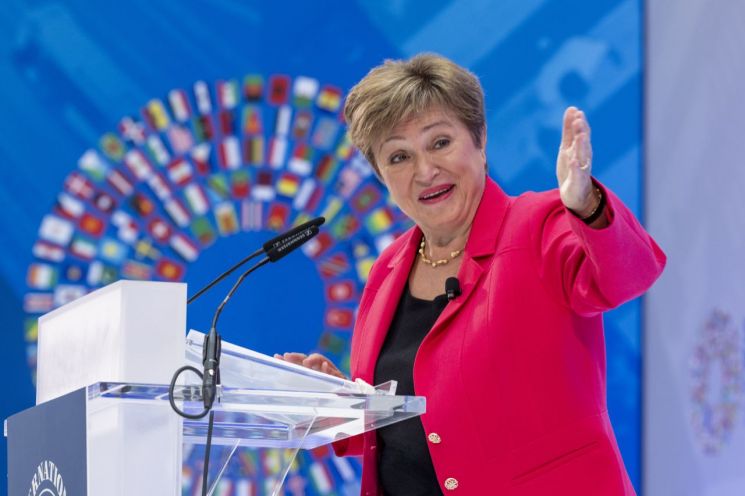 Kristalina Georgieva, Managing Director of the International Monetary Fund (IMF). Photo by EPA Yonhap News
Georgieva predicted that protectionism would surge due to President Trump's tariff policies, increasing uncertainty and lowering productivity. She said, "Trade will continue, but division incurs costs," and "For some countries, an upward inflation outlook will also be included." She added, "Volatility in financial markets is increasing, and uncertainty about trade policies is very high," emphasizing, "This reminds us that we live in a world of sudden and significant changes."
The IMF is scheduled to release the World Economic Outlook (WEO) on the 22nd. The day before, the World Trade Organization (WTO) announced that due to the Trump administration's 'tariff bombs,' the global merchandise trade growth rate this year is expected to record -0.2%, indicating a contraction. Economists at HSBC Holdings lowered their global economic growth forecasts for this year and next year from 2.5% and 2.7% respectively to 2.3%.
Regarding U.S. tariffs, Georgieva expressed concern, saying, "Considering recent tariff increases, suspensions, augmentations, and exemptions altogether, the effective U.S. tariff rate has surged to levels seen decades ago," and "Other countries are responding accordingly, and there are ripple effects." She particularly noted, "As major countries confront each other, smaller countries are caught in the intersecting waves," adding, "Small advanced economies and most emerging markets rely more on trade for growth and are exposed to greater risks."
On the Trump administration's decision to suspend reciprocal tariffs for 90 days, she said, "This is really important at this stage," and "The sooner it is implemented, the better."
Georgieva expressed concerns about the negative consequences of the trade war, including ▲ costs caused by uncertainty ▲ growth damage due to increased trade barriers ▲ productivity decline due to protectionism. She stated, "The restructuring of the global trade system is once again testing economic resilience."
As responses by countries, she suggested ▲ doubling efforts to restore fiscal soundness at home ▲ maintaining agile and credible monetary policies to stabilize prices ▲ maintaining exchange rate flexibility in emerging markets to absorb shocks ▲ efforts to resolve debt issues.
By country, the U.S. mentioned reducing federal government debt as a key task. China emphasized the need to stimulate weak private consumption, and Europe was urged to integrate capital markets and reduce restrictions on intra-regional services trade.
© The Asia Business Daily(www.asiae.co.kr). All rights reserved.
!["The Woman Who Threw Herself into the Water Clutching a Stolen Dior Bag"...A Grotesque Success Story That Shakes the Korean Psyche [Slate]](https://cwcontent.asiae.co.kr/asiaresize/183/2026021902243444107_1771435474.jpg)
















