Korean Steel Exports to the U.S. Down 14.9% in March
Aluminum Exports Also Fall 4.7% Year-on-Year
Concerns Rise Over Prolonged Slump Amid Weak Demand
Some See Tariffs as a Possible Contributing Factor
Since last month, when U.S. President Donald Trump imposed high tariffs on steel and aluminum products, direct impacts have begun to appear on South Korea's exports to the United States. In March, exports of Korean steel and aluminum to the U.S. simultaneously turned to a downward trend, indicating that trade pressure is having a tangible effect on the export front.
According to the Korea International Trade Association on the 18th, South Korea's steel exports to the U.S. in March amounted to $304 million (approximately 431.9 billion KRW), down 18.9% compared to the same period last year. In terms of export volume, it was 250,000 tons, a 14.9% decrease from the same month last year. During the same period, aluminum export volume also declined by about 4.7% year-on-year to 96,844 tons.
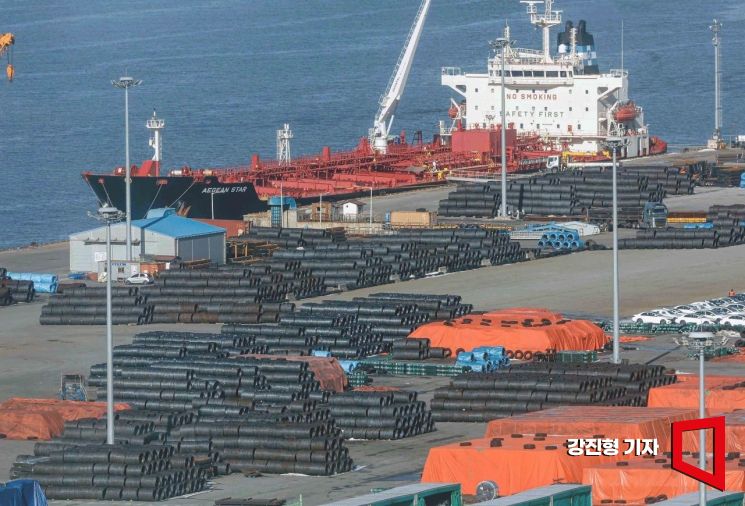 Steel products are piled up at the export yard of Pyeongtaek Port, Gyeonggi. Photo by Kang Jin-hyung
This export decline is interpreted as a consequence of the Trump administration's second term, which has actively deployed global trade pressure measures in the steel sector for the first time. Starting from the 12th of last month, the Trump administration ended the previously applied import quotas and tariff exemptions on steel and aluminum products and began imposing high tariffs globally. As a result, an additional 25% tariff was applied to steel products and 10% to aluminum products.
The imposition of tariffs has weakened the position of Korean steel companies that had maintained market share in the U.S., while the share of American steel companies appears to have expanded again. A steel industry official said, "The tariffs have reduced export price competitiveness," adding, "Steel demand in the U.S. is also weak due to sluggishness in the automotive industry." In fact, by product category, exports of automotive steel sheets fell sharply by 26.5%. However, in the case of steel pipes, exports increased by 4.5%, showing mixed effects of tariffs depending on the product.
The industry expects the decline in steel exports not to be a short-term phenomenon. Since tariffs directly impact price competitiveness, maintaining existing volumes is also expected to be difficult. Another industry official said, "With stagnant local demand in the U.S. combined with tariff burdens, exports are rapidly deteriorating," and added, "It will take considerable time to recover our position in the U.S. market."
Some argue that it is premature to conclude that the recent export decline is solely due to tariffs. Given the nature of steel and aluminum products, most contracts are made months in advance, and shipping schedules and local demand also act as variables. However, concerns remain that the export environment could worsen further as U.S. trade policy shifts decisively toward protectionism.
The steel industry is reviewing various countermeasures, including readjusting strategies by product category. An industry insider said, "Previously, we mainly exported high-profit products duty-free within the quota volume (2.63 million tons), but now we must change business strategies according to tariff policy changes," adding, "Since there is no longer a volume limit but tariffs apply, we plan to secure profitability by supplying large quantities of steel products at lower prices."
Some steelmakers plan to overcome the challenges by expanding local production. Earlier, Hyundai Steel announced plans to invest about $5.8 billion (approximately 8.24 trillion KRW) to establish an electric arc furnace steel mill in Louisiana, USA, aiming for commercial production by 2029. POSCO is also reportedly considering joint investment in Hyundai Steel's mill to share volumes.
© The Asia Business Daily(www.asiae.co.kr). All rights reserved.
!["The Woman Who Threw Herself into the Water Clutching a Stolen Dior Bag"...A Grotesque Success Story That Shakes the Korean Psyche [Slate]](https://cwcontent.asiae.co.kr/asiaresize/183/2026021902243444107_1771435474.jpg)
















