The Ball Is Now in the Medical Students' Court... Key Question Is Whether They Will Return to Classes
Medical School Presidents and Deans Expect "A Significant Number Will Return by the End of April"
"No Need to Worry About Tripling (Simultaneous Classes for Three Cohorts)"
On the 17th, the government finalized the medical school admission quota for next year at 3,058, passing the ball to the medical students. The Ministry of Education stated that it has "used all the cards" to normalize medical education. Despite the 'full return by the end of March' condition initially set for freezing medical school admissions not being met, the government broke its own principle, judging that it could no longer continue in an uncertain situation to normalize medical education. Attention is focused on whether medical students, who have been continuing their class boycott, will largely return to actual classes following the decision of 'zero increase' in medical school admissions for next year.
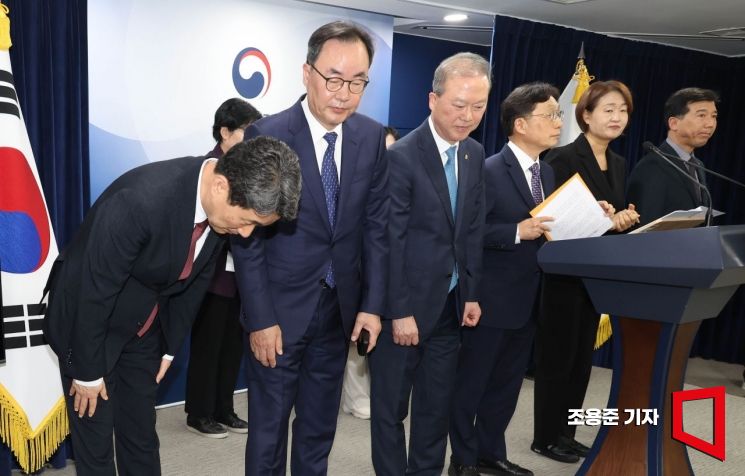 Lee Ju-ho, Deputy Prime Minister for Social Affairs and Minister of Education, is greeting after finishing a briefing on the adjustment direction of medical school admission quotas for the 2026 academic year at the Government Seoul Office in Jongno-gu, Seoul on the 17th. 2025.4.17 Photo by Jo Yong-jun
◆Class Participation Rate at 40 Medical Schools at 25.9%: "Below Target"
According to the Ministry of Education on the day, the actual average return rate across 40 medical schools was 25.9%.
Kim Hong-soon, Director of the Medical Education Support Bureau at the Ministry of Education, said at a pre-briefing held in the morning, "As of the 16th, the average class participation rate at 40 medical schools was 22.2% for pre-medical courses and 29% for medical courses, averaging 25.9%." Fourth-year medical students had the highest participation rate at 35.7% among all years. This is interpreted as being higher because if students in this year fail, they cannot take the practical exam of the national medical licensing examination, leading to higher attendance compared to other years.
However, this level falls significantly short of the standards initially mentioned by the government and universities. Regarding the 'return to a level where normal classes are possible,' the government demanded full return, while university presidents called for at least half to return. Among the 40 medical schools, 26 were found to have class participation rates below 30%. Only four schools had participation rates above 50%, three above 40%, and seven above 30%.
Director Kim said, "Participation rates vary widely from single digits to 67% depending on the school," adding, "The government worked with schools to increase participation rates, but the results did not meet expectations." Nevertheless, the reason for finalizing next year's medical school admission quota at 3,058 seems to be to send a signal to medical students boycotting classes that 'there will be no increase,' and then persuade students to return. The urgency that medical education would be impossible if students do not return even this semester also played a role.
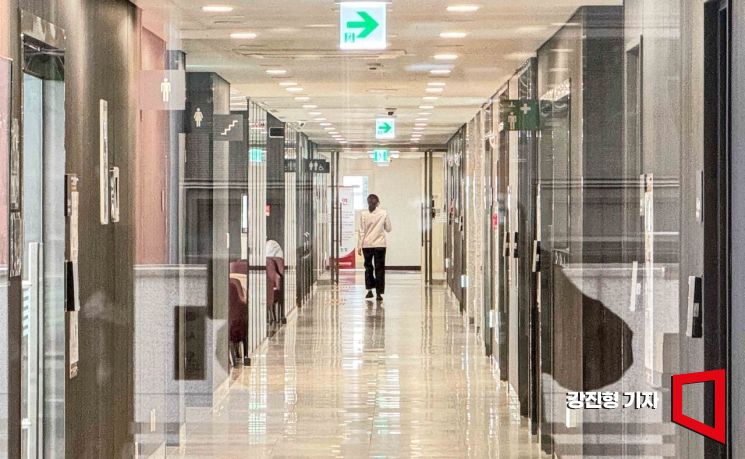 As Korea University announced that it will send expulsion notices to medical students who have not returned, a student is seen moving at the Korea University College of Medicine in Seongbuk-gu, Seoul on March 28, 2025. Photo by Kang Jin-hyung
Each university must finalize next year's admission quota by the end of April and submit it to the Korea Council for University Education (KCUE). Once KCUE approves, the final admission quota will be announced at the end of May. The later the schedule is delayed, the greater the uncertainty. This is why the government says it "had no choice but to back down to normalize medical education."
◆Students Admitted in 2024 Can Graduate One Semester Earlier Than Those Admitted in 2025 if They Attend Normal Classes This Semester
The government and universities also addressed concerns about 'doubling (simultaneous classes for 2024 and 2025 cohorts)' if medical students return, and 'tripling (simultaneous classes for 2024, 2025, and 2026 cohorts)' if many students fail to return, stating, "There will be no problem as long as students return."
Lee Jong-tae, Chairman of the Korea Association of Medical Colleges (KAMC), said at an official briefing, "The uncertainty over the 3,058 quota delayed medical students' return, but now that uncertainty has been removed, we expect more students to return," adding, "If 7,500 doctors graduate simultaneously due to doubling, problems from oversupply will increase, but if the 2024 cohort properly starts this semester, they can graduate one semester earlier."
Medical education follows a '2+4 system' with two years of pre-medical and four years of medical courses. This means the two-year pre-medical course can be shortened to 1.5 years. This does not mean excluding necessary subjects but advancing the schedule, which can be supplemented by using summer and winter semesters. Chairman Lee added, "The Ministry of Health and Welfare and the Ministry of Education are preparing plans to give the 2024 cohort an additional chance to take the national medical licensing exam and provide training opportunities."
He further said, "Once students return, each school will create individualized models for classes," adding, "Education, graduation, medical licensing exams, residency training, and specialist courses can all proceed without problems."
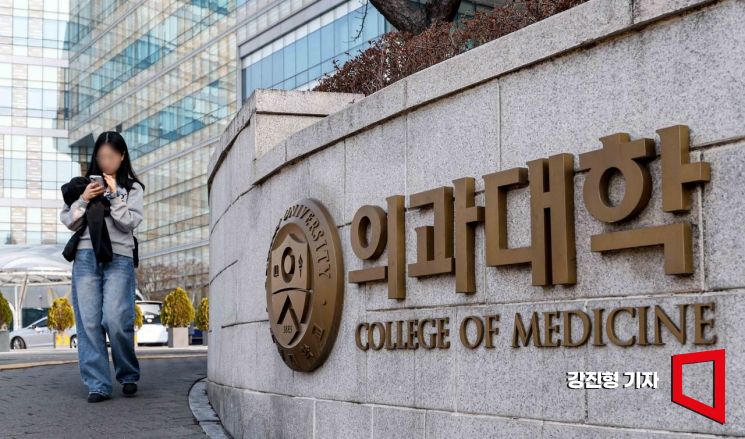 On the 21st, the deadline set by some medical schools including Yonsei University, Korea University, and Kyungpook National University for returning approached, and a student was seen moving at Yonsei University College of Medicine in Seodaemun-gu, Seoul. 2025.3.21. Photo by Kang Jin-hyung
Yang Oh-bong, Chairman of the Council of University Presidents for Medical School Advancement (Medical Presidents' Council), said there is "no need to worry" about tripling concerns. He said, "If more than half, 60-70%, or 80% return, there is no concern about tripling, which is the consensus among university presidents, deans, and medical school professors," adding, "Through consultations, we understand that more than 50% of medical students will sufficiently return by April."
◆"Ministry of Education Has Used All Cards" "KMA's Response Is Too Late"
The Ministry of Education has ultimately played its last card to encourage medical students to return. The key is the students' participation in classes. Lee Ju-ho, Deputy Prime Minister and Minister of Education, said, "We apologize to the public who expected an increase," adding, "However, we judged that normalizing medical education and preventing the medical training system from stopping is more important." He urged, "Considering the academic and admission schedules, this is the last chance. Please return to your studies promptly before it is too late."
On the same day, the Korean Medical Association (KMA) issued a press release evaluating the move as "a belated but necessary step toward normalization."
Kim Sung-geun, spokesperson for the KMA, said, "The reckless increase policy without basis and without considering educational conditions was wrong," adding, "I don't understand why it was so difficult to get to this point."
© The Asia Business Daily(www.asiae.co.kr). All rights reserved.



















