Mandatory Fire Spread Prevention Zones and Fire-Resistant Materials... Height Limit for Sound Barriers Over 15 Meters
Designs Considering Daylight and Views, Urban Aesthetics Improved with Green Spaces and Soundproof Forests
Priority Use of Low-Noise Pavement to Minimize Sound Barrier Installation
The fire risk of sound barriers and soundproof tunnels near highways and urban arterial roads will be reduced, and their design will become more pleasant.
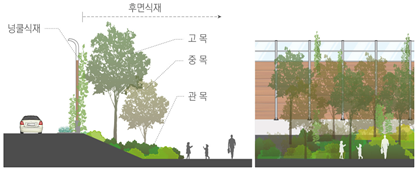 Example of green space creation around soundproof walls. Provided by the Ministry of Land, Infrastructure and Transport.
On the 18th, the Ministry of Land, Infrastructure and Transport announced that it will distribute the "Road Soundproof Facility Installation Plan Guidelines," which include performance, fire safety, and design standards for road soundproof facility installation, to road management authorities such as local governments nationwide. These guidelines are intended to respond to the increasing demand for soundproof facilities installation amid rising complaints about traffic noise.
According to the guidelines, low-noise pavement and other measures will be prioritized to minimize the installation of soundproof facilities, and even when installation is unavoidable, the height of sound barriers is recommended not to exceed 15 meters. This measure aims to reduce the sense of enclosure and concerns about structural collapse caused by excessively high sound barriers.
Additionally, in fire-vulnerable sections such as residential areas, multi-level roads, and intersections, the use of fire-resistant materials is mandatory, and 'fire spread prevention zones' will be installed every 50 meters to minimize damage spread in case of an accident.
The guidelines also require consideration of landscape improvement measures such as securing daylight and views according to the surrounding characteristics like schools, hospitals, and industrial complexes, as well as creating green spaces and soundproof forests. Examples of actual application include creating green spaces using spare land around sound barriers and improving design at the start and end points. These efforts aim to reduce the artificial image of soundproof facilities and problems that detract from urban aesthetics.
The Ministry of Land, Infrastructure and Transport posted the guidelines on the policy materials menu of its website on the same day and plans to continuously supplement and improve them in the future. Lee Woo-je, Director of the Road Bureau at the Ministry, said, "These guidelines consider fire safety, comfort, and urban landscape harmony of soundproof facilities," and added, "We hope that local governments and road management authorities will actively reflect these in their installation planning."
© The Asia Business Daily(www.asiae.co.kr). All rights reserved.

















